What Is BPC-157? A Complete Guide to the Experimental Peptide
BPC-157 has become a widely discussed peptide in online health, fitness, and research communities. It is often mentioned in conversations about tissue repair, exercise recovery, inflammation, and gastrointestinal health. What Is BPC-157 Glow Blend (TB 10mg + BPC 10mg + GHK 50mg)
But what is BPC-157, and what does scientific research actually tell us about it?
BPC-157 is an experimental peptide that has primarily been investigated in laboratory and animal studies. Although early research has generated interest in its potential biological effects, there is currently limited high-quality human evidence demonstrating its safety and effectiveness for treating medical conditions.
This guide explains what BPC-157 is, where it came from, what researchers have studied, and why more research is needed. what is BPC-157 GHK-CU 100mg
What Is BPC-157?
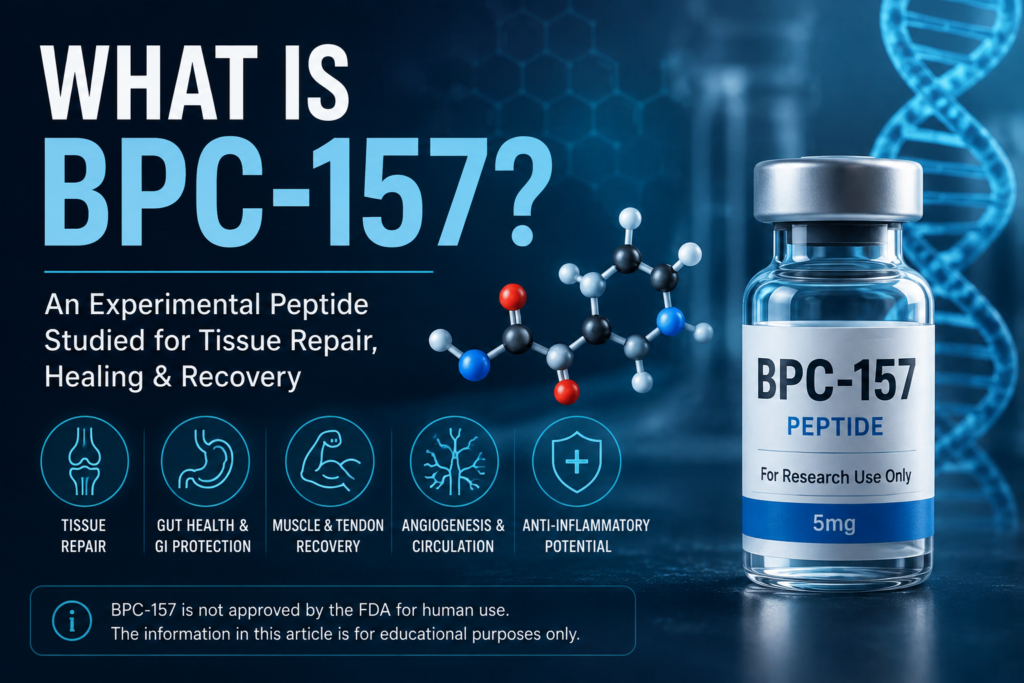
BPC-157, short for Body Protection Compound 157, is a synthetic peptide consisting of 15 amino acids.
It has attracted scientific interest because laboratory and animal research has reported potential effects involving processes such as tissue repair, inflammation, blood-vessel formation, and gastrointestinal function.
BPC-157 is sometimes described online as a “healing peptide,” but that description can be misleading if it implies that the compound has been proven to heal injuries or medical conditions in humans.
Most of the evidence surrounding BPC-157 comes from preclinical research rather than large, well-controlled clinical trials in people. what is BPC-157
What Does BPC-157 Stand For?
BPC stands for Body Protection Compound, while 157 refers to the specific peptide sequence commonly studied under that name.
BPC-157 is often discussed alongside other experimental peptides, but it should not be confused with an approved prescription medication or established medical treatment. What Is BPC-157 Selank
How Was BPC-157 Discovered?
BPC-157 is associated with research into compounds derived from or related to protective factors found in gastric juice.
Researchers subsequently investigated synthetic BPC-157 in experimental models to understand its potential biological activity.
Over time, research has examined the peptide in models involving the gastrointestinal tract, musculoskeletal tissues, blood vessels, and nervous system.
However, interesting findings in laboratory or animal models do not automatically translate into demonstrated benefits in humans. what is BPC-157 Epitalon 50mg
What Does BPC-157 Do?
Research has investigated several potential biological effects of BPC-157.
These include possible effects involving:
- Tissue repair
- Angiogenesis, or formation of new blood vessels
- Inflammatory processes
- Gastrointestinal function
- Tendon and ligament injury models
- Muscle injury models
- Bone-related healing models
- Nervous-system research
It is important to distinguish research findings from established medical benefits. What Is BPC-157
Much of the evidence comes from animal or laboratory studies, meaning researchers still need stronger human evidence to determine whether these effects occur reliably in people. What Is BPC-157
BPC-157 and Tissue Repair
One of the main reasons BPC-157 has attracted attention is research involving tissue repair.
Animal studies have investigated the peptide in models of injuries affecting structures such as tendons, muscles and ligaments.
Some experimental findings have suggested that BPC-157 may influence biological pathways involved in repair.
However, animal models are not sufficient to establish that BPC-157 effectively treats sports injuries or other injuries in humans.
Human clinical research is needed to determine appropriate dosing, effectiveness, safety and long-term outcomes.
BPC-157 and Tendon Research
Tendon injuries are one of the most frequently discussed applications of BPC-157 online.
Preclinical studies have investigated BPC-157 in animal models of tendon injury and have reported potentially favorable effects on healing-related processes.
These findings are scientifically interesting, but they should not be interpreted as proof that BPC-157 repairs damaged tendons in people.
Tendon healing is complex and can depend on the type and severity of injury, blood supply, mechanical loading, rehabilitation and numerous biological factors. what is BPC-157 HTC-2 TZ 60mg
BPC-157 and Ligament Research
Researchers have also examined BPC-157 in experimental ligament-injury models.
Some animal research has reported changes associated with tissue healing.
Again, these results are preclinical.
A treatment that appears promising in an animal model can fail to demonstrate the same benefit in human clinical trials.
Therefore, BPC-157 should not be considered an established treatment for ligament injuries based solely on laboratory or animal research.
BPC-157 and Muscle Recovery
BPC-157 is also frequently discussed in fitness and sports communities as a potential recovery peptide.
Experimental research has examined muscle injury and related biological processes.
However, there is insufficient high-quality human evidence to establish BPC-157 as a proven method for accelerating muscle recovery after exercise or injury.
For athletes and active individuals, established recovery strategies—including appropriate nutrition, sleep, progressive rehabilitation and medically appropriate treatment—remain much better supported by evidence. what is BPC-157 Glow Blend (TB 10mg + BPC 10mg + GHK 50mg)
BPC-157 and Gut Health
The gastrointestinal system is another major area of BPC-157 research.
Because the peptide originated from research involving gastric protective compounds, researchers have investigated its potential effects in experimental models of gastrointestinal injury and inflammation.
Some preclinical studies have reported potentially protective effects.
Nevertheless, that does not establish BPC-157 as a proven treatment for conditions such as ulcers, inflammatory bowel disease, gastritis or other gastrointestinal disorders.
People with persistent digestive symptoms should receive an appropriate medical evaluation rather than relying on an experimental peptide. What Is BPC-157
BPC-157 and Inflammation
Research has also explored whether BPC-157 can influence inflammatory processes.
Inflammation is a complicated biological response involving numerous cells, signaling molecules and pathways.
Although laboratory and animal findings have generated interest, there is not enough high-quality human evidence to determine whether BPC-157 can safely or effectively treat inflammatory diseases.
Is BPC-157 FDA Approved?
BPC-157 is not an FDA-approved drug for treating medical conditions.
This distinction is important because products marketed online as BPC-157 may not have undergone the same evaluation, manufacturing controls and clinical testing required for approved medicines.
Consumers should be cautious about websites that describe BPC-157 as an established treatment or make guaranteed claims about healing, pain relief or disease treatment.
Is BPC-157 Legal?
The legal and regulatory status of BPC-157 can depend on the country and the intended use.
In the United States, BPC-157 is not an FDA-approved human drug.
Its regulatory status should not be confused with whether a product is legally sold online or labeled “for research use.” A research-use label does not establish that a product is approved or safe for human use.
Anyone considering an experimental compound should check the applicable regulations and consult a qualified healthcare professional. What Is BPC-157
Is BPC-157 Safe?
The complete safety profile of BPC-157 in humans has not been established.
This is one of the biggest limitations of the current evidence.
Important unanswered questions include:
- Appropriate human dosing
- Long-term safety
- Potential drug interactions
- Effects in people with underlying medical conditions
- Effects during pregnancy
- Effects on different organs and biological systems
- Potential risks associated with long-term exposure
The absence of well-documented adverse effects in some preclinical studies does not prove that a compound is safe for humans.
BPC-157 Side Effects
Reliable information about BPC-157 side effects in humans is limited because the compound has not been adequately studied in large, long-term clinical trials.
Online reports may describe various effects, but anecdotal experiences cannot establish the frequency, cause or severity of adverse events.
This is another reason to distinguish anecdotal claims from clinical evidence.
BPC-157 Human Studies
One of the most important questions surrounding BPC-157 is how much evidence exists in humans.
Compared with established medications and therapies, the human clinical evidence remains limited.
A promising animal study can demonstrate that a compound deserves further investigation, but it cannot answer all of the questions required before a treatment can be considered established.
High-quality human trials would need to evaluate:
- Safety
- Effectiveness
- Appropriate dose
- Treatment duration
- Side effects
- Drug interactions
- Long-term outcomes
Until such evidence is available, claims about BPC-157 should be interpreted cautiously. What Is BPC-157
BPC-157 for Sports Injuries
BPC-157 is frequently discussed in connection with sports injuries, particularly tendon, ligament and muscle injuries.
The interest is understandable because preclinical research has investigated tissue-repair mechanisms.
However, there is currently insufficient clinical evidence to establish BPC-157 as a proven treatment for sports injuries.
Athletes should also be aware that experimental substances can create regulatory and anti-doping concerns.
Is BPC-157 Banned in Sports?
Athletes should check the current rules of their specific sport and anti-doping organization before using any experimental substance.
The World Anti-Doping Agency (WADA) has included BPC-157 among substances prohibited under its rules. Athletes subject to anti-doping regulations should therefore treat BPC-157 as a significant compliance concern.
Rules can change, so athletes should consult the current prohibited-list information applicable to their sport.