BPC-157 Research: Current Evidence, Mechanisms, and Research Gaps
Introduction to BPC-157 Research
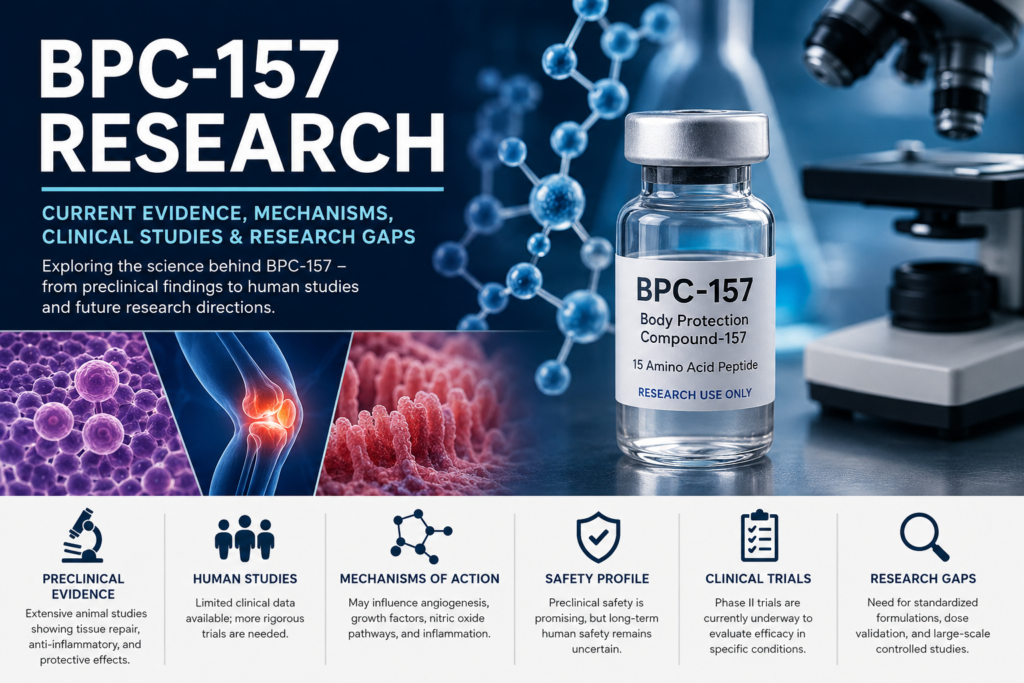
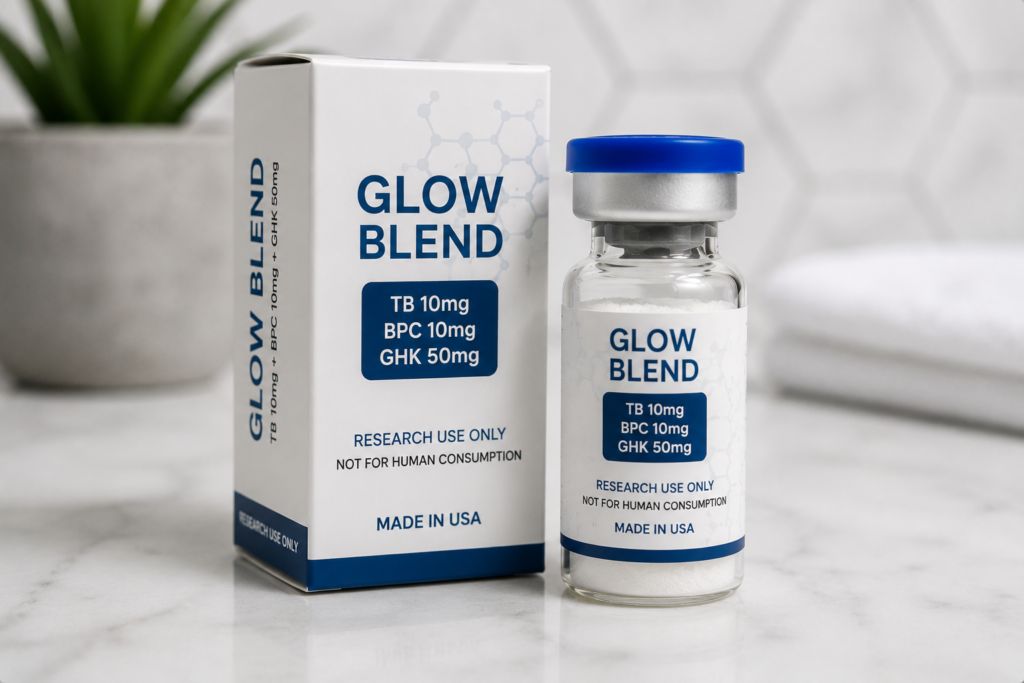
BPC-157 research has attracted substantial interest because of findings from experimental models involving tissue repair, inflammation, gastrointestinal injury, vascular signaling, and musculoskeletal damage. However, the evidence base remains highly asymmetric: a large body of preclinical literature exists, while rigorous human clinical evidence remains limited. Glow Blend (TB 10mg + BPC 10mg + GHK 50mg)
BPC-157 is a 15-amino-acid peptide commonly described in the scientific literature as a gastric peptide or Body Protection Compound-157. Research has investigated its effects across numerous biological systems, including gastrointestinal tissues, tendons, ligaments, muscle, bone, and the nervous system.
The central scientific question is no longer simply whether BPC-157 produces biological effects in experimental models. The more important translational questions are whether those effects are reproducible, whether they occur at clinically relevant exposures, whether they translate to humans, and whether the peptide has an acceptable safety profile. BPC-157 Research BPC-157 Capsules vs Injectable BPC-157
A 2025 systematic review of BPC-157 in orthopaedic sports medicine illustrates the evidence gap clearly: of 36 included studies published through 2024, 35 were preclinical and only one was a clinical study. BPC-157 Research what is BPC-157?
What Is BPC-157?
BPC-157 is a synthetic pentadecapeptide consisting of 15 amino acids. It has been investigated primarily in laboratory and animal models rather than as an established therapeutic drug.
The peptide’s biological effects have been associated with several pathways involved in tissue repair, vascular signaling, inflammation, and cellular responses. Proposed mechanisms include modulation of nitric oxide signaling, effects on angiogenesis, interactions with growth-factor pathways, and changes in inflammatory signaling.
Importantly, proposed mechanisms should not be interpreted as evidence of clinical efficacy. A molecular pathway observed in an animal model does not establish that manipulating that pathway with BPC-157 produces a meaningful therapeutic benefit in humans. BPC-157 Research
What Does Current BPC-157 Research Show?
1. Tissue repair and musculoskeletal research
One of the most extensively investigated areas is tissue repair.
Preclinical studies have reported favorable outcomes in models of:
- Tendon injury
- Ligament injury
- Muscle injury
- Bone injury
- Wound healing
- Gastrointestinal injury
The 2025 systematic review of orthopaedic literature found that experimental studies reported improvements in structural, functional, and biomechanical outcomes following BPC-157 administration in several injury models. The authors also identified potential effects involving growth-factor signaling, angiogenesis, and inflammatory cytokines.
These findings provide a rationale for further investigation, but they remain predominantly preclinical. BPC-157 Research GHK-CU 100mg
2. Gastrointestinal research
BPC-157 research has historically included extensive investigation of gastrointestinal injury and mucosal protection.
Experimental models have examined conditions involving gastrointestinal inflammation, ulceration, and tissue damage. These studies have contributed substantially to the hypothesis that BPC-157 could influence mucosal integrity and repair processes.
However, the existence of positive animal data does not establish that BPC-157 is an effective treatment for gastrointestinal disease in humans. Properly designed randomized clinical trials would be required to answer that question. BPC-157 Research
3. Angiogenesis and vascular signaling
Another recurring area of BPC-157 research concerns angiogenesis and vascular biology.
Experimental findings suggest that BPC-157 can influence pathways involved in blood-vessel formation and vascular function. This may partly explain observations of improved tissue repair in animal models.
At the same time, angiogenesis is biologically complex. Increasing vascular growth is not inherently beneficial in every disease context. Consequently, potential effects on angiogenic pathways require careful investigation rather than being assumed to represent a therapeutic advantage.
4. Inflammation
Preclinical studies have also reported changes in inflammatory signaling following BPC-157 exposure.
Researchers have proposed that modulation of inflammatory cytokines may contribute to the peptide’s effects in experimental injury models. This is an important mechanistic hypothesis, but additional work is needed to determine which molecular targets are primary, which effects are secondary, and whether comparable pharmacology occurs in humans.
BPC-157 Human Research: What Evidence Exists?
The most important limitation in the BPC-157 literature is the scarcity of high-quality human data.
The 2025 systematic review of orthopaedic applications identified only one clinical study among 36 included publications. That retrospective study involved 12 patients with chronic knee pain who received intra-articular BPC-157; seven participants reportedly experienced pain relief lasting more than six months.
This finding is interesting but cannot establish efficacy. The study was small, retrospective, and lacked the methodological features needed to determine whether the observed improvement was caused by BPC-157.
Consequently, researchers should be cautious about extrapolating these findings to broader populations or other conditions.
The importance of controlled clinical trials
For a candidate therapeutic to progress from experimental research to evidence-based medicine, researchers generally need progressively stronger evidence:
- Mechanistic and laboratory studies
- Animal pharmacology and toxicology
- Phase I human safety and pharmacokinetic studies
- Phase II efficacy studies
- Phase III confirmatory trials
- Post-marketing safety surveillance after approval
BPC-157 remains far from having the clinical evidence base normally associated with an established therapeutic.
A recent 2026 review of BPC-157 development concluded that pharmaceutical development remains limited, highlighting the absence of an approved formulation, validated dosing regimen, and completed Phase II clinical trial. BPC-157 Research Selank
BPC-157 Clinical Trials and the Current Research Pipeline
There is nevertheless renewed interest in translating BPC-157 research into controlled human studies.
One current example is BPC-HAMSTR (NCT07437547), a recruiting randomized, double-blind, placebo-controlled Phase II study examining BPC-157 for acute grade II hamstring muscle strain. The trial is designed to evaluate outcomes including return to unrestricted sport and MRI-assessed injury volume.
This type of study is particularly important because randomized, placebo-controlled designs can begin addressing limitations that characterize much of the earlier BPC-157 literature.
The results of such trials will be substantially more informative than anecdotal reports or uncontrolled clinical observations.
BPC-157 Mechanism of Action: Current Hypotheses
The mechanism of action of BPC-157 has not been definitively established.
Research has proposed several overlapping mechanisms, including:
- Modulation of nitric oxide signaling
- Effects on angiogenesis
- Regulation of inflammatory pathways
- Interaction with growth-factor signaling
- Effects on cellular repair processes
- Potential influence on vascular function
The complexity of these effects is one reason BPC-157 remains scientifically interesting. However, mechanistic breadth should not be confused with demonstrated therapeutic effectiveness.
A compound can affect multiple biological pathways without producing a clinically meaningful benefit—or could produce beneficial effects in one context and undesirable effects in another.
Future research should therefore prioritize target validation, dose-response relationships, pharmacokinetics, receptor or pathway specificity, and reproducibility across independent laboratories.
BPC-157 Safety Research
Safety is one of the largest unresolved questions.
Preclinical studies have generally reported relatively favorable safety findings, but animal safety data cannot establish long-term safety in humans.
The 2025 orthopaedic systematic review specifically noted that while preclinical studies had not identified major adverse effects across the examined organ systems, clinical safety data were lacking.
The U.S. Food and Drug Administration has also identified specific concerns regarding compounded BPC-157, including potential immunogenicity for certain routes of administration and limited safety information for proposed routes of administration.
For researchers, this highlights an important distinction between absence of observed toxicity in limited experiments and demonstrated human safety.
Long-term human studies would be necessary to characterize:
- Immunogenicity
- Organ toxicity
- Reproductive and developmental effects
- Drug interactions
- Pharmacokinetics
- Metabolite formation
- Dose-dependent adverse events
- Long-term effects of repeated exposure
Is BPC-157 FDA Approved?
No. BPC-157 is not an FDA-approved therapeutic drug.
The FDA explains that approval of a human drug requires evidence supporting safety and effectiveness for its intended use, together with appropriate manufacturing standards.
Recent regulatory discussions surrounding BPC-157 should not be confused with FDA approval. In July 2026, an FDA advisory committee reportedly recommended adding BPC-157 to a compounding-related list, but an advisory recommendation is not equivalent to FDA drug approval.
For scientific communication, the distinction is critical: regulatory consideration, permission to compound, investigational status, and FDA approval are different regulatory concepts.
Major Limitations in the BPC-157 Literature
Several limitations should be considered when evaluating BPC-157 research.
Predominance of animal studies
Much of the evidence comes from rodents and other experimental models. Animal models are valuable for hypothesis generation, but their results frequently fail to predict clinical efficacy.
Limited independent replication
A strong evidence base requires replication by independent research groups using standardized preparations, validated assays, and preregistered or appropriately controlled experimental designs.
Small human datasets
The available human literature is insufficient to establish efficacy or characterize uncommon or delayed adverse events.
Uncertain pharmacology
Questions remain regarding pharmacokinetics, bioavailability, tissue distribution, metabolism, optimal formulation, and clinically relevant exposure.
Product variability
Research findings obtained using a characterized pharmaceutical preparation cannot automatically be applied to products obtained from unregulated or poorly characterized sources.
Lack of dose-validation
There is no broadly validated clinical dosing regimen established through adequate randomized clinical trials.
What Should Future BPC-157 Research Investigate?
The next phase of BPC-157 research should focus less on expanding the list of possible biological effects and more on establishing reproducible translational evidence.
High-priority research areas include:
1. Pharmacokinetics and pharmacodynamics
Researchers need reliable measurements of absorption, distribution, metabolism, elimination, and exposure-response relationships.
2. Standardized formulations
Studies should use well-characterized pharmaceutical-grade material with documented purity, stability, and manufacturing specifications.
3. Dose-ranging studies
Human studies should establish appropriate dose ranges before efficacy claims are made.
4. Randomized controlled trials
Placebo-controlled studies with predefined primary endpoints are essential for determining clinical efficacy.
5. Independent replication
Findings should be reproduced by research groups without conflicts of interest related to BPC-157 commercialization.
6. Long-term safety monitoring
Repeated administration requires systematic evaluation of immune, cardiovascular, neurological, reproductive, and other potential risks.
7. Condition-specific research
Rather than treating BPC-157 as a generalized “healing” compound, researchers should determine whether it has measurable efficacy for specific indications.
BPC-157 Research: Evidence vs. Hypothesis
The current evidence can be summarized as follows:
| Research question | Current evidence |
|---|---|
| Does BPC-157 have biological activity? | Strong preclinical evidence |
| Does it influence tissue-repair pathways? | Supported by multiple experimental studies |
| Does it improve injury outcomes in animal models? | Reported across numerous models |
| Is it effective for human injuries? | Insufficient evidence |
| Is it proven safe for long-term human use? | No |
| Is there an established therapeutic dose? | No validated regimen |
| Is BPC-157 FDA approved? | No |
| Are controlled human trials underway? | Yes; at least one Phase II study is recruiting |
| Is further research justified? | Yes, particularly controlled translational research |
Conclusion on BPC-157 Research
Current BPC-157 research presents an intriguing but incomplete translational picture.
Preclinical studies have produced a broad range of findings involving tissue repair, inflammation, vascular signaling, gastrointestinal injury, and musculoskeletal damage. These results provide legitimate scientific hypotheses for further investigation.
The major limitation is the gap between experimental evidence and human clinical evidence. A 2025 systematic review found that the overwhelming majority of orthopaedic BPC-157 studies were preclinical, while a 2026 review emphasized the lack of an approved formulation, validated dosing strategy, and completed Phase II clinical program.
The emergence of randomized Phase II research is therefore an important development. If well-designed trials demonstrate reproducible benefits with acceptable safety, BPC-157 could move closer to legitimate therapeutic development. If they fail to reproduce preclinical findings, that would be equally valuable scientific information.
For now, the most defensible conclusion is that BPC-157 is a promising experimental research candidate, not an established clinical therapy. The field’s next advances will depend on rigorous pharmacology, independent replication, controlled human trials,