What Is Semax? A Complete Guide to This Research Peptide
What is Semax? Semax is a synthetic peptide originally developed from a fragment of adrenocorticotropic hormone (ACTH). It has been studied primarily in Russia and other countries as an experimental compound for its potential effects on the brain, nervous system, cognition, and stress responses. Semax
Although Semax has attracted interest in the research community because of its proposed neuroprotective and cognitive effects, it is important to distinguish scientific research from established medical benefits. Semax is not approved as a general treatment for cognitive enhancement or neurological conditions in many countries, including the United States. semax peptide benefits
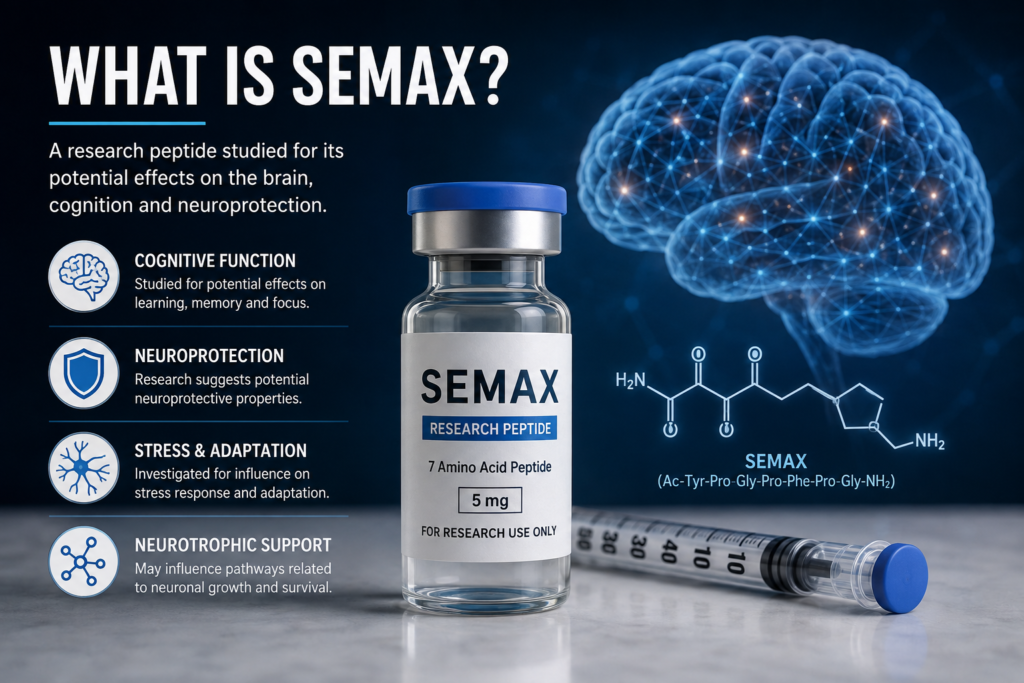
What Is Semax?
Semax is a synthetic peptide consisting of seven amino acids. It was developed as a modified fragment of ACTH, designed to retain certain biological properties without producing the same hormonal effects associated with the full ACTH molecule. Glow Blend (TB 10mg + BPC 10mg + GHK 50mg)
Researchers have investigated Semax for its potential influence on several biological pathways associated with the central nervous system. Areas of scientific interest include neuroprotection, learning and memory, stress responses, inflammation, and neuronal signaling.
Because research is still developing, claims about Semax should be interpreted carefully. Results from laboratory studies or limited clinical research do not necessarily demonstrate that Semax is safe or effective for routine human use. what is semax GHK-CU 100mg
How Does Semax Work?
The exact mechanism of action of Semax has not been completely established. Research suggests that the peptide may influence several processes involved in brain function and neuronal signaling.
Some studies have investigated potential effects involving:
- Neurotrophic factors associated with neuronal growth and survival
- Neurotransmitter systems involved in cognitive processes
- Oxidative stress and cellular protection
- Inflammatory signaling
- Stress-response pathways
- Brain plasticity and adaptation
One area of interest is brain-derived neurotrophic factor (BDNF), a protein involved in neuronal health, learning, memory, and neuroplasticity. Researchers have investigated whether Semax can influence BDNF-related pathways, although additional research is needed to establish the significance of these findings in humans. what is semax Tesamorelin + Ipamorelin
What Is Semax Used For?
Semax has been investigated for a range of neurological and cognitive applications. Research has particularly focused on its potential neuroprotective properties and possible effects on cognitive function.
Scientific investigations have explored Semax in areas such as:
- Cognitive function and memory
- Neurological recovery
- Neuroprotection
- Stress and adaptation
- Inflammatory processes affecting the nervous system
- Brain injury research
However, research interest should not be confused with proven therapeutic effectiveness. The quality, size, and availability of clinical evidence vary considerably depending on the condition being studied. what is semax Selank
Semax and Cognitive Function
One of the reasons Semax has become popular in peptide research is its proposed relationship with cognition.
Researchers have investigated whether Semax may influence processes involved in learning, memory, attention, and neuronal communication. Some experimental findings suggest that the peptide may affect neurotrophic and neurotransmitter pathways associated with cognitive performance.
However, there is not enough high-quality evidence to conclude that Semax reliably improves cognitive performance in healthy people. More rigorous, large-scale clinical studies are needed before strong conclusions can be made.
Semax and Neuroprotection
Neuroprotection is another major area of Semax research.
Neuroprotective compounds are studied for their potential ability to help neurons withstand processes such as oxidative stress, inflammation, metabolic disruption, or injury. Laboratory and animal research has explored whether Semax may affect pathways involved in neuronal survival and recovery.
These findings are scientifically interesting, but evidence from preclinical models cannot automatically be translated into proven benefits for humans.
Is Semax a Nootropic?
Semax is sometimes described online as a nootropic, meaning a substance believed to influence cognitive performance.
However, calling Semax a nootropic does not establish that it is effective or appropriate for cognitive enhancement. Much of the online discussion surrounding Semax includes anecdotal experiences, while clinical evidence remains comparatively limited.
Anyone researching Semax should therefore separate peer-reviewed scientific evidence from marketing claims and personal reports.
Is Semax Safe?
The long-term safety profile of Semax has not been established sufficiently to consider it risk-free.
Potential safety concerns include unknown long-term effects, individual reactions, product quality, contamination, incorrect formulation, and differences between research-grade products and pharmaceutical preparations.
People considering any unapproved peptide should discuss potential risks with a qualified healthcare professional rather than relying solely on information from peptide vendors or online forums.
Semax Research Peptide: What Does “Research Use” Mean?
The term Semax research peptide generally refers to Semax supplied for laboratory or scientific research rather than an approved consumer medicine.
Research products can vary significantly in quality. Important considerations include:
- Identity and purity testing
- Independent analytical testing
- Accurate labeling
- Proper storage conditions
- Manufacturing standards
- Documentation such as certificates of analysis
A product marketed as a “research peptide” should not automatically be assumed to be suitable for human consumption.
Semax vs. Other Peptides
Semax is one of many synthetic peptides being investigated for potential neurological or biological applications. Its research profile is different from peptides studied primarily for metabolism, tissue repair, hormones, or other biological functions.
What makes Semax particularly interesting to researchers is its relationship to neurological pathways and its origin as an ACTH-derived peptide.
Comparisons between Semax and other experimental peptides should consider the available scientific evidence, mechanism of action, safety data, and regulatory status rather than marketing claims alone.