
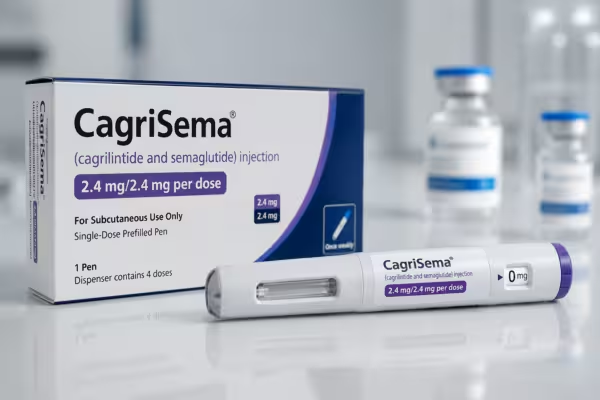
CagriSema Peptide: A Complete Guide to Cagrilintide and Semaglutide
CagriSema is an investigational combination therapy attracting significant attention in weight-management and metabolic health research. It combines two different molecules—cagrilintide, a long-acting amylin analogue, and semaglutide, a GLP-1 receptor agonist—into a once-weekly treatment being developed by Novo Nordisk. ara-290
The combination is designed to target complementary biological pathways involved in appetite regulation, food intake, blood glucose control, and body weight. Clinical trials have produced substantial weight-loss results, making CagriSema one of the most closely watched investigational treatments in the obesity field. Mod GRF 1-29
This guide explains what CagriSema is, how it works, what the research shows, how it compares with its individual components, and what is currently known about its development and safety.
What Is CagriSema?
CagriSema is the name used for the combination of:
- Cagrilintide — a long-acting amylin analogue
- Semaglutide — a GLP-1 receptor agonist
The investigational formulation being developed for weight management combines 2.4 mg of cagrilintide with 2.4 mg of semaglutide in a once-weekly injectable treatment.
Rather than relying on one metabolic pathway, CagriSema is designed to combine the effects of an amylin analogue and GLP-1 receptor agonist. Glow Blend (TB 10mg + BPC 10mg + GHK 50mg)
CagriSema at a Glance
| Characteristic | Details |
|---|---|
| Name | CagriSema |
| Components | Cagrilintide + semaglutide |
| Cagrilintide class | Long-acting amylin analogue |
| Semaglutide class | GLP-1 receptor agonist |
| Administration studied | Once-weekly injection |
| Primary research areas | Obesity and type 2 diabetes |
| Research status | Investigational |
| Developer | Novo Nordisk |
| Key clinical programs | REDEFINE and REIMAGINE |
How Does CagriSema Work?
The scientific rationale behind CagriSema comes from combining two complementary mechanisms.
Cagrilintide
Cagrilintide is a long-acting analogue of amylin, a hormone naturally produced by the pancreas alongside insulin.
Amylin is involved in regulating food intake and digestion. By activating amylin-related pathways, cagrilintide is being investigated for its potential to influence:
- Appetite
- Food intake
- Satiety
- Gastric emptying
- Body-weight regulation
Semaglutide
Semaglutide is a GLP-1 receptor agonist.
GLP-1 signaling plays an important role in glucose regulation and appetite. Semaglutide has been extensively studied for weight management and diabetes treatment.
Why Combine Them?
The concept behind CagriSema is that amylin and GLP-1 pathways may complement one another.
Instead of targeting appetite and metabolic regulation through one pathway, the combination is intended to influence multiple biological signals involved in energy intake and glucose metabolism.
This dual-pathway approach is one of the primary reasons CagriSema has generated interest in obesity research. Novo Nordisk describes it as a fixed-dose combination of a novel amylin analogue and a GLP-1 receptor agonist.
CagriSema and Weight Loss Research
One of the strongest areas of evidence for CagriSema comes from the REDEFINE clinical development program.
In the phase 3 REDEFINE 1 trial, adults with obesity or overweight plus an obesity-related complication received CagriSema or placebo for 68 weeks.
The trial reported an estimated mean body-weight reduction of 20.4% with CagriSema compared with 3.0% with placebo under the trial’s treatment-regimen estimand.
The researchers also reported that participants receiving CagriSema were more likely to reach clinically meaningful weight-loss thresholds, including reductions of 5%, 20%, 25%, and 30%.
These findings helped establish CagriSema as a significant investigational candidate in obesity treatment.
What Are the Potential Benefits of CagriSema?
Because CagriSema remains an investigational treatment, its potential benefits should be described in terms of clinical research findings rather than guaranteed outcomes.
Research has primarily focused on the following areas.
1. Weight Reduction
Weight loss is the primary area of interest surrounding CagriSema.
The REDEFINE 1 study demonstrated substantial average weight reduction compared with placebo after 68 weeks.
2. Appetite Regulation
Both components of CagriSema interact with biological systems involved in appetite and food intake.
Combining an amylin analogue with a GLP-1 receptor agonist may provide complementary effects on satiety and energy intake.
3. Glycemic Control
Because semaglutide is a GLP-1 receptor agonist and cagrilintide affects metabolic regulation, Cagri-Sema is also being investigated in people with type 2 diabetes.
The REDEFINE 2 trial evaluated Cagri-Sema in adults with overweight or obesity and type 2 diabetes.
More recent phase 3 REIMAGINE studies have continued investigating Cagri-Sema’s effects on blood glucose and body weight in people with type 2 diabetes.
4. Cardiometabolic Health
Weight reduction and improved glycemic control can have important implications for cardiometabolic health.
However, potential cardiovascular benefits of Cagri-Sema itself should not be assumed simply because semaglutide has established cardiovascular evidence. Cagri-Sema requires its own clinical evidence for specific outcomes.
Cagri-Sema vs. Semaglutide
Cagri-Sema and semaglutide are not the same treatment.
Semaglutide works primarily through GLP-1 receptor activation, whereas Cagri-Sema combines semaglutide with cagrilintide to engage both GLP-1 and amylin-related pathways.
This creates a broader pharmacological approach to appetite and metabolic regulation.
Clinical research has specifically evaluated whether combining the two agents can produce greater effects than either component alone.
Cagri-Sema vs. Cagrilintide
Cagrilintide is one of the two components of Cagri-Sema.
As an individual compound, cagrilintide has been studied for its effects on appetite and body weight. Cagri-Sema adds semaglutide to cagrilintide, creating a dual-mechanism approach.
Therefore:
Cagrilintide = amylin analogue
Semaglutide = GLP-1 receptor agonist
Cagri-Sema = cagrilintide + semaglutide
Cagri-Sema vs. Tirzepatide
Tirzepatide and CagriSema use different combinations of metabolic pathways.
Tirzepatide is a GIP and GLP-1 receptor agonist, while Cagri-Sema combines an amylin analogue with a GLP-1 receptor agonist.
A 2026 phase 3 head-to-head trial, REDEFINE 4, compared Cagri-Sema with tirzepatide in adults with obesity.
According to Novo Nordisk’s reported results, Cagri-Sema produced 23.0% weight loss after 84 weeks when evaluating treatment effects among participants who adhered to treatment, compared with 25.5% for tirzepatide. The trial did not meet its primary endpoint for demonstrating non-inferiority to tirzepatide.
This is an important distinction when interpreting claims that Cagri-Sema is definitively “better” than existing obesity treatments.
Cagri-Sema Clinical Trials
Several major clinical programs have investigated the combination.
REDEFINE 1
REDEFINE 1 evaluated Cagri-Sema in adults with overweight or obesity without diabetes.
The 68-week study found significant weight reduction compared with placebo, with gastrointestinal adverse events being among the most common reported adverse events.
REDEFINE 2
REDEFINE 2 evaluated adults with overweight or obesity and type 2 diabetes.
The trial investigated both weight reduction and glycemic outcomes and provided additional evidence for the combination in a diabetes population.
REDEFINE 4
REDEFINE 4 was a head-to-head phase 3 trial comparing Cagri-Sema with tirzepatide.
Although Cagri-Sema produced substantial weight loss, the study did not meet its predefined non-inferiority endpoint against tirzepatide.
REIMAGINE Program
The REIMAGINE program has focused on Cagri-Sema in adults with type 2 diabetes.
Reported 2026 results from REIMAGINE studies showed significant reductions in HbA1c and body weight compared with relevant comparators.
What Are the Side Effects of Cagri-Sema?
Clinical studies have reported gastrointestinal adverse events as the most common category of side effects.
In REDEFINE 1, gastrointestinal adverse events occurred in 79.6% of participants receiving Cagri-Sema compared with 39.9% receiving placebo. Reported events included:
- Nausea
- Vomiting
- Diarrhea
- Constipation
- Abdominal pain
The study reported that these events were generally mild to moderate and mainly transient.
Because Cagri-Sema combines two pharmacological mechanisms, its complete safety profile continues to be evaluated through ongoing clinical development.
Is Cagri-Sema FDA Approved?
Cagri-Sema has been an investigational treatment undergoing regulatory review and clinical development.
Novo Nordisk announced in December 2025 that it had submitted a New Drug Application to the FDA for Cagri-Sema 2.4 mg/2.4 mg for weight management.
Because regulatory status can change, anyone researching Cagri-Sema should verify the latest information directly with the FDA and the developer rather than relying on older product pages. Bpc-157 + TB-500
Is Cagri-Sema a Peptide?
Cagri-Sema is often described online as a “peptide” because both of its active components are peptide-based medicines.
However, Cagri-Sema is more accurately described as a fixed-dose combination of cagrilintide and semaglutide rather than a single peptide molecule.
This distinction matters for product descriptions and scientific accuracy.
Who Is Researching Cagri-Sema?
Cagri-Sema is being developed by Novo Nordisk, which has conducted extensive phase 3 research through the REDEFINE and REIMAGINE programs.
The combination represents part of a broader effort to develop treatments that address obesity through multiple biological mechanisms.
Why Is Cagri-Sema Generating So Much Interest?
There are several reasons for the attention surrounding Cagri-Sema.
First, obesity research has increasingly moved toward therapies that target multiple metabolic pathways.
Second, both components have strong biological rationales:
- Semaglutide targets GLP-1 receptors.
- Cagrilintide targets amylin-related pathways.
Third, phase 3 research has demonstrated substantial reductions in body weight.
Finally, head-to-head research against other advanced obesity treatments is helping researchers understand where multi-pathway therapies may fit within the rapidly evolving metabolic medicine landscape. where to buy bpc 157 and tb 500

Reviews
There are no reviews yet.