Tesamorelin vs Ipamorelin: Key Differences, Benefits, Mechanisms, and Research
Tesamorelin vs ipamorelin is a common comparison among people researching peptides that influence the growth hormone (GH) pathway. Although both compounds can stimulate endogenous GH release, they work through different mechanisms and have substantially different levels of clinical evidence and regulatory status. Tesamorelin + Ipamorelin
Tesamorelin is a growth hormone-releasing factor (GHRF) analog with an FDA-approved indication for reducing excess abdominal fat in adults with HIV-associated lipodystrophy. Ipamorelin is a growth hormone-releasing peptide that has been investigated for its ability to stimulate GH secretion, but it does not have FDA approval for bodybuilding, fat loss, anti-aging, or general performance enhancement. what is semax?
This guide explains the differences between tesamorelin vs ipamorelin, including how they work, what the research shows, potential applications, safety considerations, and why they should not automatically be considered interchangeable. GHK-CU 100mg
What Is Tesamorelin?
Tesamorelin is a synthetic analog of growth hormone-releasing hormone (GHRH), also called growth hormone-releasing factor. It acts on GHRF receptors in the pituitary to stimulate the production and pulsatile release of endogenous growth hormone. GH subsequently contributes to downstream effects involving insulin-like growth factor-1 (IGF-1).
Unlike many peptides discussed in online wellness and fitness communities, tesamorelin has undergone substantial clinical investigation.
In the United States, tesamorelin is marketed as Egrifta and is FDA-approved for reducing excess abdominal fat in adults with HIV-associated lipodystrophy. The FDA specifically states that it is not indicated for weight-loss management.
Clinical trials have demonstrated reductions in visceral adipose tissue in appropriately selected patients. A recent 2026 meta-analysis of randomized controlled trials also found that tesamorelin was associated with reductions in visceral adipose tissue, trunk fat, hepatic fat, and waist circumference, alongside an increase in lean body mass in adults with HIV-associated lipodystrophy. tesamorelin vs ipamorelin MGF
What Is Ipamorelin?
Ipamorelin is a synthetic growth hormone-releasing peptide (GHRP) that stimulates GH secretion through a different pathway from GHRH analogs such as tesamorelin.
Human pharmacokinetic and pharmacodynamic research has shown that ipamorelin can produce a transient GH-release episode. In one study involving healthy volunteers, GH peaked approximately 40 minutes after administration and subsequently declined.
Ipamorelin is frequently discussed in research involving body composition, recovery, and the GH axis. However, it is important to distinguish research interest from established clinical indications. Current reviews characterize ipamorelin and other GH-axis peptides used for sports or performance purposes as investigational, with uncertainties surrounding long-term safety and efficacy. tesamorelin vs ipamorelin PEG-MGF
Tesamorelin vs Ipamorelin: How Do They Work?
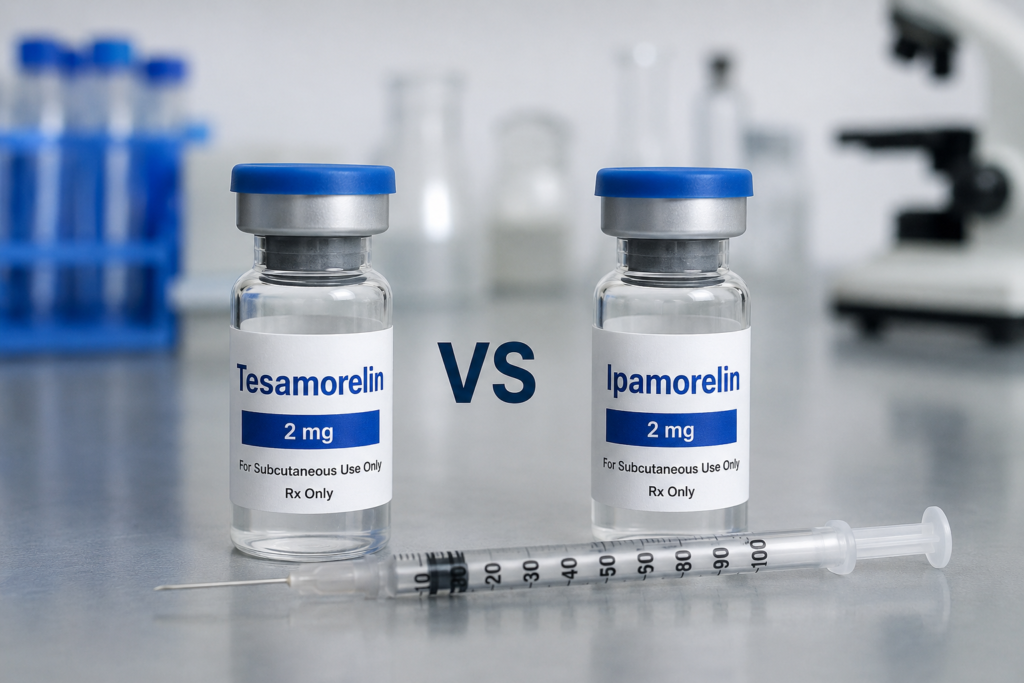
The biggest difference between tesamorelin and ipamorelin is where and how they stimulate the GH pathway.
| Feature | Tesamorelin | Ipamorelin |
|---|---|---|
| Peptide class | GHRH/GHRF analog | Growth hormone-releasing peptide |
| Primary pathway | GHRF/GHRH receptor | Ghrelin/GH secretagogue receptor pathway |
| Effect on GH | Stimulates endogenous GH release | Stimulates endogenous GH release |
| Effect on IGF-1 | Increases IGF-1 | Can increase GH and downstream IGF-1 |
| FDA-approved indication | HIV-associated lipodystrophy | No FDA-approved therapeutic indication |
| Human clinical evidence | Substantial clinical research | More limited clinical evidence |
| Approved for general weight loss? | No | No |
| Approved for bodybuilding? | No | No |
The distinction is important because two peptides that influence the same hormonal system are not necessarily equivalent.
Tesamorelin vs Ipamorelin for Fat Loss
This is one of the most common reasons people search for tesamorelin vs ipamorelin.
Tesamorelin has comparatively strong evidence for reducing visceral adipose tissue in its approved patient population. Clinical trials have repeatedly demonstrated reductions in visceral abdominal fat, while a 2026 meta-analysis found significant improvements in visceral adipose tissue and other body-composition measures.
Ipamorelin is often marketed online in connection with body composition and fat loss, but the evidence supporting these uses is considerably less established. Current reviews emphasize that GH-axis peptides such as ipamorelin remain investigational when used for athletic performance or physique-related goals.
Therefore, it would be inaccurate to claim that ipamorelin produces the same fat-loss effects demonstrated with tesamorelin in clinical trials. GHK-Cu Peptide Guide
Does Tesamorelin Burn All Types of Body Fat?
No.
Research suggests that tesamorelin has a particularly notable effect on visceral adipose tissue, the fat stored around internal abdominal organs. In clinical studies, reductions in visceral fat did not necessarily correspond to equivalent reductions in subcutaneous fat or overall body weight.
This distinction is important when evaluating claims about peptides and weight loss.
Tesamorelin vs Ipamorelin for Muscle and Lean Body Mass
Both peptides are connected to the GH/IGF-1 axis, which plays an important role in metabolism, tissue growth, and body composition.
However, that does not mean either compound should automatically be considered a muscle-building drug.
A 2026 meta-analysis of tesamorelin trials in HIV-associated lipodystrophy reported an average increase in lean body mass while also finding reductions in visceral and hepatic fat.
For ipamorelin, the evidence base is much less developed for clinically meaningful increases in muscle mass. Reviews of injectable peptides continue to describe the performance and body-composition applications of ipamorelin as investigational. how much ghk-cu should i inject daily
Tesamorelin vs Ipamorelin for IGF-1
Both compounds can influence the GH–IGF-1 axis, but the magnitude and clinical significance depend on the individual, treatment context, and other physiological factors.
Tesamorelin has well-documented effects on IGF-1. The FDA prescribing information notes that tesamorelin stimulates GH secretion and subsequently increases IGF-1 and IGFBP-3 levels. Because prolonged elevation of IGF-1 can have clinical implications, the prescribing information recommends monitoring IGF-1 during treatment.
Ipamorelin also stimulates GH secretion, and human pharmacodynamic research has demonstrated a measurable GH response following administration. However, there is substantially less clinical evidence establishing long-term outcomes associated with using ipamorelin to manipulate IGF-1 levels. what does semax do
Safety Considerations for tesamorelin vs ipamorelin
Neither peptide should be considered risk-free simply because it is a peptide.
Tesamorelin has an established prescription safety profile and FDA labeling that includes warnings concerning elevated IGF-1, fluid retention, glucose intolerance or diabetes, hypersensitivity reactions, injection-site reactions, and malignancy-related considerations.
Ipamorelin has a much less established clinical safety profile. Recent reviews of injectable peptides highlight uncertainties involving long-term safety, product quality, dosing, and unregulated supply chains for investigational peptide products.
People considering either compound should discuss the decision with a qualified healthcare professional rather than relying on online dosing protocols or product marketing. IGF-1 DES
Is Tesamorelin Stronger Than Ipamorelin?
There is no scientifically valid way to simply label one as “stronger” without defining what outcome is being measured.
If the question is which has stronger clinical evidence for reducing visceral abdominal fat in HIV-associated lipodystrophy, tesamorelin has a clear advantage because that is its FDA-approved therapeutic indication and it has been evaluated in randomized clinical trials.
If the question is which produces a GH response, both compounds can stimulate endogenous GH, but they do so through different mechanisms.
For performance enhancement, muscle gain, anti-aging, or general fat loss, there is not enough high-quality evidence to conclude that ipamorelin is superior to tesamorelin—or vice versa.
Can Tesamorelin and Ipamorelin Be Used Together?
The combination of different GH-axis peptides is frequently discussed online, but combining compounds does not automatically make treatment more effective or safer.
The evidence supporting peptide combinations for bodybuilding, fat loss, or anti-aging is limited, and the safety of many self-directed combinations has not been adequately established. Recent literature specifically emphasizes uncertainty around self-administration and stacking practices involving GH-axis peptides.
Any combination involving tesamorelin or ipamorelin should therefore be approached as a medical decision rather than a routine supplementation strategy.
Which Is Better: Tesamorelin or Ipamorelin?
The answer depends entirely on the intended use.
Tesamorelin may be more relevant when researching:
- Visceral abdominal fat
- HIV-associated lipodystrophy
- Clinically studied GH-axis therapies
- FDA-approved peptide treatment
- Body-composition research supported by randomized trials
Ipamorelin may be more relevant when researching:
- Growth hormone secretagogues
- GH-release mechanisms
- Experimental peptide research
- Pharmacology of GHRP-class compounds
The important distinction is that research interest does not equal regulatory approval or proven clinical benefit.
Tesamorelin vs Ipamorelin: Key Takeaways
Tesamorelin and ipamorelin both interact with the body’s growth hormone system, but they are pharmacologically different compounds.
Tesamorelin is a GHRH/GHRF analog with an FDA-approved indication for reducing excess abdominal fat associated with HIV lipodystrophy. It has substantially more human clinical evidence, particularly regarding visceral adipose tissue and body composition.
Ipamorelin is a GH-releasing peptide that has demonstrated GH-stimulating activity in human research but remains investigational for the body-composition and performance uses frequently promoted online.
Ultimately, the best way to compare tesamorelin vs ipamorelin is to look beyond marketing claims and evaluate each compound’s mechanism, clinical evidence, regulatory status, potential risks, and intended application.
Frequently Asked Questions about tesamorelin vs ipamorelin
Is tesamorelin the same as ipamorelin?
No. Tesamorelin is a GHRH/GHRF analog, while ipamorelin is a growth hormone-releasing peptide. They stimulate the GH axis through different mechanisms.
Which is better for visceral fat?
Tesamorelin has considerably stronger clinical evidence for reducing visceral adipose tissue, particularly in adults with HIV-associated lipodystrophy.