How Much GHK-Cu Should I Inject Daily? What the Research Actually Shows
How much GHK-Cu should I inject daily? This question is increasingly common among people researching copper peptides for skin, tissue repair, and other potential applications. However, there is an important distinction between GHK-Cu research and an established injectable treatment protocol. GHK-CU 100mg
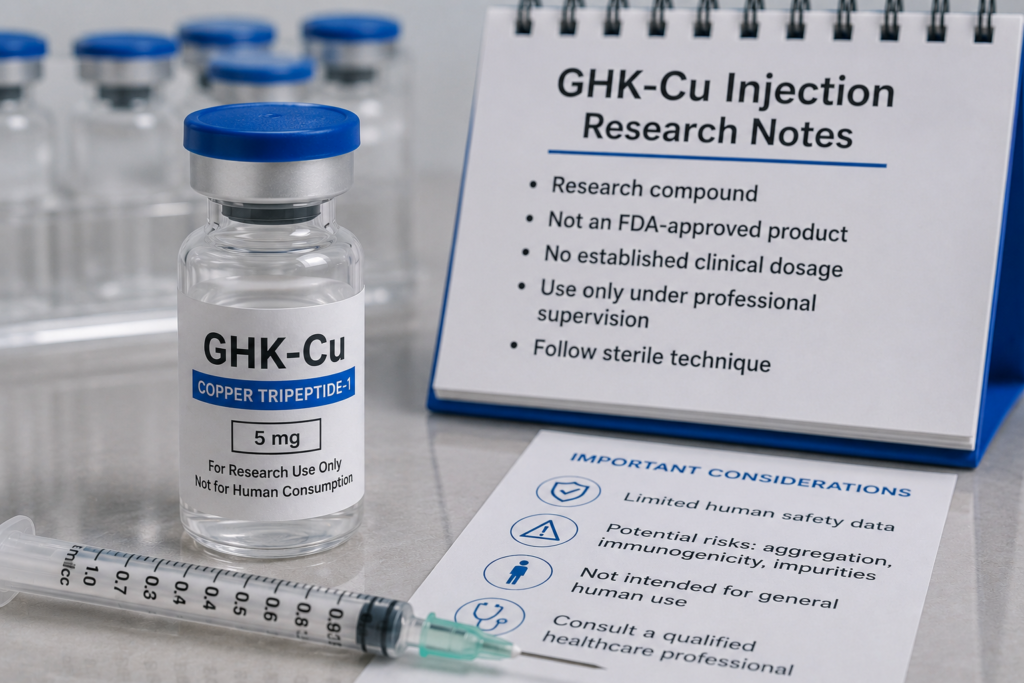
GHK-Cu, also known as copper tripeptide-1, is a naturally occurring peptide that binds copper. It has been studied extensively in laboratory and topical skin research. However, there is not an established, FDA-approved how much ghk-cu should i inject daily for research use. The FDA currently identifies compounded injectable GHK-Cu as a substance with potential safety concerns, citing limited human safety information and potential risks related to peptide aggregation and impurities.
For that reason, online numbers presented as a standard “GHK-Cu injection dosage” should not be treated as medically established dosing instructions. how much ghk-cu should i inject daily GHK-Cu Peptide Guide
What Is GHK-Cu?
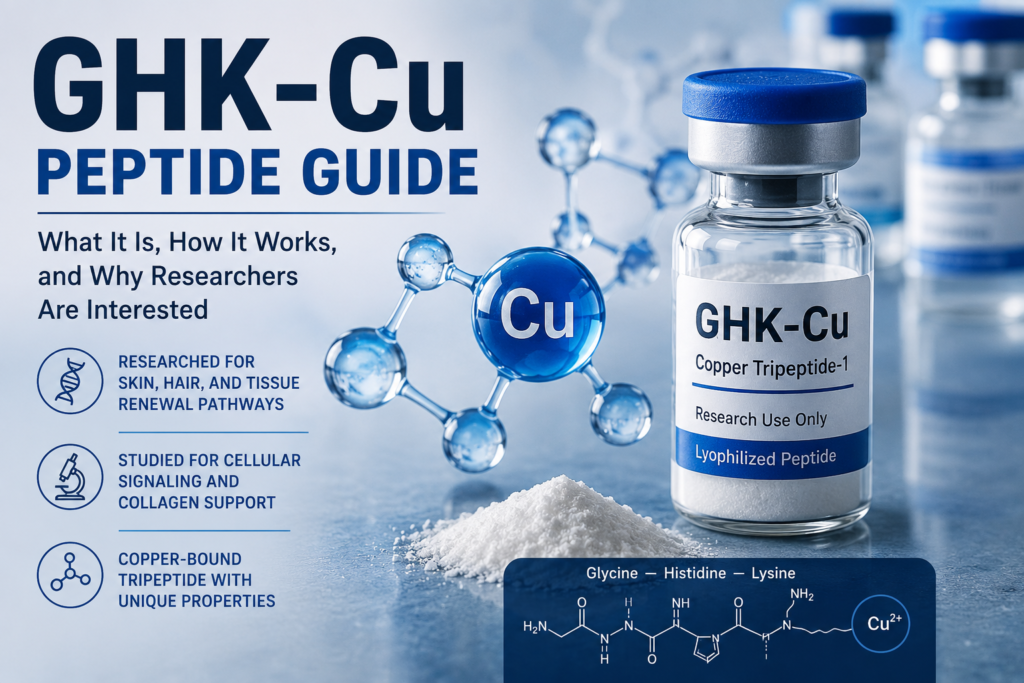
GHK-Cu is a complex formed when the naturally occurring tripeptide glycyl-L-histidyl-L-lysine (GHK) binds copper.
Researchers have investigated GHK-Cu for its potential involvement in biological processes related to:
- Collagen and extracellular-matrix production
- Wound healing
- Skin remodeling
- Inflammation
- Angiogenesis
- Cellular signaling
- Tissue repair
Much of the human research has focused on topical GHK-Cu, rather than injection.
For example, a randomized clinical study examined a topical copper tripeptide product following CO₂ laser resurfacing. The study found no significant differences in several objective skin outcomes, although participants using the GHK-Cu product reported greater satisfaction with overall skin quality. how much ghk-cu should i inject daily How to Store GHK-Cu Peptides
Is There a Standard Daily Injectable GHK-Cu Dose?
No established standard daily injectable dose has been demonstrated in high-quality human clinical trials.
This is the most important point for anyone searching for “how much GHK-Cu should I inject daily?”
The available evidence does not provide a validated dosage that can be safely recommended for routine self-injection. Human research has predominantly investigated topical applications, while injectable GHK-Cu has substantially less human safety and pharmacokinetic information.
The FDA specifically states that compounded injectable GHK-Cu may present risks involving immunogenicity, peptide aggregation, and peptide-related impurities, and that limited human data are available to evaluate safety. how much ghk-cu should i inject daily How Long Does GHK-Cu Take to Work?
Why Online GHK-Cu Dosage Numbers Can Be Misleading
Online peptide websites may list specific amounts of GHK-Cu for injection. These figures can appear authoritative, but a number appearing on a vendor website does not establish a clinically validated human dose.
A legitimate dosing recommendation normally requires evidence addressing questions such as:
- How much reaches the bloodstream?
- How long does the compound remain active?
- What dose produces the desired biological effect?
- What dose produces adverse effects?
- How does repeated administration affect copper metabolism?
- What happens with long-term exposure?
- How do age, body weight, kidney function, and other factors affect exposure?
how much ghk-cu should i inject daily, For injectable GHK-Cu, these questions have not been adequately answered through large, well-controlled human clinical trials.
GHK-Cu Injection vs. Topical GHK-Cu
One of the biggest sources of confusion is treating topical research as evidence for injectable dosing.
These are fundamentally different routes of administration.
Topical GHK-Cu
Topical GHK-Cu has been investigated in human studies involving skin appearance, wound healing, and skin remodeling. Research has also examined how copper tripeptide formulations interact with skin tissue.
A current clinical trial is also investigating a 0.1% topical GHK-Cu gel for standardized skin wounds in healthy adults. The study is designed to evaluate wound healing and safety rather than injectable administration.
Injectable GHK-Cu
Injectable GHK-Cu is a different situation.
Injecting a peptide bypasses the skin barrier and exposes the body to systemic concentrations that are not directly comparable with topical application. Consequently, a topical concentration should never be converted into an injectable dose. how much ghk-cu should i inject daily Tesamorelin + Ipamorelin
What Does the Research Say About GHK-Cu Benefits?
Research into GHK-Cu has focused heavily on tissue remodeling and skin biology.
Laboratory and preclinical studies have investigated possible effects on collagen production, fibroblast activity, inflammatory signaling, angiogenesis, and extracellular-matrix remodeling.
Human evidence exists primarily for topical formulations. For example, clinical research has investigated topical GHK-Cu following dermatological procedures, while newer clinical research is examining topical applications for wound healing.
how much ghk-cu should i inject daily, These findings are interesting, but they do not establish that injecting GHK-Cu provides the same effects. Semax
Is Injectable GHK-Cu FDA Approved?
There is currently no FDA-approved injectable GHK-Cu product for general therapeutic use.
The FDA’s current compounding information specifically lists GHK-Cu for injectable routes among substances that may present significant safety risks. The agency cites limited human safety data and potential concerns involving aggregation and peptide-related impurities.
The FDA also explains that compounded drugs are not FDA-approved and therefore are not reviewed by the agency before marketing for safety, effectiveness, or quality.
This is particularly important for injectable products because contamination or incorrect concentrations can potentially cause serious harm. how much ghk-cu should i inject daily Selank
Why Injectable Peptide Quality Matters
The risks associated with injection are not limited to the peptide itself.
An injectable product must also have appropriate:
- Sterility
- Purity
- Identity testing
- Concentration accuracy
- Endotoxin control
- Storage conditions
- Container integrity
- Manufacturing quality
The FDA has emphasized that poor compounding practices can result in contamination or products containing too much or too little active ingredient. Such problems can cause serious injury.
Therefore, a product labeled “GHK-Cu 50 mg” or another amount does not, by itself, establish that the product is appropriate or safe for injection. Selank Nasal Spray – Research Peptide
Can You Calculate a GHK-Cu Injection Dose From the Vial?
The amount printed on a vial is not the same thing as an established daily dose.
For example, a vial’s total peptide content tells you how much material is present in the container. It does not establish:
- How much should be administered
- How frequently it should be administered
- How long treatment should continue
- What concentration is appropriate
- Whether systemic exposure is safe
Attempting to create an injection schedule from the vial size alone is therefore not scientifically justified.
What About GHK-Cu Research Doses?
Some websites publish numerical doses described as “research doses.” These should be interpreted carefully.
A dose used in an animal experiment, laboratory experiment, or unvalidated protocol cannot automatically be converted into a safe human injection schedule.
Likewise, topical concentrations cannot be converted directly into injectable amounts.
The absence of a validated human injectable dose is itself an important research finding. Selank Peptide Benefits Explained
What Are the Potential Risks of Injectable GHK-Cu?
Because human injectable research is limited, the complete safety profile remains uncertain.
Potential concerns include:
- Injection-site reactions
- Contamination or infection
- Peptide aggregation
- Impurities
- Immunogenic reactions
- Unknown systemic effects
- Uncertain effects of repeated exposure
- Uncharacterized pharmacokinetics
The FDA specifically highlights immunogenicity, aggregation, and peptide-related impurities as concerns for compounded injectable GHK-Cu.
This uncertainty is one reason a healthcare professional should be involved when considering any injectable peptide. Mod GRF 1-29