What Is GHK-Cu? A Complete Guide to Copper Peptide Research
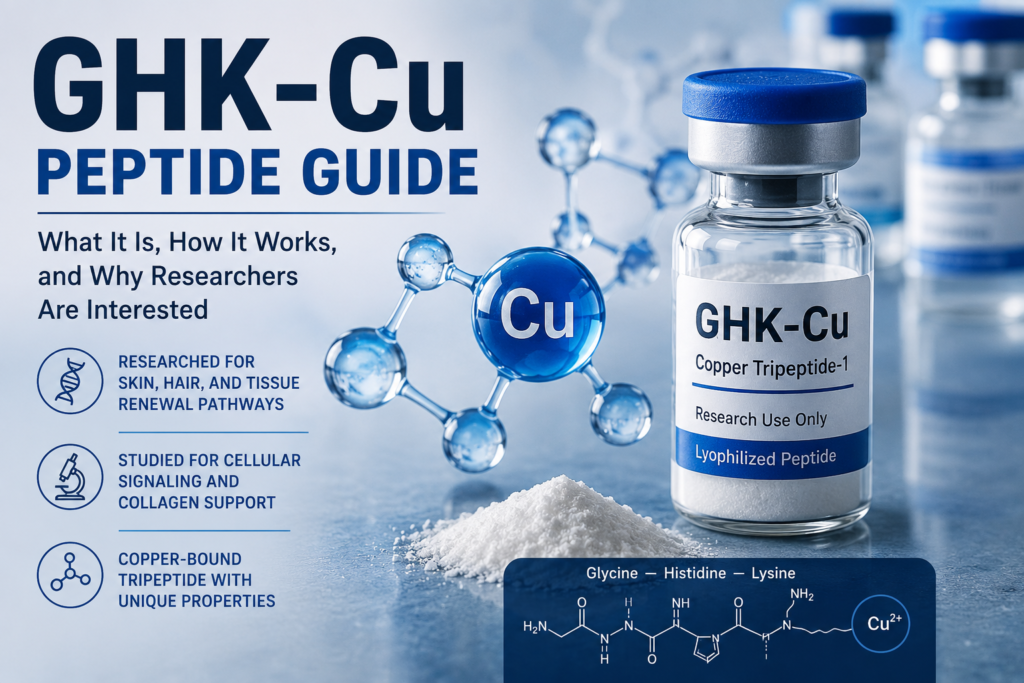
What is GHK-Cu? GHK-Cu is a naturally occurring copper-binding peptide that has attracted significant scientific interest for its potential role in skin health, wound healing, tissue remodeling, and cellular signaling. Also known as copper tripeptide-1, GHK-Cu consists of the tripeptide glycyl-L-histidyl-L-lysine (GHK) bound to a copper ion. GHK-CU 100mg
GHK-Cu has been studied for decades, particularly in connection with skin biology and tissue repair. It is also widely discussed online as a cosmetic ingredient and research peptide. GHK-Cu Peptide Guide
However, it is important to know what is ghk-cu is to distinguish established research from marketing claims. Although GHK-Cu has demonstrated interesting biological activity in laboratory and some human research, evidence for specific therapeutic applications varies considerably depending on the formulation and route of administration. BPC-157 vs GHK-Cu
What Is GHK-Cu?
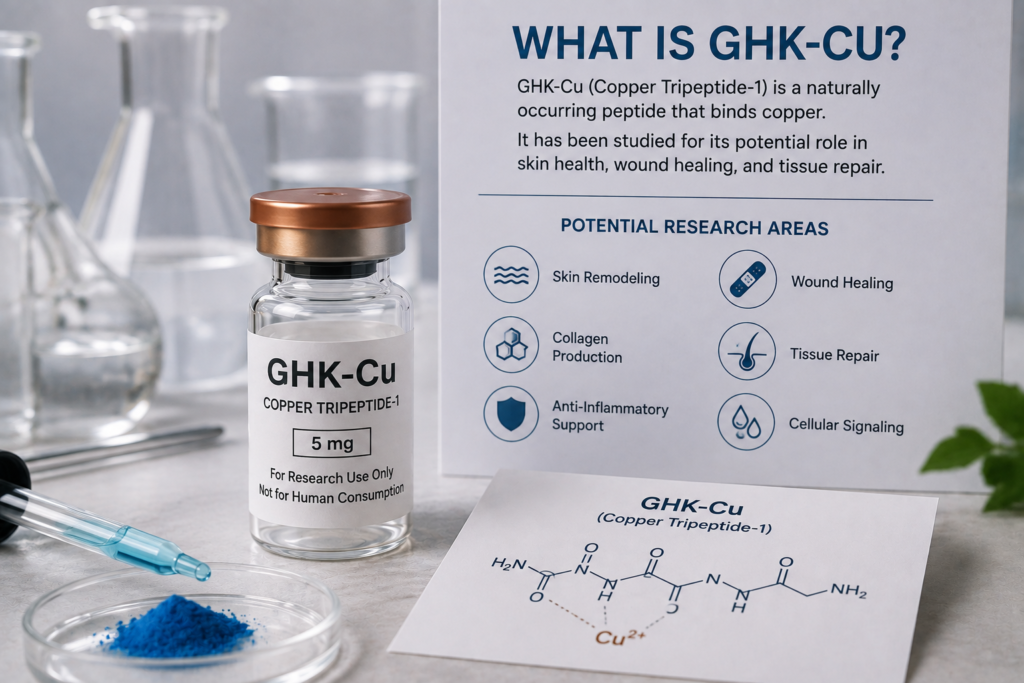
GHK-Cu is a copper peptide formed when the naturally occurring peptide GHK binds with copper.
GHK itself is a small three-amino-acid peptide:
Glycine – Histidine – Lysine
When GHK binds copper, it forms the copper-peptide complex commonly called GHK-Cu.
Researchers have investigated this complex because copper plays an important role in numerous biological processes, while GHK appears to have signaling properties of its own. what is ghk-cu how much ghk-cu should i inject daily
GHK-Cu is particularly associated with research into:
- Skin remodeling
- Collagen production
- Wound healing
- Extracellular-matrix regulation
- Inflammatory signaling
- Cellular repair
- Angiogenesis
- Skin aging
What Does GHK-Cu Do?
The biological activity of GHK-Cu is complex and is still being investigated.
Research suggests that copper peptides may interact with cellular pathways involved in tissue remodeling and repair. GHK-Cu has been studied for its potential influence on fibroblasts, collagen, extracellular-matrix components, inflammatory processes, and other mechanisms involved in maintaining tissue structure.
One of the reasons GHK-Cu has become popular in cosmetic science is its potential relationship with collagen and skin remodeling.
However, saying that GHK-Cu “boosts collagen” should not be interpreted as proof that every GHK-Cu product will produce a clinically significant increase in collagen or visible skin improvements. what is ghk-cu Semax
GHK-Cu and Skin Health
Skin health is one of the most extensively discussed applications of GHK-Cu.
The skin continuously undergoes processes involving collagen production, extracellular-matrix turnover, inflammation, and tissue repair. Researchers have investigated whether copper peptides can influence some of these processes.
Studies of topical copper peptide formulations have examined areas including:
- Skin elasticity
- Fine lines and wrinkles
- Skin texture
- Collagen-related processes
- Wound healing
- Skin regeneration
Research findings have generated interest in GHK-Cu as a cosmetic ingredient, although outcomes depend on the specific formulation, concentration, duration of use, and study design. what is ghk-cu Selank
GHK-Cu and Collagen
Collagen is one of the primary structural proteins in the skin and contributes to its strength and elasticity.
GHK-Cu research has investigated its potential relationship with collagen synthesis and extracellular-matrix remodeling. Laboratory research suggests that copper peptides may influence fibroblast activity and processes associated with tissue structure.
This is one reason GHK-Cu is frequently included in anti-aging skincare formulations.
Nevertheless, laboratory evidence does not automatically demonstrate that applying or administering GHK-Cu will produce a predictable increase in collagen in every person. what is ghk-cu Tesamorelin + Ipamorelin
GHK-Cu and Wound Healing
Another important research area is wound healing.
Wound repair involves multiple stages, including inflammation, tissue formation, collagen deposition, blood-vessel development, and remodeling. Researchers have investigated GHK-Cu in relation to several of these processes.
Experimental studies have reported biological activity involving cells and pathways associated with tissue repair.
Human research has also investigated topical copper peptide formulations in dermatological settings. These findings are part of the reason GHK-Cu continues to be studied for potential applications in regenerative and cosmetic science. what is ghk-cu Glow Blend (TB 10mg + BPC 10mg + GHK 50mg)
GHK-Cu and Inflammation
Inflammation is an important part of the body’s response to tissue damage, but excessive or prolonged inflammatory signaling can interfere with normal tissue remodeling.
Research has explored whether GHK-Cu can influence inflammatory signaling and cellular responses associated with tissue injury.
This potential activity has contributed to interest in GHK-Cu for skin and tissue research.
However, GHK-Cu should not automatically be considered an established anti-inflammatory treatment. More research is needed to determine the clinical significance of these effects.
Is GHK-Cu a Copper Peptide?
Yes.
GHK-Cu is commonly classified as a copper peptide because the GHK peptide is bound to a copper ion.
Other copper-containing peptides have also been investigated, but GHK-Cu is particularly well known in skincare and peptide research.
The term “copper peptide” therefore describes a broader category, while GHK-Cu specifically refers to the GHK-copper complex. what is ghk-cu BPC-157 Capsules vs Injectable BPC-157
GHK-Cu in Skincare
GHK-Cu is widely used and studied as a topical cosmetic ingredient.
It can be found in products such as:
- Serums
- Creams
- Facial treatments
- Skin-repair formulations
- Anti-aging skincare products
Topical application is particularly relevant because much of the human research involving GHK-Cu has focused on skin applications.
When evaluating a GHK-Cu skincare product, the presence of the ingredient alone does not guarantee a particular outcome. Product formulation, stability, concentration, delivery system, and overall skincare routine can all influence performance. what is ghk-cu Sermorelin
GHK-Cu vs. Injectable GHK-Cu
It is important to distinguish topical GHK-Cu from injectable GHK-Cu.
Topical GHK-Cu is primarily researched and marketed in connection with skin applications. Injectable GHK-Cu involves systemic exposure and presents a different set of pharmacological and safety questions.
The existence of research supporting topical GHK-Cu does not establish that injectable GHK-Cu is equally safe or effective.
The FDA has specifically identified compounded injectable GHK-Cu as a substance that may present significant safety risks because of limited human safety information and concerns including peptide aggregation and impurities.
Consequently, topical research should not be used to establish an injectable GHK-Cu dosage.
Is GHK-Cu FDA Approved?
There is an important distinction between an ingredient being used in cosmetic products and an injectable drug being FDA-approved.
GHK-Cu is not an FDA-approved injectable medication for general therapeutic use.
The FDA has raised concerns about compounded injectable GHK-Cu, including limited human safety information and potential risks related to aggregation and impurities.
This does not mean that every topical cosmetic product containing a copper peptide is unsafe. Instead, regulatory status depends on the specific product, formulation, intended use, and claims being made. what is ghk-cu Mod GRF 1-29
Is GHK-Cu Safe?
The safety profile of GHK-Cu depends heavily on how it is formulated and administered.
Topical GHK-Cu has been investigated in cosmetic and dermatological research. Injectable GHK-Cu has substantially less established human safety information.
Potential concerns with injectable peptide products can include:
- Product contamination
- Incorrect concentration
- Peptide impurities
- Aggregation
- Injection-site reactions
- Immunogenicity
- Unknown effects from repeated systemic exposure
Anyone considering an injectable form should consult a qualified healthcare professional rather than relying on online peptide dosing guides.
What Is GHK-Cu Used For?
GHK-Cu has been investigated for a variety of potential applications, particularly involving skin and tissue biology.
Research areas include:
Skin Remodeling
Researchers have examined whether GHK-Cu can influence processes associated with extracellular-matrix remodeling and skin structure.
Collagen Research
GHK-Cu has been studied for potential effects on collagen-related pathways and fibroblast activity.
Wound Healing
Experimental research has investigated GHK-Cu in connection with tissue repair and wound-healing processes.
Skin Aging
Because collagen and extracellular-matrix changes are associated with aging skin, GHK-Cu has attracted interest as a cosmetic research ingredient.
Cellular Signaling
GHK-Cu has also been studied for its potential influence on signaling pathways involved in inflammation, repair, and tissue remodeling.
Does GHK-Cu Help Hair Growth?
GHK-Cu is sometimes promoted online as a hair-growth peptide.
Laboratory and preclinical research has explored copper peptides in relation to hair follicles and cellular processes involved in hair biology. However, evidence supporting GHK-Cu as an established treatment for hair loss is considerably less definitive than online marketing may suggest.
More controlled human research would be needed to determine whether GHK-Cu provides meaningful benefits for common forms of hair loss.
How Is GHK-Cu Different From Other Peptides?
Peptides can have very different structures and biological functions.
GHK-Cu is particularly associated with copper binding, skin biology, tissue remodeling, and cellular signaling.
Other peptides may instead be investigated for metabolic signaling, hormone regulation, neurological pathways, or other biological functions.
This is why the term “peptide” alone does not tell you what a compound does. The specific peptide, biological target, formulation, and evidence base all matter.