
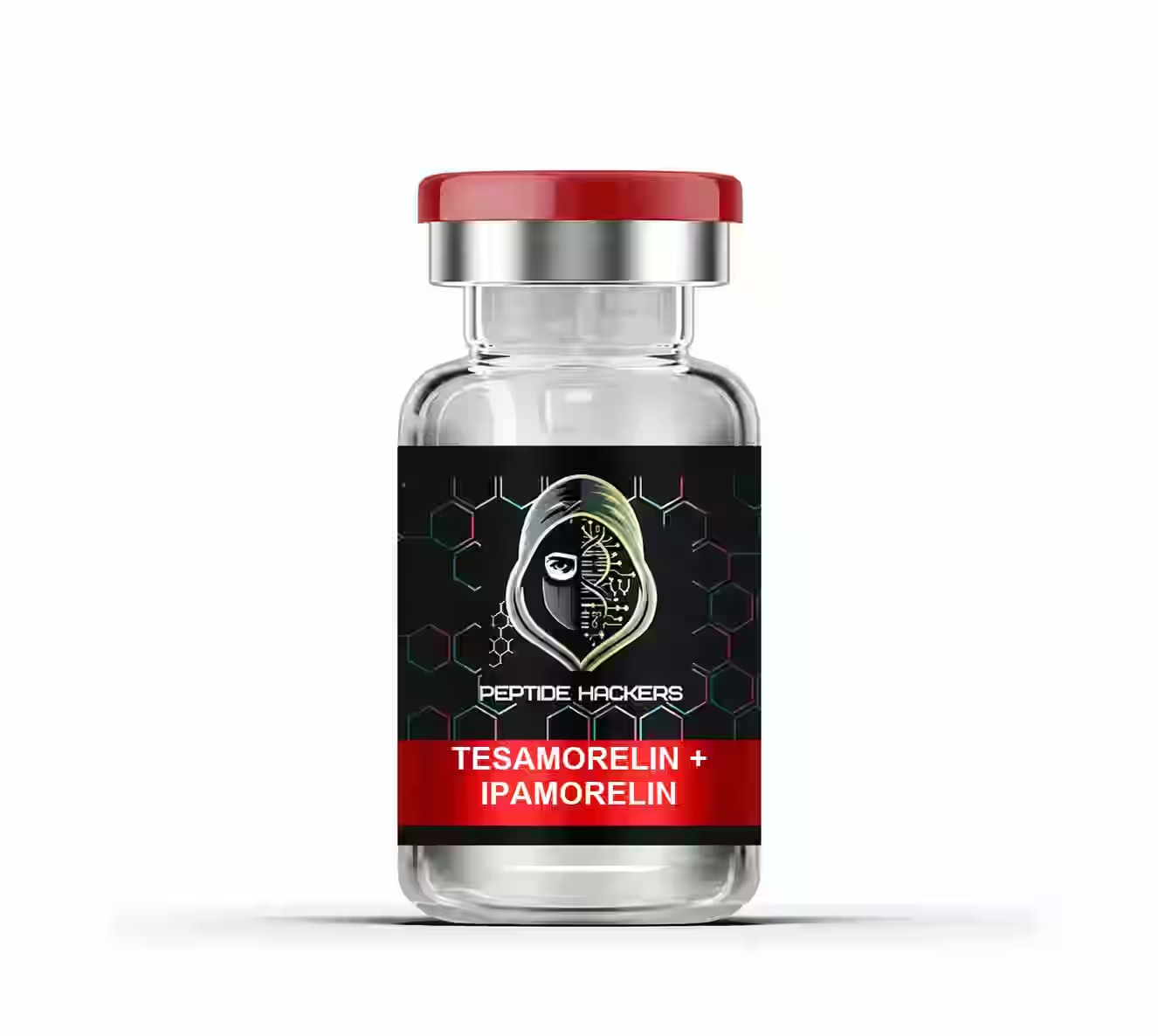
Tesamorelin Ipamorelin Blend: Research Guide, Ingredients, Uses & Considerations
A tesamorelin ipamorelin blend combines two peptides associated with research into the growth hormone (GH) signaling pathway. Tesamorelin is a growth hormone–releasing hormone (GHRH) analog, while ipamorelin is a synthetic growth hormone secretagogue studied for its interaction with the ghrelin receptor. Glow Blend (TB 10mg + BPC 10mg + GHK 50mg)
Because the two compounds influence different points within the growth-hormone signaling system, researchers may be interested in studying them individually or in combination. However, a blend should not automatically be assumed to produce additive or synergistic effects, and evidence for a specific tesamorelin-ipamorelin formulation depends on the exact composition and experimental model. PEG-MGF
Research use only: Peptide research products are not automatically approved medicines. This article is intended for educational and laboratory research purposes and does not provide instructions for human use, dosing, or administration.
What Is a Tesamorelin Ipamorelin Blend?
A tesamorelin ipamorelin blend is a multi-peptide research formulation containing tesamorelin and ipamorelin.
The two compounds have different molecular characteristics:
- Tesamorelin is a synthetic analog of GHRH.
- Ipamorelin is a growth hormone secretagogue that has been investigated as a selective ghrelin-receptor agonist.
The scientific interest in combining them comes from their involvement in related but distinct aspects of GH regulation.
Unlike a standardized pharmaceutical product, however, the term “tesamorelin ipamorelin blend” does not identify one universally recognized formulation. The ratio, total quantity, purity, and formulation can vary between research suppliers.
Always verify the product-specific certificate of analysis and specification before conducting research. MGF
Tesamorelin vs. Ipamorelin
Understanding the difference between the two peptides is important when evaluating a blend.
| Characteristic | Tesamorelin | Ipamorelin |
|---|---|---|
| Peptide category | GHRH analog | Growth hormone secretagogue |
| Primary research pathway | GHRH-related signaling | Ghrelin receptor/GHS-R signaling |
| Research focus | GH-axis regulation and metabolic research | GH secretion and receptor signaling |
| Molecular role | Mimics aspects of GHRH activity | Mimics aspects of ghrelin-related signaling |
| Research status | Extensively studied | Primarily investigational |
Although both compounds are associated with GH signaling, they are not interchangeable. IGF-1 DES
What Is Tesamorelin?
Tesamorelin is a synthetic analog of growth hormone-releasing hormone.
GHRH is a naturally occurring hypothalamic hormone involved in regulation of growth hormone secretion. Tesamorelin was developed to mimic GHRH activity and has been investigated extensively in the context of the GH axis.
Research involving tesamorelin has focused on areas such as:
- Growth hormone regulation
- IGF-1 signaling
- Metabolic biology
- Adipose-tissue research
- Body-composition studies
- Endocrine signaling
Tesamorelin also has an established pharmaceutical history for a specific medical indication, which is distinct from research-grade tesamorelin products and from experimental peptide blends. GHK-CU 100mg
What Is Ipamorelin?
Ipamorelin is a synthetic peptide that has been studied as a growth hormone secretagogue.
Research has examined its interaction with the growth hormone secretagogue receptor (GHS-R), also known as the ghrelin receptor.
The compound is of interest because researchers can use it to investigate:
- Growth hormone secretion
- GHS-R signaling
- Endocrine regulation
- Peptide-receptor interactions
- Growth hormone axis mechanisms
Ipamorelin should not be confused with GHRH analogs such as tesamorelin. The two peptides act through different receptor systems. Semax
How Does the Tesamorelin Ipamorelin Blend Work?
A simplified model of the two pathways is:
Tesamorelin → GHRH receptor signaling → pituitary GH pathway
Ipamorelin → GHS-R signaling → GH secretory pathway
Because the pathways are biologically related, researchers may investigate whether stimulation through different signaling mechanisms produces measurable changes in experimental GH-axis models.
However, the existence of two mechanisms does not establish that combining the compounds produces a predictable or superior biological response. GHK-Cu Peptide Guide
Combination-specific research would be needed to determine whether the interaction is additive, synergistic, neutral, or otherwise.
Why Study Tesamorelin and Ipamorelin Together?
The primary scientific rationale for studying a tesamorelin-ipamorelin combination is the opportunity to investigate different regulatory mechanisms within the growth hormone axis.
Researchers may be interested in questions such as:
- How do GHRH and GHS-R pathways interact?
- Does simultaneous pathway stimulation alter GH signaling?
- How do different peptide concentrations affect experimental responses?
- How does receptor signaling change between experimental models?
- What downstream effects occur following activation of these pathways?
These questions are appropriate for controlled laboratory investigation but should not be interpreted as evidence of established benefits from using the peptides together. how much ghk-cu should i inject daily
Tesamorelin Ipamorelin Blend Research Applications
1. Growth Hormone Signaling Research
The blend may be relevant to laboratory studies investigating how multiple signaling pathways influence GH regulation.
2. Endocrine Research
Tesamorelin and ipamorelin provide different experimental tools for examining endocrine signaling and pituitary regulation.
3. Receptor Biology
Researchers can investigate interactions between GHRH-related and GHS-R-related pathways.
4. Metabolic Research
Tesamorelin has been investigated in metabolic research, particularly in relation to adipose tissue and IGF-1 pathways. Ipamorelin provides a separate model for studying secretagogue-related signaling.
5. Peptide Combination Studies
A defined blend can be useful for experiments designed to examine how multiple peptide pathways behave under controlled conditions.
Potential Benefits: What Does Research Actually Show?
Tesamorelin and ipamorelin are sometimes promoted online for claims involving:
- Fat loss
- Muscle growth
- Recovery
- Sleep
- Anti-aging
- Athletic performance
Such marketing claims should be separated from scientific evidence. BPC-157 peptide research
Tesamorelin has clinical evidence for a specific approved indication, but that does not mean that every tesamorelin product or tesamorelin-ipamorelin blend has the same clinical status.
Ipamorelin remains primarily an investigational compound, and evidence supporting broad human benefits is limited.
Most importantly, research involving the individual peptides should not automatically be interpreted as evidence that a particular tesamorelin ipamorelin blend provides the same effects.
Tesamorelin Ipamorelin Blend vs. Tesamorelin Alone
A blend contains more than one active peptide, whereas tesamorelin alone provides a single experimental compound.
| Feature | Tesamorelin Alone | Tesamorelin + Ipamorelin Blend |
| Number of peptides | 1 | 2 |
| GHRH-related activity | Yes | Yes |
| GHS-R-related activity | No | Yes |
| Experimental complexity | Lower | Higher |
| Combination effects | Not applicable | Require direct investigation |
For controlled experiments, a single compound can sometimes make it easier to attribute an observed result to a specific mechanism. A blend may instead be useful when the research question specifically concerns pathway interactions. semax peptide benefits
Tesamorelin Ipamorelin Blend vs. CJC-1295 and Ipamorelin
Another common research combination involves CJC-1295 and ipamorelin.
CJC-1295 is a GHRH-related peptide, while ipamorelin is a growth hormone secretagogue. Tesamorelin is also related to GHRH signaling, but it is structurally and pharmacologically distinct from CJC-1295.
Therefore:
Tesamorelin + Ipamorelin ≠ CJC-1295 + Ipamorelin
Researchers should verify the exact peptide identity rather than treating GHRH-related compounds as interchangeable.
Quality Considerations for a Tesamorelin Ipamorelin Blend
Researchers evaluating a blend should look beyond the product name.
Exact Composition
Verify the amount of tesamorelin and ipamorelin in the formulation.
Peptide Identity
Confirm the identity and sequence of each component.
Purity Testing
Appropriate analytical testing may include HPLC and mass spectrometry, depending on the supplier and product.
Batch-Specific COA
A batch-specific Certificate of Analysis (COA) can provide useful information about the material actually being supplied.
Storage Information
Follow the manufacturer’s storage requirements for the specific formulation.
Product Traceability
Batch numbers, lot information, manufacturing information, and analytical documentation can help researchers maintain experimental reproducibility.
Is a Tesamorelin Ipamorelin Blend FDA Approved?
The term “tesamorelin ipamorelin blend” does not refer to a single FDA-approved combination product.
Tesamorelin itself has an approved medical product for a specific indication, but that regulatory status should not be extended to an experimental combination containing tesamorelin and ipamorelin.
Ipamorelin is not an FDA-approved treatment for general human use.
Researchers should therefore distinguish between:
- An approved pharmaceutical containing tesamorelin
- Research-grade tesamorelin
- Research-grade ipamorelin
- Experimental tesamorelin-ipamorelin combinations
These categories are not equivalent. Selank Nasal Spray – Research Peptide
Is the Tesamorelin Ipamorelin Blend Safe?
Safety depends on the specific formulation, purity, route of administration, experimental conditions, and biological system being studied.
There is insufficient evidence to establish the safety of an arbitrary tesamorelin-ipamorelin blend for self-administration.
Growth hormone signaling can affect multiple physiological systems, and changing endocrine pathways can produce effects beyond the intended research endpoint.
For laboratory work, researchers should follow institutional safety procedures and applicable regulations.
Reviews
There are no reviews yet.