BPC-157 peptide research
BPC-157 peptide research has expanded significantly over the past several decades, generating interest in the peptide’s potential effects on tissue repair, inflammation, vascular biology, gastrointestinal injury, and musculoskeletal healing.
BPC-157 peptide research is a synthetic 15-amino-acid peptide that has been investigated primarily in laboratory and animal models. Researchers have reported biological activity across multiple experimental systems, including models of tendon, ligament, muscle, gastrointestinal, and vascular injury.
However, the scientific status of BPC-157 requires an important distinction: a substantial preclinical literature exists, but rigorous human clinical evidence remains limited.
A 2026 review of BPC-157 development concluded that despite more than three decades of preclinical research, pharmaceutical development remains at an early stage, with no approved formulation, no validated dosing regimen, and no completed Phase II clinical trial identified in its literature review. BPC-157 research
That evidence gap is now becoming an increasingly important research question as controlled human studies begin to emerge.
What Is BPC-157 peptide research?
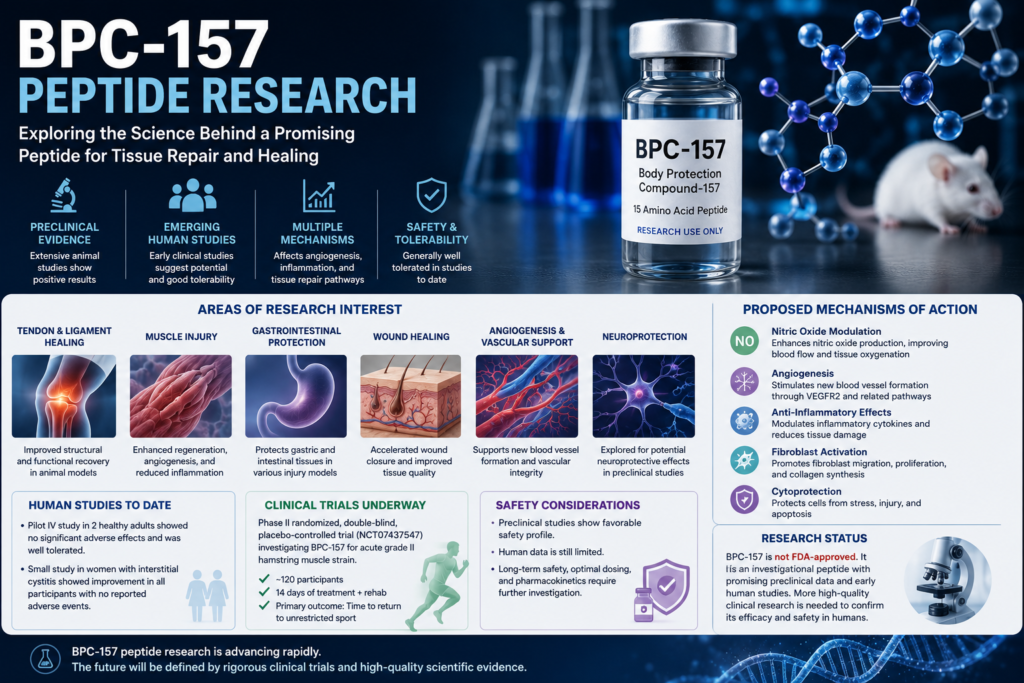
BPC-157, commonly referred to as Body Protection Compound-157, is a pentadecapeptide consisting of 15 amino acids.
The peptide has attracted scientific interest because experimental studies have associated it with processes involved in:
- Tissue repair
- Angiogenesis
- Vascular function
- Inflammatory signaling
- Fibroblast activity
- Gastrointestinal protection
- Musculoskeletal healing
- Cellular stress responses
BPC-157 was originally investigated in connection with gastric tissue and gastrointestinal biology. Over time, research expanded into models of soft-tissue injury and other physiological systems. BPC-157 Capsules vs Injectable BPC-157
The breadth of these findings has made BPC-157 an interesting experimental compound. At the same time, the number of biological effects reported in animal models should not be interpreted as proof of therapeutic effectiveness in humans. BPC-157 peptide research GHK-CU 100mg
What Does BPC-157 Peptide Research Show?
The current evidence can broadly be divided into preclinical research and human clinical research.
Preclinical BPC-157 research
Most BPC-157 studies have been performed using animals or laboratory models.
Researchers have investigated the peptide in experimental models involving:
- Tendon injury
- Ligament injury
- Muscle injury
- Bone injury
- Wound healing
- Gastrointestinal damage
- Inflammation
- Vascular dysfunction
- Neurological injury
A 2025 review focusing specifically on musculoskeletal healing reported that BPC-157 has demonstrated regenerative effects across numerous animal models and identified pathways involving VEGFR2, nitric oxide synthesis, Akt-eNOS signaling, ERK1/2, angiogenesis, fibroblast activity, and inflammatory responses. BPC-157 peptide research
These findings provide several hypotheses for further investigation.
They do not, however, establish that BPC-157 produces equivalent effects in humans. BPC-157 peptide research GHK-Cu Peptide Guide
BPC-157 peptide research and Tissue Repair
One of the most prominent areas of BPC-157 peptide research is tissue repair.
Experimental research has examined whether BPC-157 can influence biological processes involved in the response to tissue injury.
Tendon and ligament research
Tendon and ligament injuries are particularly relevant because these tissues have relatively limited vascularity and can heal slowly.
Preclinical BPC-157 studies have reported improvements in several measures of tendon and ligament healing, including structural and functional outcomes.
Proposed explanations include increased angiogenic activity, modulation of fibroblast responses, and changes in inflammatory signaling.
The evidence has been sufficiently interesting to support continued research, but the clinical significance remains uncertain.
The 2025 musculoskeletal review emphasized that the current literature is dominated by preclinical studies and that high-quality human trials are still required before BPC-157 can be considered an evidence-based treatment. BPC-157 peptide research Selank Peptide Benefits Explained
Muscle injury research
BPC-157 has also been studied in experimental models of skeletal-muscle injury.
Researchers have investigated potential effects on:
- Muscle regeneration
- Blood-vessel formation
- Inflammatory responses
- Neuromuscular function
- Structural recovery
These findings have contributed to interest in BPC-157 among sports-medicine researchers.
Importantly, experimental improvements in muscle injury models do not demonstrate faster recovery in athletes or other human populations.
That question requires controlled clinical trials using objective endpoints.
BPC-157 peptide research and Gastrointestinal Research
Gastrointestinal research is another major component of the BPC-157 literature.
Experimental studies have investigated BPC-157 in models involving gastrointestinal injury and inflammation. These studies have contributed to the hypothesis that BPC-157 may influence mucosal protection and repair.
The gastrointestinal research is scientifically important because it represents part of the original biological rationale for studying the peptide.
However, promising animal findings should not be confused with evidence that BPC-157 is an established treatment for gastrointestinal disorders.
Human trials with appropriate controls, validated endpoints, and adequate follow-up are necessary to determine whether these experimental effects translate clinically.
BPC-157 Mechanism of Action
The BPC-157 mechanism of action remains incompletely defined.
Rather than acting through one clearly established molecular target, research suggests that BPC-157 may influence several interconnected signaling pathways.
Angiogenesis and vascular signaling
One recurring finding in BPC-157 research involves angiogenesis—the formation of new blood vessels.
The 2025 musculoskeletal review described evidence involving VEGFR2 and nitric oxide signaling through the Akt-eNOS pathway. These mechanisms have been proposed as potential contributors to vascular and tissue-repair effects observed in experimental models.
Because adequate blood supply is important for tissue repair, modulation of angiogenic pathways is a plausible area of investigation.
Fibroblast activity
Fibroblasts play a central role in connective-tissue repair and extracellular-matrix production.
Experimental BPC-157 research has reported effects on fibroblast activity, providing another possible explanation for observations involving tendon and soft-tissue repair.
Again, the key translational question is whether these cellular effects occur at clinically relevant concentrations in humans.
Inflammatory signaling
BPC-157 has also been investigated for potential anti-inflammatory effects.
Researchers have reported changes in inflammatory mediators and cellular responses in experimental models.
Future studies need to determine whether these effects represent a direct pharmacological mechanism, a downstream consequence of tissue repair, or a combination of biological processes.
BPC-157 Human Studies
The human evidence for BPC-157 remains much smaller than the preclinical literature.
This is arguably the most important limitation when evaluating claims about the peptide.
Pilot study of intravenous BPC-157
A 2025 pilot study evaluated intravenous BPC-157 in two healthy adults.
Participants received escalating intravenous infusions over two days, with laboratory testing and vital-sign monitoring. The investigators reported no measurable changes in the tested cardiac, hepatic, renal, thyroid, or glucose biomarkers and reported that the infusions were tolerated without reported adverse effects.
However, the study included only two participants.
It therefore cannot establish general safety, much less efficacy. Larger studies with appropriate controls and longer follow-up are required.
BPC-157 and interstitial cystitis
Another small human study investigated BPC-157 in 12 women with interstitial cystitis who had not responded to pentosan polysulfate.
Participants received a single procedure involving injections around the inflamed bladder area. All 12 participants reported improvement on the study’s Global Response Assessment, and no adverse events were reported.
This is an interesting preliminary finding, but it was a small uncontrolled study.
Without a randomized placebo-controlled comparison, it is impossible to determine how much of the observed improvement was attributable specifically to BPC-157.
BPC-157 Clinical Trials
One of the most important developments in current BPC-157 peptide research is the emergence of controlled clinical trials.
ClinicalTrials.gov lists NCT07437547, a recruiting Phase II randomized, double-blind, placebo-controlled study investigating BPC-157 for acute grade II hamstring muscle strain.
The study plans to enroll approximately 120 participants.
Participants receive either investigational BPC-157 or placebo for 14 days alongside a standardized rehabilitation program.
The study’s primary outcomes include:
- Time to return to unrestricted sport
- Change in MRI-assessed hamstring injury volume
Additional outcomes include pain, hamstring strength, functional scores, and safety measures.
This type of study is particularly valuable because it addresses several weaknesses of the existing BPC-157 literature.
Instead of relying on animal models or uncontrolled observations, the trial uses:
- Randomization
- Placebo control
- Blinding
- Objective imaging
- Functional outcomes
- Standardized rehabilitation
- Prospective safety monitoring
Results from such trials will provide much stronger evidence about whether preclinical BPC-157 findings translate into clinically meaningful benefits.
BPC-157 peptide research Safety Research
Safety remains one of the largest unanswered questions.
Some animal studies have reported favorable tolerability, but animal safety findings cannot establish long-term safety in humans.
The FDA currently identifies BPC-157 among substances for which compounded drugs may present potential safety risks. Specifically, the agency notes concerns about immunogenicity for certain routes of administration, peptide-related impurities, active pharmaceutical ingredient characterization, and limited safety information for proposed routes.
This distinction is important.
Limited evidence of harm is not the same as demonstrated long-term safety.
Future BPC-157 safety research needs to investigate:
- Pharmacokinetics
- Repeated-dose exposure
- Immunogenicity
- Organ toxicity
- Reproductive effects
- Drug interactions
- Metabolism
- Tissue distribution
- Long-term adverse events
Is BPC-157 FDA Approved?
No.
BPC-157 is not an FDA-approved therapeutic drug.
FDA materials state that BPC-157 is not a component of an FDA-approved drug and that there is no applicable United States Pharmacopeia or National Formulary drug-substance monograph for BPC-157 free base or its acetate form.
The regulatory status should also be distinguished from the status of compounded products.
The FDA explains that compounded drugs are not FDA-approved and are not reviewed by the agency for safety, effectiveness, or quality before being marketed.
In July 2026, an FDA advisory committee discussed BPC-157 free base and BPC-157 acetate in the context of substances proposed for the 503A bulk-drug list, with ulcerative colitis among the uses evaluated. This was a regulatory advisory process, not an FDA approval of BPC-157 as a treatment. BPC-157 peptide research Tesamorelin + Ipamorelin
BPC-157 Peptide Research and Drug Development
Moving BPC-157 from experimental peptide research to an established therapeutic would require substantially more evidence.
Important development stages include:
1. Characterizing the molecule
Researchers need reproducible information about peptide identity, purity, stability, degradation products, and formulation.
2. Establishing pharmacokinetics
Human studies need to determine how BPC-157 is absorbed, distributed, metabolized, and eliminated.
3. Defining pharmacodynamics
Researchers need to establish which biological effects occur at which exposures and whether measurable biomarkers correlate with clinical outcomes.
4. Determining dose-response relationships
A clinically useful dose cannot simply be inferred from an animal experiment or anecdotal human use.
5. Conducting controlled efficacy trials
Randomized clinical trials must determine whether BPC-157 provides benefits beyond placebo and standard treatment.
6. Establishing long-term safety
Large populations and longer follow-up are necessary to identify uncommon or delayed adverse effects.
A 2026 review specifically identified formulation, pharmacokinetic-pharmacodynamic disconnects, dosing, and regulatory issues as significant barriers to BPC-157 development.
Key Limitations of Current BPC-157 peptide research
The existing literature has several recurring limitations.
Heavy reliance on animal models
Animal studies are valuable for identifying mechanisms and generating hypotheses, but many experimental therapies fail during human translation.
Small human studies
The currently available human studies involve very small numbers of participants.
The two-person intravenous pilot study is a clear example of why preliminary safety observations cannot establish population-level safety.
Lack of large randomized trials
The emergence of the Phase II hamstring trial is important precisely because much of the earlier evidence lacked this level of methodological rigor.
Uncertain pharmacology
Reliable human pharmacokinetic and pharmacodynamic information remains limited.
Product and formulation variability
Research findings obtained with a characterized investigational preparation cannot automatically be generalized to products from other sources. BPC-157 peptide research
Limited long-term safety data
There is currently insufficient evidence to characterize the risks associated with prolonged human exposure. BPC-157 peptide research