Semax and Selank: Research Peptides, Differences, Uses, and Scientific Background
Semax and Selank are synthetic peptides that have attracted scientific interest because of their effects on neurological, cognitive, stress-related, and neurochemical pathways. Although they are often discussed together online, they are distinct compounds with different amino-acid sequences and research histories. GHK-CU 100mg
For researchers exploring neuroactive peptides, comparing Semax vs Selank can help clarify their reported mechanisms, research applications, and differences. Selank
Research-use notice: Semax and Selank are investigational compounds and should not be presented as FDA-approved treatments for anxiety, depression, cognitive disorders, or other medical conditions. Research findings should not be interpreted as proof of clinical efficacy or safety for self-administration
What Are Semax and Selank?
Semax and Selank are short synthetic peptides developed and investigated primarily in Russia and other research settings.
What Is Semax?
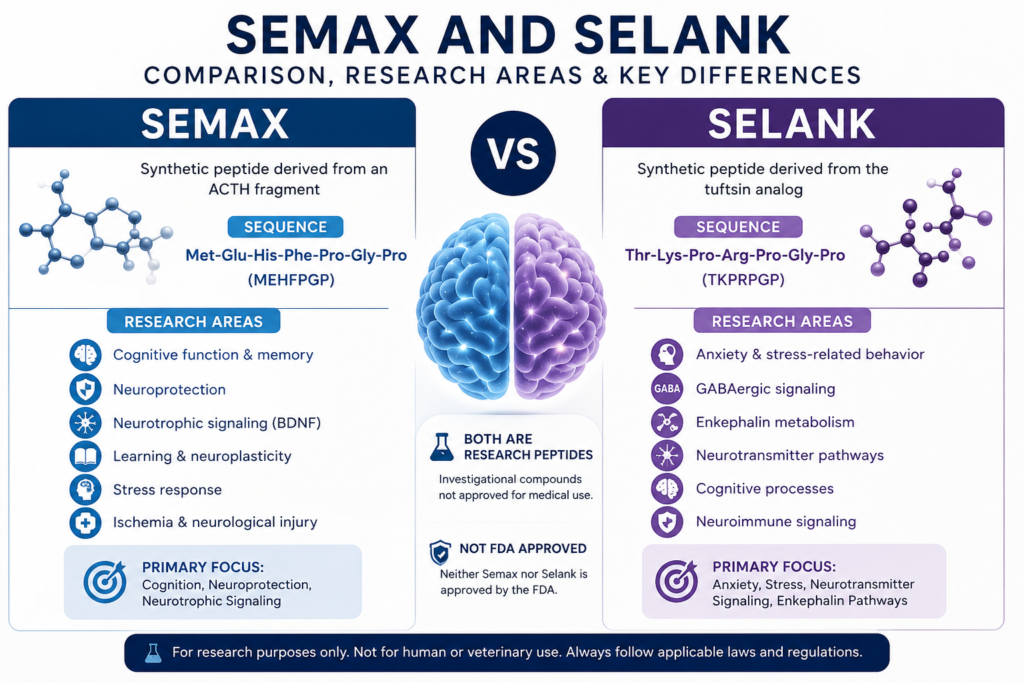
Semax is a synthetic peptide derived from a fragment of adrenocorticotropic hormone (ACTH). Its sequence is Met-Glu-His-Phe-Pro-Gly-Pro.
Research has investigated Semax in areas including:
- Cognitive function
- Neuroprotection
- Memory and learning
- Stress responses
- Neurotransmitter signaling
- Brain-derived neurotrophic factor (BDNF)
- Ischemia-related neurological research
Preclinical research has particularly examined Semax’s potential effects on neurotrophic and neuroprotective pathways.
What Is Selank?
Selank is a synthetic heptapeptide with the sequence Thr-Lys-Pro-Arg-Pro-Gly-Pro. It was developed as an analog of the naturally occurring peptide tuftsin.
Research involving Selank has focused on:
- Anxiety-related behavior
- Stress responses
- GABAergic signaling
- Enkephalin metabolism
- Neurotransmitter pathways
- Cognitive processes
- Neuroimmune signaling
Although both compounds are classified as research peptides, they have different molecular structures and have been investigated for different biological effects.
Semax vs Selank: Key Differences
The easiest way to understand these peptides is to compare their primary research areas.
| Feature | Semax | Selank |
|---|---|---|
| Peptide type | Synthetic heptapeptide | Synthetic heptapeptide |
| Sequence | Met-Glu-His-Phe-Pro-Gly-Pro | Thr-Lys-Pro-Arg-Pro-Gly-Pro |
| Original peptide relationship | ACTH fragment | Tuftsin analog |
| Major research areas | Cognition, neuroprotection, neurotrophic signaling | Anxiety, stress, neurotransmitter signaling |
| BDNF research | Frequently investigated | Less central to research |
| GABA-related research | Investigated | Frequently investigated |
| Anxiety research | Investigated | Major research area |
| Cognitive research | Major research area | Investigated |
| Status | Investigational | Investigational |
The table provides a general overview of research directions and should not be interpreted as evidence that one compound is clinically superior to the other.
How Does Semax Work?
The exact biological mechanisms of Semax continue to be investigated.
Preclinical studies have examined its effects on several neurological pathways, including neurotrophic signaling and the expression of genes associated with neuronal function.
One area of interest is brain-derived neurotrophic factor (BDNF). Research has investigated whether Semax can influence BDNF-related signaling, which is important in studies of neuronal plasticity, learning, and memory.
Semax has also been studied in experimental models involving oxidative stress, inflammation, ischemia, and neuronal injury.
These findings are primarily preclinical and should not be translated directly into claims about human treatment outcomes.
How Does Selank Work?
Selank has been investigated through several proposed mechanisms.
One research area involves enkephalin metabolism. Laboratory research has found that Selank can inhibit enzymes involved in the breakdown of endogenous enkephalins.
Researchers have also investigated Selank’s relationship with GABAergic neurotransmission, serotonin metabolism, and immune-related signaling.
These mechanisms may help explain why Selank has been studied in connection with stress and anxiety-related pathways.
However, the precise mechanism responsible for any effects observed in humans remains an area of scientific investigation.
Semax and Cognitive Research
Semax has received considerable attention in research involving learning, memory, and neuroprotection.
Animal and laboratory studies have examined whether Semax can affect:
- Memory formation
- Learning processes
- Neurotrophic signaling
- Neuronal survival
- Oxidative stress
- Inflammatory pathways
- Brain recovery following experimental injury
Its relationship with BDNF and other neurotrophic pathways has been an important research topic.
For this reason, Semax is often discussed in scientific literature involving cognitive neuroscience and neuroprotection.
Selank and Cognitive Research
Selank has also been investigated in relation to cognition and memory, although its research profile is more strongly associated with anxiety and stress-related mechanisms.
Preclinical studies have examined potential effects on:
- Learning
- Memory consolidation
- Neurotransmitter metabolism
- Serotonergic pathways
- Stress-related behavior
This makes Selank another compound of interest for researchers investigating the relationship between peptide signaling and cognitive processes.
Semax vs Selank for Anxiety Research
One of the biggest differences between the two peptides is their research emphasis.
Selank has a stronger research history surrounding anxiety and stress-related pathways.
Human studies have investigated Selank in patients with anxiety-related conditions, while preclinical research has examined its effects on neurotransmitter and neurochemical systems.
Semax has also been investigated in stress-related and neurological models, but its research profile is more commonly associated with neuroprotection, cognition, and neurotrophic signaling.
This distinction is useful when reviewing the scientific literature.
Importantly, neither peptide should be promoted as an approved treatment for anxiety.
Semax and Selank for Neuroprotection Research
Semax has been extensively investigated in experimental models of neurological injury and neuroprotection.
Researchers have examined its potential effects on mechanisms associated with:
- Oxidative stress
- Inflammation
- Neuronal damage
- Neurotrophic signaling
- Cerebral ischemia
Selank has also been studied in neurological and neuroimmune contexts, but its research profile differs from Semax.
Therefore, researchers interested specifically in neuroprotection may encounter more Semax-focused literature, while researchers examining anxiety, stress, or GABA-related signaling may encounter more Selank research.
Can Semax and Selank Be Used Together?
Semax and Selank are sometimes discussed together because both are synthetic neuroactive peptides.
However, the fact that two compounds are researched individually does not establish that combining them is safe or effective.
There is insufficient high-quality evidence to recommend combining Semax and Selank for self-administration. Potential interactions, appropriate dosing, long-term safety, product purity, and formulation differences require careful scientific evaluation.
For research purposes, each compound should be evaluated according to an appropriate experimental protocol.
Semax vs Selank: Which Is Better?
There is no scientifically established answer that one peptide is universally “better.”
The two compounds have different research profiles:
Semax is particularly associated with research into:
- Neuroprotection
- Cognitive processes
- Memory and learning
- BDNF-related signaling
- Neurological injury models
Selank is particularly associated with research into:
- Anxiety-related behavior
- Stress responses
- GABAergic signaling
- Enkephalin metabolism
- Neuroimmune pathways
The appropriate research compound therefore depends on the biological question being investigated.
Semax and Selank Safety Considerations
Safety is an important consideration when evaluating any investigational peptide.
Research compounds may differ substantially in purity, formulation, manufacturing quality, and analytical characterization.
Researchers should consider:
- Peptide identity
- Purity percentage
- Certificate of analysis
- Batch information
- Analytical testing
- Storage requirements
- Potential contaminants
- Applicable regulatory requirements
Online claims about peptide safety should also be evaluated carefully because anecdotal reports are not equivalent to controlled clinical evidence. what is BPC-157?
Regulatory Status
Semax and Selank should not be marketed as FDA-approved medications.
In particular, the FDA has identified concerns surrounding compounded selank acetate, including potential immunogenicity and peptide-related impurities.
This is important for websites selling research materials. Product descriptions should clearly distinguish research use from approved medical applications and avoid unsupported claims such as “treats anxiety,” “cures depression,” or “improves memory.”