What Is Dihexa Peptide? A Research-Based Guide to Dihexa
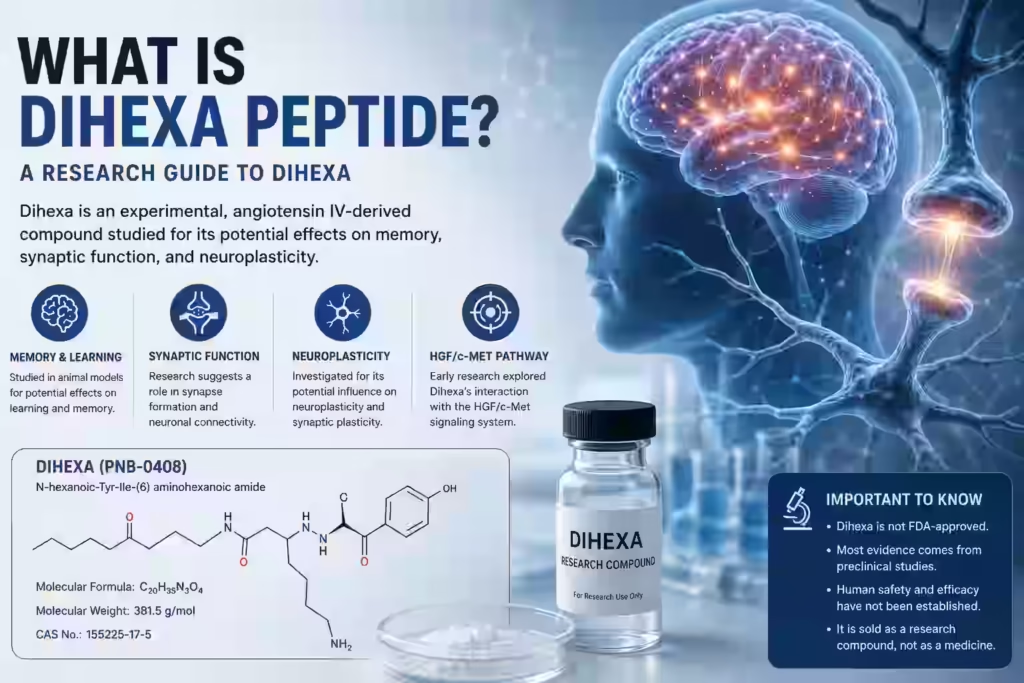
Dihexa peptide is a term commonly used online to describe an experimental compound investigated for its potential effects on memory, synaptic function, and neuroplasticity. Scientifically, however, Dihexa is more accurately described as an angiotensin IV-derived peptidomimetic or small peptide-derived compound, rather than a conventional peptide. Dihexa Peptide
what is dihexa peptide Also known as N-hexanoic-Tyr-Ile-(6) aminohexanoic amide and PNB-0408, Dihexa has been studied primarily in laboratory and animal research. Researchers have investigated its relationship with pathways involved in neuronal signaling and cognitive function. dihexa peptide benefits
Importantly, what is dihexa peptide is not an FDA-approved medication, and there is no established human clinical evidence demonstrating that it improves memory, cognition, or neurological health. what does dihexa do
What Is Dihexa Peptide?
Dihexa is a synthetic compound derived from research into angiotensin IV (Ang IV) and its effects on the brain.
The compound was developed as researchers investigated ways to create more stable analogs of angiotensin-related molecules. Unlike naturally occurring peptides that can be rapidly broken down by enzymes, Dihexa was designed with chemical modifications intended to improve stability and allow it to reach the central nervous system.
The U.S. National Library of Medicine’s MeSH database identifies Dihexa by its chemical name, N-hexanoic-Tyr-Ile-(6) aminohexanoic amide, and classifies the substance under oligopeptides.
The FDA’s substance database also lists Dihexa under several chemical identifiers, including PNB-0408 and its systematic chemical names. what is dihexa peptideBronchogen
Is Dihexa Actually a Peptide?
This is an important distinction.
Dihexa is frequently called a research peptide because it is derived from peptide-based research and contains amino-acid-derived structural components. However, its modified structure means that describing it simply as a conventional peptide can be misleading.
Dihexa was developed from research surrounding angiotensin IV, a naturally occurring peptide. Its structure was modified to produce a more stable compound with different pharmacological characteristics.
For SEO purposes, the phrase “Dihexa peptide” is widely used, but scientifically it is more precise to describe Dihexa as an angiotensin IV-derived peptidomimetic compound. what is dihexa peptideACE-031
What Is Dihexa Derived From?
Dihexa originated from research into angiotensin IV, a peptide associated with the renin-angiotensin system.
Scientists became interested in angiotensin IV because experimental research suggested that certain angiotensin IV analogs could influence learning and memory in animal models.
Researchers subsequently developed modified analogs designed to overcome limitations associated with naturally occurring peptides. Dihexa emerged from this research program as an orally active, brain-penetrant compound investigated for potential effects on cognitive processes. what is dihexa peptideTB-500
How Does Dihexa Work?
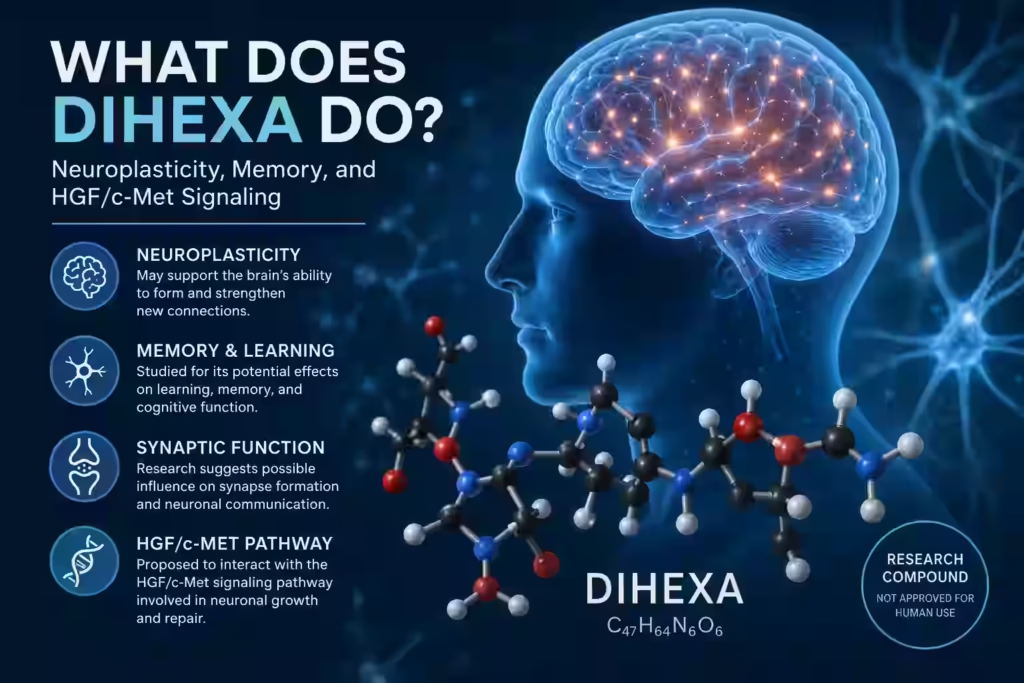
Early research proposed that Dihexa could influence the hepatocyte growth factor (HGF)/c-Met signaling system.
HGF is a growth factor involved in several biological processes, while c-Met is its receptor. In the nervous system, HGF/c-Met signaling has been investigated for its relationship with neuronal development, synaptic function, and neuroplasticity.
A 2014 study reported that Dihexa interacted with HGF and increased HGF-dependent c-Met signaling, with associated effects on hippocampal spinogenesis and synaptogenesis in laboratory models.
However, there is an important scientific qualification: that 2014 paper was formally retracted in 2025 following a Washington State University investigation that identified falsified and/or fabricated data in specified figures. Consequently, the frequently repeated HGF/c-Met mechanism should be presented as a proposed mechanism requiring independent confirmation, rather than as an established fact. what is dihexa peptideCerebrolysin
Dihexa and Neuroplasticity
Neuroplasticity refers to the brain’s ability to change its structure and connections in response to learning, experience, and other stimuli.
Synapses are critical to this process because they allow neurons to communicate with one another. Researchers have therefore investigated whether compounds affecting growth-factor pathways might influence synaptic formation and neuronal connectivity.
Early Dihexa research reported effects involving dendritic spine formation and synaptogenesis in experimental models. These findings helped generate interest in Dihexa as a potential research compound for studying cognitive processes.
However, laboratory evidence should not be interpreted as proof that Dihexa enhances neuroplasticity in humans. what is dihexa peptide cagrisema
Dihexa and Memory Research
One of the primary reasons Dihexa has attracted attention is its connection to memory research.
Early animal studies investigated angiotensin IV-derived compounds in models of learning and memory. Dihexa was subsequently studied as a more stable analog capable of entering the brain.
Research has reported cognitive effects in certain animal models, including experiments involving spatial learning and memory.
More recent preclinical work has continued investigating Dihexa in animal models of cognitive impairment. These studies are scientifically interesting, but they remain preclinical evidence.
There is currently no adequate human clinical evidence demonstrating that Dihexa improves memory in people. what is dihexa peptideGHK-CU 100mg
What Are the Potential Benefits of Dihexa?
Online discussions often associate Dihexa with several potential cognitive or neurological benefits. The scientific literature, however, supports describing these as research areas rather than established benefits.
Areas investigated include:
- Memory and learning
- Synaptic plasticity
- Dendritic spine formation
- Neuronal connectivity
- Cognitive impairment models
- HGF/c-Met-related signaling
- Neurobiological mechanisms associated with Alzheimer’s disease
Animal research has produced findings that warrant further investigation, but results in rodents or cell cultures cannot automatically be translated into human therapeutic benefits. what is dihexa peptide Selank
Is Dihexa FDA Approved?
No. Dihexa is not FDA approved.
The FDA’s substance database identifies Dihexa as a substance and lists its chemical identifiers, but inclusion in a substance database does not mean that the FDA has approved the compound as a drug or treatment.
Dihexa should therefore be regarded as an experimental research compound, not an established treatment for Alzheimer’s disease, dementia, memory loss, or other neurological conditions. what is dihexa peptidewhat is in glow peptide
Has Dihexa Been Tested in Humans?
Human evidence is a major limitation of the current Dihexa literature.
Most of the research discussed in connection with Dihexa involves cellular experiments and animal models. The commonly cited early literature investigated cognitive and neurological effects in laboratory animals rather than human participants.
This means that important questions about human pharmacokinetics, effectiveness, appropriate clinical dosing, interactions, and long-term safety remain unanswered.
A positive animal study is an important starting point for drug research, but it is not equivalent to a successful human clinical trial. what is dihexa peptideGlow Peptide
Why Is Dihexa Research Controversial?
The current evidence base deserves additional caution because important papers underlying the original Dihexa mechanism have been retracted.
The 2014 paper linking Dihexa’s procognitive and synaptogenic effects to the HGF/c-Met system was retracted in 2025 after a Washington State University investigation found falsified and/or fabricated data in specified figures.
This does not prove that Dihexa has no biological activity. A retraction means that specific published evidence can no longer be relied upon as valid scientific support.
The distinction is important:
Retracted evidence is not evidence of failure, but it should not be presented as reliable proof of efficacy or mechanism.
This is especially relevant when evaluating online articles that repeat older claims about Dihexa without mentioning the subsequent retractions. what is dihexa peptideSermorelin
What Does Current Dihexa Research Actually Tell Us?
The most accurate way to characterize Dihexa today is as an experimental research compound with interesting preclinical findings but substantial scientific uncertainty.
Research has investigated its relationship with:
- Angiotensin IV-derived signaling
- HGF/c-Met biology
- Synaptic formation
- Neuronal connectivity
- Learning and memory
- Animal models of cognitive impairment
At the same time, the evidence base has important limitations, including the lack of established human clinical efficacy and the retraction of key mechanistic research.
Consequently, claims that Dihexa is a proven cognitive enhancer, memory treatment, or neuroregenerative therapy go beyond the available evidence. what is dihexa peptidebronchogen dosage
Dihexa vs. Other Research Peptides
Dihexa is sometimes grouped together with compounds such as Semax, Selank, BPC-157, and other substances marketed online as research peptides.
However, these compounds are chemically and pharmacologically different.
Dihexa is particularly notable because it originated from angiotensin IV research rather than from the same peptide-development pathways as many other compounds commonly marketed as research peptides.
Comparing these substances solely because they are all called “peptides” can therefore be misleading. Their structures, mechanisms, research histories, and evidence levels can be substantially different. what is dihexa peptidewhere to buy bpc 157 peptide
Is Dihexa Safe?
The human safety profile of Dihexa has not been adequately established.
Because human clinical data are lacking, it is not possible to make reliable conclusions about long-term safety, adverse effects, drug interactions, or appropriate therapeutic use in people.
This is particularly important when reading commercial websites that describe experimental compounds using language such as “cognitive enhancer,” “memory peptide,” or “neuroregenerative compound.” Such terminology may describe a marketing position rather than an established clinical indication. what is dihexa peptidebpc 157 benefits
Frequently Asked Questions About Dihexa Peptide
What is Dihexa peptide?
Dihexa is an experimental angiotensin IV-derived compound also known as N-hexanoic-Tyr-Ile-(6) aminohexanoic amide and PNB-0408. It is commonly called a research peptide, although its modified structure is more accurately described as a peptidomimetic or peptide-derived compound.
What is Dihexa used for?
Dihexa is primarily discussed in the context of laboratory research involving memory, synaptic function, neuroplasticity, and signaling pathways such as HGF/c-Met. It is not an FDA-approved treatment for any medical condition.
Does Dihexa improve memory?
Animal studies have reported cognitive effects associated with Dihexa and related angiotensin IV analogs. However, there is insufficient human evidence to conclude that Dihexa improves memory in people.
Does Dihexa increase neuroplasticity?
Preclinical studies have investigated Dihexa’s potential effects on synaptic formation and neuronal connectivity. However, claims about increased neuroplasticity in humans remain unproven.
Is Dihexa a natural peptide?
No. Dihexa is a synthetic compound derived from research involving angiotensin IV. It is not a naturally occurring human peptide.