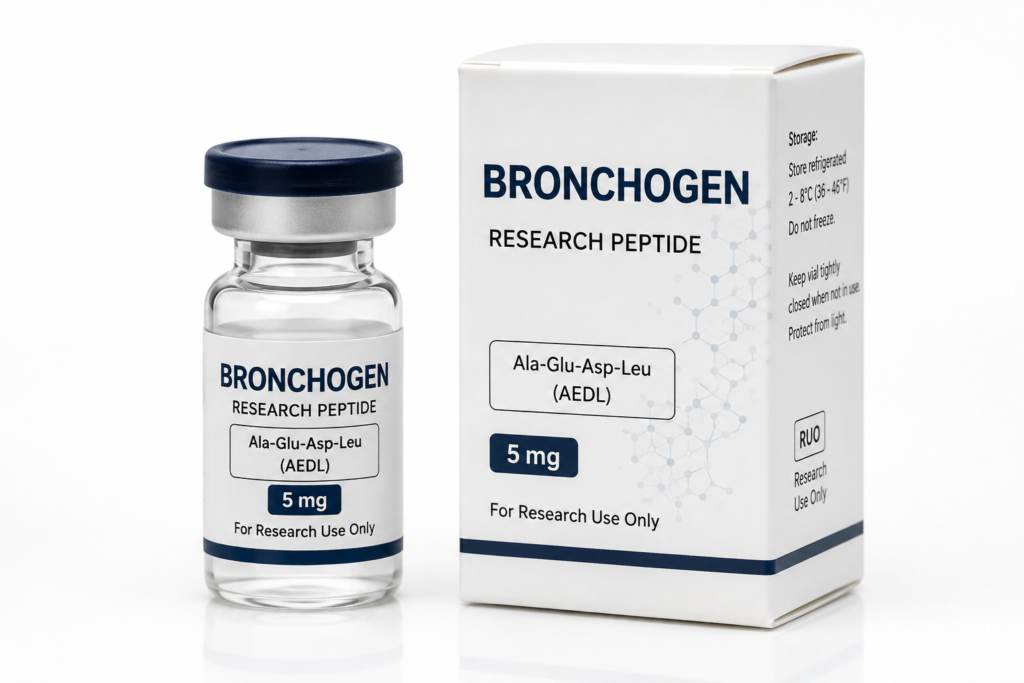
bronchogen dosage: What Research Shows About Experimental Peptide Dosing
Bronchogen dosage is a common search topic among people researching experimental peptides and respiratory-focused peptide bioregulators. However, determining an appropriate human dose is difficult because Bronchogen has not been established as an approved human medicine and does not have a validated human dosing regimen. Bronchogen
The available scientific literature primarily involves cell-culture, biochemical, and animal research. Experimental concentrations used in these studies should not be converted into a human dosage or used as instructions for self-administration. bronchogen peptide benefits
This article explains what is known about Bronchogen dosage from published research, what remains unknown, and why experimental research doses should be interpreted carefully. Bpc-157 + TB-500
Important: Bronchogen is an experimental research peptide. There is no established human therapeutic dose, and preclinical research does not establish a safe or effective dosage for people.
What Is Bronchogen?
Bronchogen is generally described in the scientific literature as a short synthetic tetrapeptide associated with research into bronchial and respiratory tissue biology.
One important point when researching Bronchogen is that the peptide sequence has been reported with different amino-acid orders in the literature. A 2011 study identifies Bronchogen as Ala-Asp-Glu-Leu, while other literature has used Ala-Glu-Asp-Leu. Researchers should therefore verify the precise molecular identity of the material being studied.
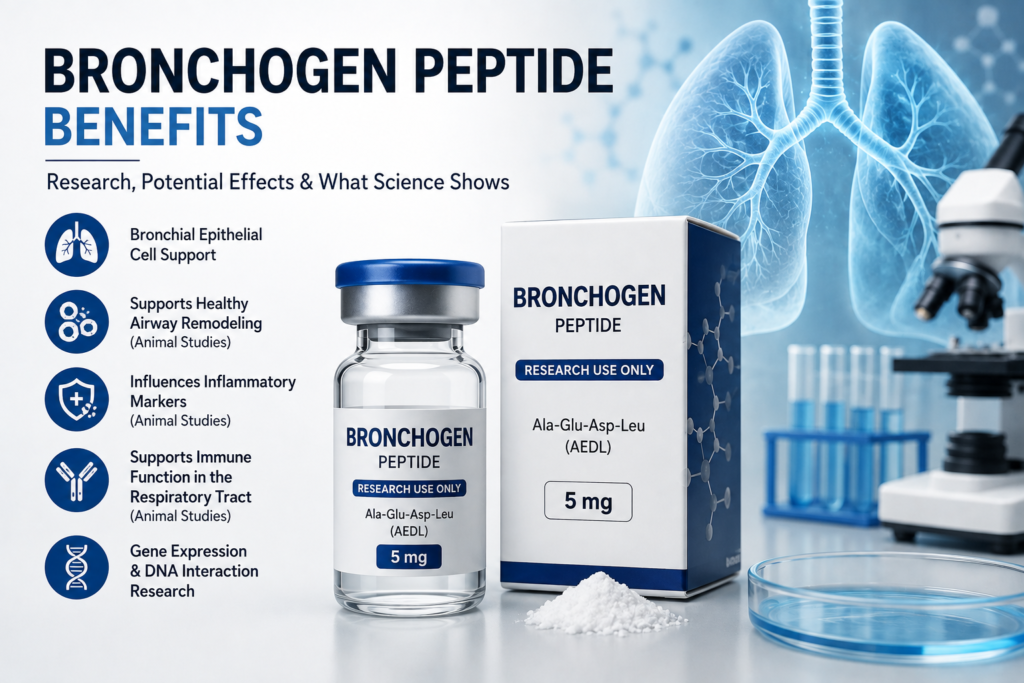
Research involving Bronchogen has examined:
- Bronchial epithelial cells
- Cellular differentiation
- Gene expression
- Airway tissue remodeling
- Inflammatory processes
- DNA–peptide interactions
- Experimental obstructive lung pathology
Is There an Established Bronchogen Dosage?
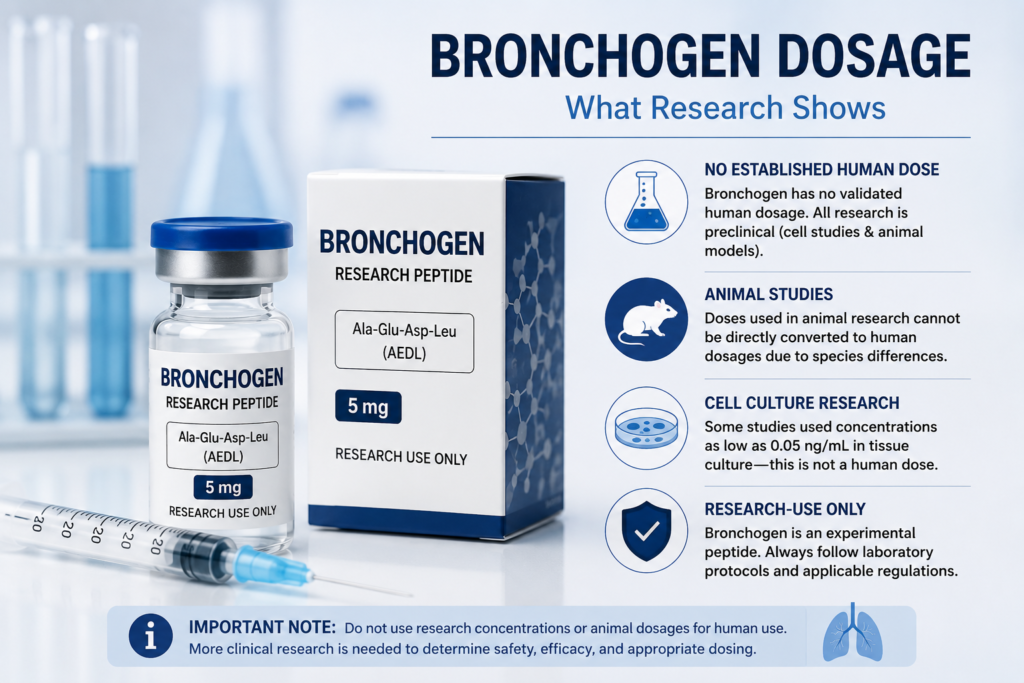
No. There is currently no established human therapeutic dosage for Bronchogen.
This is the most important point for anyone searching for terms such as:
- Bronchogen dosage
- Bronchogen peptide dosage
- Bronchogen dose
- How much Bronchogen to take
- Bronchogen dosing protocol
- Bronchogen injection dosage
Published experimental studies do not provide a validated human dosing schedule.
A dose used in an animal experiment or concentration used in a cell culture is designed for that specific research model. It cannot automatically be translated into a dose for humans. Glow Peptide
What Dosages Have Been Used in Bronchogen Research?
Some experimental studies have reported specific research concentrations, but these should not be confused with human therapeutic doses.
For example, a study examining synthetic tissue-specific peptides in organotypic cultures of young and aged rats reported an effective concentration of 0.05 ng/mL for the peptides tested, including Bronchogen. The experiment involved tissue cultures rather than human administration.
This is an in-vitro experimental concentration, not a recommended human dose.
The distinction matters because concentrations in a culture dish cannot simply be converted into an injectable, oral, or other human dosage. Glow Blend (TB 10mg + BPC 10mg + GHK 50mg)
Bronchogen Dosage in Animal Research
Bronchogen has also been studied in animal models of respiratory disease.
A study published in Russian Journal of Physiology investigated the effects of the tetrapeptide Bronchogen in rats with experimentally induced obstructive lung pathology. Researchers evaluated changes in bronchial epithelial structure and inflammatory activity.
Animal studies can help researchers investigate:
- Biological activity
- Dose-response relationships
- Potential mechanisms
- Tissue effects
- Pharmacological characteristics
- Preliminary safety signals
However, animal dosing cannot be directly translated into a human regimen without appropriate pharmacokinetic, toxicology, and clinical studies.
Why You Shouldn’t Convert an Animal Dose Into a Human Dose
It can be tempting to take an experimental animal dose and calculate an equivalent amount for a person.
That approach is unreliable for peptide research.
Differences between species can affect:
- Metabolism
- Absorption
- Distribution
- Clearance
- Protein binding
- Receptor activity
- Tissue exposure
- Immune responses
- Toxicity
Even when researchers use established methods for estimating equivalent exposures between species, the result is not automatically a clinically appropriate human dose.
A validated human dose requires dedicated pharmacokinetic, pharmacodynamic, safety, and clinical research.
Bronchogen Dosage and Cell-Culture Research
Cell-culture experiments provide another important example of why dosage information can be misleading online.
When Bronchogen is added to cultured cells, researchers typically report a concentration, such as nanograms per milliliter, rather than a human dose.
The 0.05 ng/mL concentration reported in an organotypic tissue-culture experiment represents the concentration surrounding experimental tissue under controlled laboratory conditions.
It does not indicate how much Bronchogen a person should receive.
Factors such as cellular uptake, peptide stability, distribution, metabolism, and exposure time can be completely different in a living organism.
Bronchogen and DNA Research
Bronchogen has also been investigated in biochemical experiments involving DNA.
One study examined the effect of Bronchogen on DNA thermostability and reported an increase in DNA melting temperature of approximately 3.1°C within a narrow experimental peptide-to-DNA ratio range.
This type of study provides information about a potential molecular interaction under controlled laboratory conditions.
It does not establish a therapeutic dosage or demonstrate that the same interaction occurs in humans after administration.
Does More Bronchogen Mean Better Results?
There is no established evidence showing that increasing Bronchogen exposure produces better outcomes in humans.
In fact, assuming that a higher dose produces a stronger or better effect can be particularly problematic with experimental compounds.
Biological responses can be:
- Dose-dependent
- Nonlinear
- Saturable
- Tissue-specific
- Biphasic
- Limited by toxicity
Without human dose-ranging studies, it is impossible to determine the dose that would provide an appropriate balance between exposure, biological activity, and safety.
Bronchogen Dosage vs. Clinical Peptide Dosing
Bronchogen should not be confused with approved peptide medicines that have established prescribing information.
Approved medications typically undergo a structured development process involving:
- Preclinical pharmacology
- Toxicology testing
- Pharmacokinetic studies
- Phase 1 safety studies
- Dose-ranging studies
- Phase 2 efficacy studies
- Phase 3 clinical trials
- Regulatory review
- Post-marketing safety monitoring
Bronchogen does not currently have the same level of clinical evidence establishing a human dosing regimen. how to take bpc 157 and tb 500
Is There a Standard Bronchogen Injection Dose?
No established standard human injection dose exists.
Online sources may list amounts in micrograms or milligrams, but the existence of a number on a website does not mean that it represents a scientifically validated human dosage.
Researchers should distinguish between:
- Published experimental concentrations
- Animal-study administration levels
- Laboratory protocols
- Vendor product specifications
- Human clinical dosing
These categories are not interchangeable.
Bronchogen Dosage and Research Purposes
For legitimate laboratory research, the appropriate concentration depends on the specific experimental model and research objective.
Researchers may investigate variables such as:
- Concentration-response relationships
- Exposure duration
- Cellular uptake
- Tissue-specific activity
- Molecular signaling
- Peptide stability
- Pharmacodynamic markers
The appropriate experimental conditions should be determined from validated protocols and relevant scientific literature rather than from generalized human dosing claims found online. bpc-157 tb-500 blend dosage calculator
bronchogen dosage and safety
The lack of a validated human dosage also means that the human safety profile remains incompletely characterized.
Important unanswered questions include:
- What exposure level is safe in humans?
- How long does Bronchogen remain active?
- How is it metabolized?
- How is it eliminated?
- What dose produces measurable biological activity?
- What dose could cause adverse effects?
- Does the route of administration change its activity?
- Are there clinically relevant drug interactions?
These questions require dedicated human research.
Does Bronchogen Have a Half-Life?
A reliable, clinically established human half-life for Bronchogen has not been established in the available evidence reviewed here.
Peptide half-life can depend on factors including:
- Molecular structure
- Protease degradation
- Route of administration
- Renal clearance
- Tissue distribution
- Chemical modifications
- Formulation
Therefore, assumptions about Bronchogen’s duration of action should not be used to construct a human dosing schedule. bronchogen dosage 5-Amino-1MQ
Bronchogen Dosage for Lung Conditions
Bronchogen has attracted attention because experimental research has focused on bronchial and lung-related models.
In an animal model of obstructive lung pathology, researchers reported effects involving bronchial epithelial structure and inflammatory activity.
However, these findings do not establish a dosage for treating:
- COPD
- Asthma
- Bronchitis
- Emphysema
- Respiratory inflammation
- Lung injury
- Other pulmonary conditions
There are currently no established human dosing guidelines demonstrating that Bronchogen is an effective treatment for these diseases.
Does Bronchogen Have a Recommended Dose?
No clinically recommended dose has been established.
The safest interpretation of the current evidence is that Bronchogen remains a research compound, and experimental concentrations should remain within the context of the specific laboratory or preclinical protocol in which they were studied. bronchogen dosage ACE-031