
Bronchogen Peptide Benefits: What the Research Really Shows
Bronchogen peptide benefits have become an area of interest among people researching experimental peptides and respiratory biology. Bronchogen is a short synthetic peptide that has been investigated in laboratory and animal studies involving bronchial epithelial cells, gene expression, airway tissue remodeling, inflammation, and local respiratory immune function. Bronchogen
Unlike established respiratory medications, Bronchogen does not have a well-established body of human clinical evidence demonstrating that it can treat lung disease. Most of the available research is preclinical, meaning the findings come from cell cultures, biochemical experiments, and animal models. GHK-CU 100mg
This article examines what researchers have actually observed and explains which potential bronchogen peptide benefitsremain theoretical. Glow Peptide
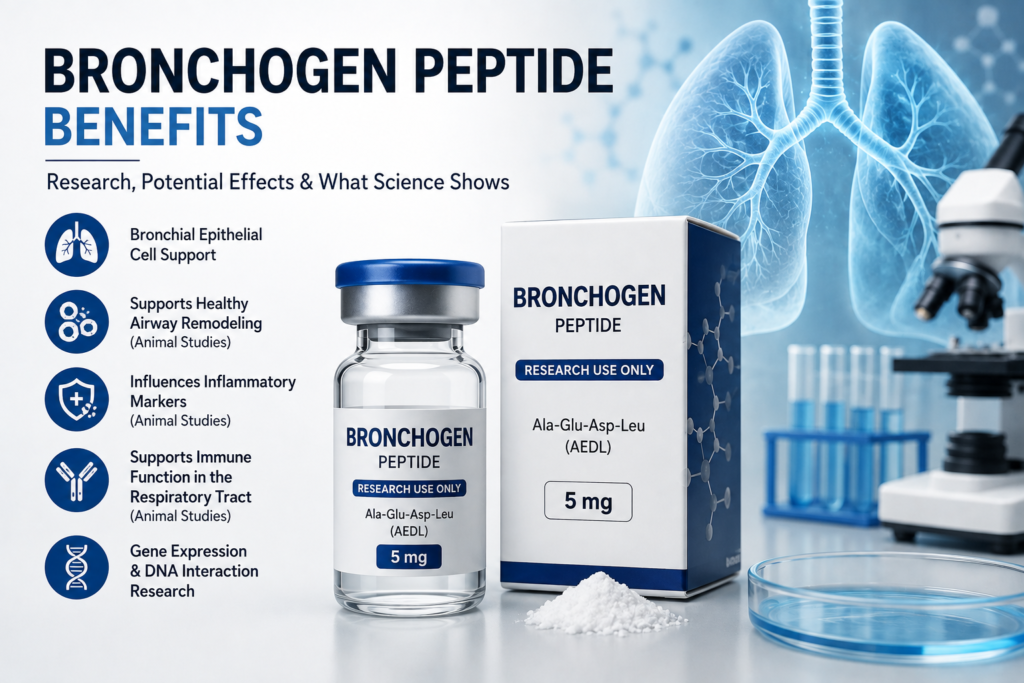
What Is Bronchogen Peptide?
Bronchogen is generally described as a short-chain tetrapeptide. The scientific literature most commonly identifies it as Ala-Glu-Asp-Leu (AEDL), although other publications have reported the sequence as Ala-Asp-Glu-Leu (ADEL). Researchers evaluating the compound should therefore verify the exact sequence and analytical identity of the material being studied.
Bronchogen has been investigated as part of a broader research program involving short peptides and tissue-specific biological effects.
Its research profile is particularly focused on the bronchial epithelium, making it different from experimental peptides primarily studied for metabolic, growth-hormone, or neurological pathways. ipamorelin peptide
What Are the Potential Bronchogen Peptide Benefits?
When discussing Bronchogen peptide benefits, it is important to distinguish experimental findings from clinically proven benefits.
Research has investigated Bronchogen in relation to:
- Bronchial epithelial cell differentiation
- Gene-expression regulation
- Bronchial epithelial structure
- Airway tissue remodeling
- Inflammatory signaling
- Secretory IgA and local immune function
- DNA–peptide interactions
These findings are scientifically interesting, but they have not established Bronchogen as a human treatment for respiratory disease. 5-Amino-1MQ
1. Bronchial Epithelial Research
One of the most relevant areas of Bronchogen research involves bronchial epithelial cells.
A study published in Bulletin of Experimental Biology and Medicine examined short peptides in cultured human cells and found that Bronchogen stimulated expression of the differentiation-associated factors CXCL12 and Hoxa3 in bronchial epithelial cell cultures. The effect was particularly pronounced in older cell cultures used in the experiment.
This finding is significant from a research perspective because the bronchial epithelium plays an important role in maintaining the airway’s protective barrier and normal respiratory function.
However, this was an in-vitro study, meaning the experiment was conducted using cultured cells rather than people. It therefore cannot demonstrate that Bronchogen improves lung function or respiratory health in humans. bronchogen peptide benefits bpc 157 peptide
2. Potential Effects on Bronchial Cell Differentiation
Cell differentiation is another reason researchers have become interested in Bronchogen.
The bronchial epithelium contains several specialized cell types that contribute to airway defense and function. Research involving Bronchogen has examined whether short peptides can influence the expression of genes associated with maintaining these specialized characteristics.
A separate study examining the peptide ADEL reported effects on proteins and genes involved in bronchial epithelial proliferation and differentiation, including Ki67, Mcl-1, p53, NKX2-1, SCGB1A1, SCGB3A2, FOXA1, and FOXA2. The study also investigated expression of MUC4, MUC5AC, and SFTPA1.
These results have contributed to the hypothesis that short peptides may influence the functional state of bronchial epithelial cells.
Further research is necessary to determine whether these laboratory effects translate into meaningful physiological effects in humans.
3. Research Into Airway Tissue Remodeling
Another potential Bronchogen benefit identified in preclinical research involves airway tissue remodeling.
In a rat model of obstructive lung pathology, researchers administered Bronchogen and evaluated changes in bronchial epithelial structure. The study reported reductions in several pathological changes, including goblet-cell hyperplasia, squamous metaplasia, lymphocytic infiltration, and emphysematous changes, along with restoration of ciliated-cell populations.
These findings are potentially important because airway remodeling is associated with chronic respiratory pathology.
However, the study involved rats with experimentally induced lung pathology, not patients with naturally occurring COPD or another human respiratory disease.
Therefore, the results should be viewed as evidence supporting further research rather than proof of a therapeutic effect.
4. Bronchogen and Inflammatory Research
Inflammation is another area in which Bronchogen has been investigated.
In the same rat study, researchers reported changes in the cellular composition and pro-inflammatory cytokine and enzyme profiles of bronchoalveolar lavage fluid following experimental treatment. The authors interpreted the findings as a reduction in neutrophilic inflammatory activity.
This provides a potential mechanism for future research into how short peptides may interact with inflammatory processes in respiratory tissue.
It is important to emphasize that an anti-inflammatory effect observed in an animal model does not establish Bronchogen as an anti-inflammatory treatment for humans. Glow Blend (TB 10mg + BPC 10mg + GHK 50mg)
5. Potential Effects on Local Respiratory Immunity
Bronchogen has also been studied in relation to secretory immunoglobulin A (IgA).
IgA is an important component of mucosal immunity, including the respiratory tract. In the rat obstructive-lung model, researchers reported increased secretory IgA following Bronchogen treatment.
This finding is interesting because healthy bronchial epithelial function is closely connected to the airway’s barrier and immune functions.
Nevertheless, additional research would be needed to determine whether comparable effects occur in humans and whether any such changes produce meaningful clinical outcomes.
6. Bronchogen and Gene Expression
Gene-expression research represents another major area of interest.
The bronchial epithelium is a biologically active tissue that regulates barrier function, cellular differentiation, inflammatory signaling, and interactions with the immune system.
Research involving Bronchogen and related short peptides has investigated changes in genes associated with bronchial epithelial differentiation. One study reported that ADEL affected the expression of several genes involved in maintaining bronchial epithelial characteristics.
This has led researchers to investigate whether short peptides could act as signaling molecules capable of influencing cellular activity at the gene-expression level.
However, these mechanisms remain an area of scientific investigation rather than an established therapeutic pathway. bronchogen peptide benefits Tesofensine Peptide
7. Bronchogen and DNA Interaction Research
Bronchogen has also been examined directly in biochemical experiments involving DNA.
One study found that Bronchogen increased the melting temperature of DNA by approximately 3.1°C under a specific range of experimental peptide-to-DNA ratios. The researchers interpreted the result as evidence of a DNA-stabilizing interaction.
Another study examining short peptides reported that Bronchogen could interact with particular DNA sequences in laboratory conditions.
These findings are relevant to research into peptide-mediated regulation of cellular processes, but they should not be interpreted as evidence that Bronchogen changes human DNA or provides a clinical bronchogen peptide benefits. bpc 157 peptide

Bronchogen and Lung Health: What Does the Evidence Mean?
The respiratory focus of Bronchogen research explains why the peptide is sometimes described online as a “lung peptide” or “lung-support peptide.”
The available research does provide a scientific rationale for investigating Bronchogen in respiratory models. Studies have explored bronchial epithelial differentiation, airway remodeling, inflammatory signaling, and local immune markers.
However, there is an important difference between research relevance and clinical effectiveness.
There are currently no established human clinical trials demonstrating that Bronchogen improves lung function, treats COPD, reverses emphysema, or prevents respiratory disease. bronchogen peptide benefits TB-500
Does Bronchogen Help With COPD?
Bronchogen has been investigated in a rat model designed to reproduce aspects of obstructive lung pathology. Researchers reported improvements in several structural and inflammatory characteristics following experimental peptide treatment.
That does not mean Bronchogen has been proven to treat COPD in humans.
COPD is a complex chronic disease involving airway inflammation, structural remodeling, airflow limitation, and in many cases emphysema. Human clinical research is necessary to determine whether an experimental peptide produces meaningful improvements in these outcomes.
Therefore, claims that Bronchogen “treats COPD” or “reverses COPD” go beyond the available evidence. bronchogen peptide benefits
Does Bronchogen Repair Lung Tissue?
The term “lung repair peptide” is sometimes used in connection with Bronchogen because of findings from experimental airway models.
The underlying research is more specific. In a rat model, Bronchogen treatment was associated with changes in bronchial epithelial remodeling and restoration of ciliated-cell populations.
These findings may justify further investigation into epithelial repair and airway biology.
They do not establish that Bronchogen can repair damaged lungs in humans. bronchogen peptide benefits cagrisema
Is Bronchogen an Anti-Inflammatory Peptide?
Bronchogen has demonstrated changes in inflammatory markers in animal research.
In the experimental obstructive-lung model, researchers observed normalization of inflammatory-cell composition and changes in pro-inflammatory cytokine and enzyme profiles after treatment.
For this reason, inflammatory signaling is a reasonable area for continued research.
bronchogen peptide benefits Calling Bronchogen a clinically proven anti-inflammatory peptide would, however, overstate the available evidence.
Bronchogen Peptide Benefits: Research vs. Clinical Evidence
A useful way to understand the current evidence is to separate laboratory observations from established medical outcomes.
| Area of interest | Research finding | Evidence level |
|---|---|---|
| Bronchial differentiation | Changes in differentiation-associated gene expression | Cell culture |
| Airway remodeling | Changes in epithelial abnormalities in an obstructive-lung model | Animal |
| Inflammation | Changes in inflammatory-cell and cytokine profiles | Animal |
| Local immunity | Increased secretory IgA in an animal model | Animal |
| DNA interactions | Changes in DNA thermal stability and peptide–DNA interactions | Biochemical |
| Human respiratory benefits | No established clinical efficacy | Insufficient evidence |
This distinction is particularly important when evaluating online claims about Bronchogen peptide benefits.
Is Bronchogen a Research Peptide?
Yes. Bronchogen is best understood as an experimental research peptide.
Its scientific literature primarily concerns preclinical research involving:
- Bronchial epithelial cells
- Gene expression
- Cellular differentiation
- Airway tissue remodeling
- Inflammatory signaling
- DNA interactions
- Experimental lung pathology
bronchogen peptide benefits It is not an established replacement for conventional medical treatment.
Bronchogen Safety and Limitations
A significant limitation of the current research is the lack of comprehensive human safety data.
Preclinical studies cannot establish a complete human safety profile, including:
- Long-term safety
- Human pharmacokinetics
- Drug interactions
- Contraindications
- Rare adverse reactions
- Safety in pregnancy
- Safety in people with chronic respiratory conditions
For this reason, experimental research findings should not be interpreted as clinical dosing or treatment recommendations. bronchogen peptide benefits
Bronchogen Dosage: What Does Research Show?
There is no established human therapeutic dosage for Bronchogen.
Experimental concentrations and animal-study protocols are designed for specific research conditions. They should not automatically be converted into human dosing recommendations.
Anyone researching Bronchogen should distinguish between an experimental protocol and a clinically validated dosage. bronchogen peptide benefits
Is Bronchogen FDA Approved?
No. Bronchogen is not an FDA-approved medication.
There is no established FDA-approved indication for Bronchogen to treat COPD, asthma, bronchitis, lung inflammation, emphysema, or other respiratory conditions.
The available scientific evidence remains predominantly preclinical. bronchogen peptide benefits BPC-157 vs GHK-Cu
Frequently Asked Questions About Bronchogen Peptide Benefits
What are the potential benefits of Bronchogen peptide?
Preclinical research has investigated Bronchogen for potential effects on bronchial epithelial differentiation, airway tissue remodeling, inflammatory signaling, local immune markers, and gene expression. These remain research findings rather than proven human benefits.
What does Bronchogen peptide do?
Laboratory studies suggest Bronchogen can influence biological processes involving bronchial epithelial cells and gene expression, while animal research has reported changes in airway tissue structure and inflammatory markers.
Does Bronchogen repair the lungs?
Animal research has reported changes in bronchial epithelial remodeling, but there is insufficient human evidence to conclude that Bronchogen repairs damaged lung tissue.
Can Bronchogen treat COPD?
There is no established clinical evidence demonstrating that Bronchogen treats COPD in humans. Its effects have been studied in experimental animal models of obstructive lung pathology.
Is Bronchogen an anti-inflammatory peptide?
Bronchogen has demonstrated effects on inflammatory markers in an animal model, but its anti-inflammatory effects in humans have not been established.
Is Bronchogen FDA approved?
No. Bronchogen is an experimental peptide and is not an FDA-approved respiratory medication.
What is the Bronchogen peptide sequence?
Published research identifies Bronchogen as Ala-Glu-Asp-Leu (AEDL) in some studies and Ala-Asp-Glu-Leu (ADEL) in others. Researchers should verify the exact sequence and analytical identity of the material they are evaluating.