bpc 157 benefits: What the Research Really Says About This Peptide
bpc 157 benefits are a popular search topic among people interested in peptides, sports recovery, tissue repair, and regenerative research. BPC-157 has attracted attention because preclinical studies have reported interesting effects involving muscles, tendons, ligaments, gastrointestinal tissues, blood vessels, and inflammatory pathways. bpc 157 peptide
However, there is an important distinction between potential bpc 157 benefits observed in laboratory and animal research and benefits proven in humans. Current evidence remains limited, and BPC-157 is considered investigational rather than an established medical treatment. A 2025 systematic review of BPC-157 in orthopaedic sports medicine found 36 relevant studies, but 35 were preclinical and only one was a clinical study. BPC-157 research
This article examines the potential bpc 157 benefits, what researchers have discovered so far, and the important safety limitations surrounding the peptide. BPC-157 — Certificate of Analysis
What Is BPC-157?
BPC-157, commonly referred to as Body Protection Compound-157, is a synthetic 15-amino-acid peptide derived from a sequence associated with gastric protein research.
Researchers have investigated BPC-157 because of its reported biological activity in experimental models. Areas of interest include:
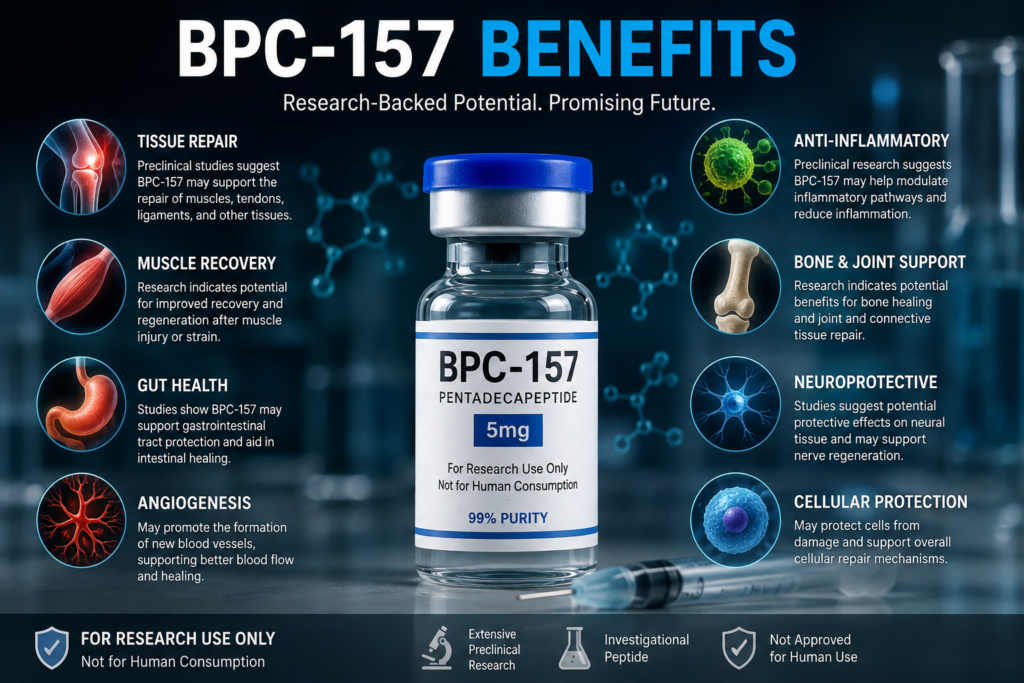
- Tissue repair
- Tendon and ligament research
- Muscle recovery
- Gastrointestinal protection
- Blood-vessel formation
- Inflammatory signaling
- Cellular repair mechanisms
- Bone and connective-tissue research
Although these findings have generated considerable interest, they do not establish BPC-157 as an approved treatment for any of these conditions. BPC-157 Capsules vs Injectable BPC-157
bpc 157 benefits: What Are Researchers Studying?
1. Tissue Repair and Healing Research
One of the most widely discussed potential BPC-157 benefits is its relationship with tissue-repair processes.
Preclinical studies have investigated BPC-157 in models involving muscle, tendon, ligament, and bone injuries. Researchers have reported improvements in structural and functional outcomes in several experimental models.
These findings are one reason BPC-157 has become popular in discussions surrounding regenerative and sports medicine.
Important: Positive results in animal models do not demonstrate that BPC-157 will produce the same results in humans. BPC-157 peptide research
2. Tendon and Ligament Research
Tendons and ligaments can be difficult to repair because they have relatively limited blood supply compared with some other tissues.
BPC-157 research has examined processes associated with tendon and ligament healing, including vascular responses, fibroblast activity, and tissue remodeling. Reviews of the preclinical literature have reported promising findings involving tendon and ligament injury models.
This is an area where BPC-157 has generated particularly strong interest among researchers and sports-medicine communities.
However, evidence from controlled human trials remains insufficient to establish BPC-157 as an effective treatment for tendon or ligament injuries.
3. Muscle Recovery Research
Another commonly searched phrase is “BPC-157 for muscle recovery.”
Experimental studies have investigated whether BPC-157 can influence muscle repair and recovery following injury. Research has reported improvements in certain muscle-injury models, contributing to interest in the peptide’s potential regenerative properties.
For athletes and fitness enthusiasts, this is perhaps one of the most appealing areas of BPC-157 research.
Nevertheless, there is currently not enough clinical evidence to conclude that BPC-157 reliably accelerates muscle recovery in healthy athletes. BPC-157 vs GHK-Cu
4. Gastrointestinal Research
BPC-157 was originally associated with research into gastric and gastrointestinal processes, making gut-related research another important area of interest.
Experimental research has investigated potential effects involving gastrointestinal tissue integrity, intestinal injury, and inflammatory processes.
The FDA’s recent review specifically considered BPC-157 in relation to ulcerative colitis when evaluating its potential use as a compounded bulk drug substance.
This does not mean that BPC-157 is an approved treatment for ulcerative colitis. It simply reflects an area that has been evaluated in the regulatory and research context.
5. Inflammation Research
Inflammation is an important component of many injuries and diseases. Preclinical studies have examined whether BPC-157 can influence inflammatory signaling and inflammatory cytokines.
Some reviews describe reductions in inflammatory activity in experimental models.
This has led to interest in BPC-157 as a potential subject for future research into inflammatory and tissue-repair processes.
More human research is required before these findings can be translated into reliable clinical recommendations.
6. Blood Vessel and Angiogenesis Research
Another potential benefit being investigated is BPC-157’s relationship with angiogenesis, the biological process through which new blood vessels develop.
Researchers have proposed that effects on vascular signaling may contribute to some of the tissue-repair findings observed in experimental models. Studies have reported activity involving pathways associated with blood-vessel formation and vascular integrity.
This is scientifically interesting because adequate blood supply can be important for tissue repair.
However, the clinical importance of these findings in humans remains uncertain. Glow Blend (TB 10mg + BPC 10mg + GHK 50mg)
7. Bone and Connective-Tissue Research
BPC-157 has also been investigated in experimental models involving bone and connective-tissue injuries.
The 2025 systematic review of orthopaedic research reported promising preclinical findings involving bone, tendon, ligament, and muscle injury models.
These results may justify further research, but they should not be interpreted as proof that BPC-157 can treat fractures or other orthopaedic conditions in humans.
Does bpc 157 benefits Really Work?
The answer depends on what is meant by “work.”
In laboratory and animal research: BPC-157 has demonstrated biological activity and potentially beneficial effects across several experimental models.
In humans: Evidence remains limited. The available clinical studies are small and have important methodological limitations. A recent FDA briefing identified five clinical studies involving BPC-157 and noted that the studies were short, involved small numbers of participants, and provided limited safety information.
Therefore, it would be inaccurate to describe BPC-157’s potential benefits as clinically proven. bpc 157 benefits GHK-CU 100mg
bpc 157 benefits vs. Online Marketing Claims
BPC-157 is sometimes marketed online with claims that it can:
- Rapidly heal injuries
- Repair damaged tendons
- Build muscle
- Improve athletic performance
- Eliminate chronic pain
- Treat gastrointestinal diseases
- Reduce inflammation
- Reverse aging
These claims should be approached carefully.
Some are loosely connected to findings from preclinical studies, while others go substantially beyond the available evidence.
A scientific study showing that a peptide affects a biological pathway is not equivalent to a clinical trial demonstrating that the peptide safely improves a patient’s health outcome. bpc 157 benefits MGF
What Does Human Research Show?
Human evidence is currently much more limited than the extensive animal literature surrounding BPC-157.
The 2025 systematic review identified only one clinical study among 36 included studies. That study involved 12 patients receiving an intra-articular BPC-157 injection for unspecified chronic knee pain, with seven reporting relief lasting more than six months. However, the study’s design and small sample size limit how confidently these findings can be interpreted. What Does Ipamorelin Do?
The FDA’s 2026 briefing also identified several small clinical studies involving different routes of administration. While no serious adverse events appeared to have been reported in those studies, the FDA emphasized their short duration, small sample sizes, exploratory nature, and limited safety monitoring.
This is why larger, well-controlled clinical trials are still needed. bpc 157 benefits Tesamorelin + Ipamorelin
Is BPC-157 FDA Approved?
bpc 157 benefits is not an FDA-approved drug for general therapeutic use.
The FDA has stated that compounded BPC-157 may present concerns involving immunogenicity and peptide-related impurities and that available safety information is limited.
A 2026 review likewise described BPC-157 as lacking an approved pharmaceutical formulation, validated dosing regimen, and completed Phase II clinical trial.
Therefore, consumers should be skeptical of websites or sellers describing BPC-157 as an established treatment for injuries, chronic pain, gastrointestinal disease, or other medical conditions.
Is BPC-157 Safe?
The long-term safety profile of BPC-157 in humans remains insufficiently established.
Current concerns include:
- Limited long-term human safety data
- Small clinical-study populations
- Lack of standardized pharmaceutical formulations
- Potential peptide impurities
- Possible immunogenicity
- Uncertainty surrounding products obtained from unregulated sources
The FDA specifically notes that it lacks sufficient safety-related information to determine whether compounded BPC-157 would cause harm when administered to humans through proposed routes.
Consequently, “natural,” “research-grade,” or “peptide” should not automatically be interpreted as meaning safe for human use.
bpc 157 benefits and Athletes
BPC-157 has attracted considerable attention among athletes because of its potential association with muscle, tendon, ligament, and injury-recovery research.
However, athletes should be particularly careful about regulatory and anti-doping considerations. The 2025 systematic review notes that BPC-157 is banned in professional sports.
Competitive athletes should check the rules of their specific sporting organization and current anti-doping regulations before considering any substance associated with performance or recovery. bpc 157 benefits cjc-1295+ ipamorelin