
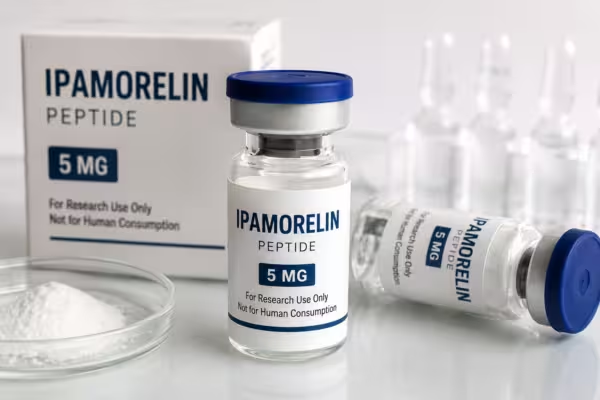
Ipamorelin Peptide: What It Is, How It Works & What the Research Says
Ipamorelin peptide is a synthetic pentapeptide that has been studied for its ability to stimulate the release of growth hormone (GH). Unlike growth hormone itself, ipamorelin acts as a growth hormone secretagogue, meaning it signals the body to release its own GH. Glow Blend (TB 10mg + BPC 10mg + GHK 50mg)
Interest in ipamorelin has grown within peptide research because of its selective activity at the growth-hormone secretagogue receptor. However, it is important to distinguish scientific research from established medical use: ipamorelin is not an FDA-approved drug for general human use, and the FDA has identified safety concerns surrounding certain compounded ipamorelin products. Tesamorelin + Ipamorelin
What Is Ipamorelin Peptide?
Ipamorelin is a synthetic pentapeptide, meaning it contains five amino acids. It was originally developed as a selective growth-hormone-releasing compound.
Early pharmacological research found that ipamorelin stimulates GH release through the growth hormone secretagogue receptor (GHS-R). In preclinical research, it demonstrated GH-releasing activity while producing substantially less stimulation of certain other hormones than some earlier growth-hormone secretagogues.
This selective profile is one reason ipamorelin has remained a subject of peptide and endocrine research. tesamorelin vs ipamorelin
Quick Overview for Ipamorelin Peptide
| Characteristic | Ipamorelin Peptide |
|---|---|
| Peptide type | Synthetic pentapeptide |
| Primary research area | Growth-hormone secretion |
| Mechanism | Growth hormone secretagogue receptor agonist |
| Molecular target | GHS-R |
| FDA-approved medication | No |
| Research status | Investigational |
| Common research interest | GH signaling and endocrine physiology |
How Does Ipamorelin Peptide Work?
Ipamorelin Peptide works differently from growth hormone itself.
Rather than supplying synthetic GH, ipamorelin interacts with the growth hormone secretagogue receptor and can stimulate the pituitary gland to release GH.
In early research, ipamorelin demonstrated GH-releasing activity in laboratory and animal models. Human pharmacokinetic research subsequently investigated how ipamorelin behaves in the body and how it influences GH secretion.
A simplified pathway is:
Ipamorelin → GHS receptor stimulation → pituitary GH release → downstream GH/IGF-1 signaling
This mechanism makes ipamorelin particularly interesting to researchers studying the body’s endogenous GH system.
Ipamorelin Peptide vs. Growth Hormone
Ipamorelin Peptide and growth hormone are not the same substance.
Growth hormone products provide GH directly, whereas ipamorelin is intended to stimulate endogenous GH release through the growth-hormone secretagogue pathway.
This distinction is important when researching peptides because increasing GH secretion does not necessarily produce the same physiological effects as administering recombinant GH. is it safe combine tesamorelin with cdc/ipamorelin together
What Is Ipamorelin Peptide Used For in Research?
Researchers have investigated Ipamorelin Peptide in several areas, including:
- Growth-hormone secretion
- Endocrine physiology
- Growth-hormone receptor signaling
- Pharmacokinetics
- Gastrointestinal motility
- Potential therapeutic applications
One human clinical study investigated intravenous ipamorelin for postoperative ileus following bowel surgery. Although the study provided human safety and pharmacological data, it did not establish ipamorelin as a broadly approved treatment.
Consequently, claims that ipamorelin is a proven treatment for muscle growth, fat loss, anti-aging, or athletic performance should be viewed critically. how many mg of semax a day
Potential Research Benefits of Ipamorelin
Because ipamorelin stimulates GH release, researchers have explored its potential relevance to several biological processes associated with GH.
Growth Hormone Research
The primary research interest surrounding ipamorelin is its ability to stimulate GH secretion.
Early studies demonstrated potent GH-releasing activity in vitro and in animal models.
Endocrine Research
Ipamorelin provides researchers with a tool for investigating the relationship between growth-hormone secretagogues, pituitary GH release, and downstream endocrine signaling.
Gastrointestinal Research
Ipamorelin has also been investigated for effects on gastrointestinal motility because the ghrelin receptor system is involved in gastrointestinal physiology. A randomized clinical trial examined ipamorelin in patients following bowel resection, although the primary efficacy endpoint was not significantly different from placebo.
Pharmacokinetic Research
Human research has examined how quickly ipamorelin is cleared from the body and how GH secretion changes following administration. One pharmacokinetic study in healthy volunteers found a short terminal half-life and a transient GH response.
Ipamorelin and Muscle Growth
Ipamorelin is frequently marketed online as a peptide for muscle growth and recovery.
However, increased GH secretion does not automatically establish that ipamorelin increases muscle mass in healthy adults. Glow Blend (TB 10mg + BPC 10mg + GHK 50mg)
There is insufficient high-quality clinical evidence to characterize ipamorelin as an established muscle-building treatment.
Research into the GH axis is scientifically interesting, but laboratory or endocrine effects should not be presented as guaranteed improvements in strength, muscle mass, or athletic performance.
Ipamorelin and Fat Loss
Another common claim is that ipamorelin promotes fat loss.
Because GH is involved in metabolism and body composition, researchers have an interest in compounds that influence GH secretion. However, this does not establish ipamorelin as an approved weight-loss medication.
Claims about dramatic fat loss should therefore be approached cautiously unless supported by controlled human clinical evidence.
Ipamorelin and Recovery
Ipamorelin is also discussed in connection with exercise recovery and tissue repair.
The rationale generally comes from the biological functions associated with GH and IGF-1 signaling. However, evidence that ipamorelin itself produces meaningful improvements in recovery in healthy people remains limited.
For informational purposes, it is more accurate to describe recovery as a research interest rather than an established clinical benefit.
Is Ipamorelin FDA Approved?
No. Ipamorelin is not an FDA-approved medication for general human use.
The FDA has evaluated ipamorelin-related substances in the context of pharmaceutical compounding and has identified safety concerns.
In its evaluation of ipamorelin acetate and ipamorelin free base, the FDA noted insufficient safety and effectiveness information for proposed subcutaneous use and raised concerns involving peptide aggregation, impurities, immunogenicity, and limited clinical data.
The FDA currently lists ipamorelin acetate under its 503B Category 2 interim compounding policy, citing potential immunogenicity from aggregation or peptide-related impurities and limited information about safety through certain routes of administration. how to take sermorelin peptide
Is Ipamorelin Safe?
The answer depends on the formulation, route, source, and intended use, but the available evidence does not establish ipamorelin as risk-free.
The FDA has specifically raised concerns about:
- Peptide aggregation
- Peptide-related impurities
- Potential immunogenicity
- Limited safety information
- Limited data for certain injectable routes
The FDA also noted reports of serious adverse events in a study involving intravenous ipamorelin for postoperative ileus, while stating that causality for reported deaths was unclear.
This is an important reason consumers should not assume that an online peptide product has the same quality or safety profile as an FDA-approved pharmaceutical. PEG-MGF
Why Product Quality Matters With Ipamorelin
Peptide quality is particularly important when a product is intended for administration into the human body.
Important quality considerations include:
- Identity
- Purity
- Peptide concentration
- Sterility where applicable
- Endotoxin testing
- Impurity characterization
- Appropriate storage
- Manufacturing controls
The FDA has noted that ipamorelin-related substances can present challenges involving peptide characterization, aggregation, and impurities.
For this reason, a product label alone should not be considered proof of pharmaceutical quality.
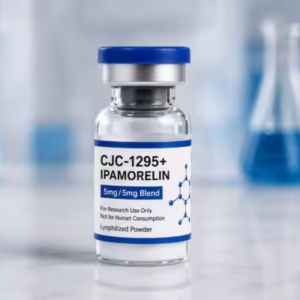
Ipamorelin Peptide vs. CJC-1295
Ipamorelin Peptide and CJC-1295 are often discussed together, but they are different types of GH-axis peptides.
Ipamorelin primarily acts as a growth hormone secretagogue through the GHS receptor.
CJC-1295 is a GHRH-related compound that acts through the GHRH pathway.
Because they influence GH secretion through different mechanisms, they are sometimes investigated together. However, combining peptides does not automatically mean that the combination is safe or more effective.
There is insufficient evidence to establish a universally appropriate CJC-1295/ipamorelin protocol for general human use.
Ipamorelin Peptide vs. Tesamorelin
Tesamorelin is another peptide that affects the GH axis, but it is different from ipamorelin.
Tesamorelin is a GHRH analogue, whereas ipamorelin is a growth hormone secretagogue acting through the GHS receptor.
Tesamorelin has an FDA-approved indication for reducing excess abdominal fat in adults with HIV-associated lipodystrophy, while ipamorelin does not have an equivalent FDA-approved indication.
This distinction is important when comparing peptide products marketed online. Beta-Amyloid (1-42), E22 Deletion
Reviews
There are no reviews yet.