
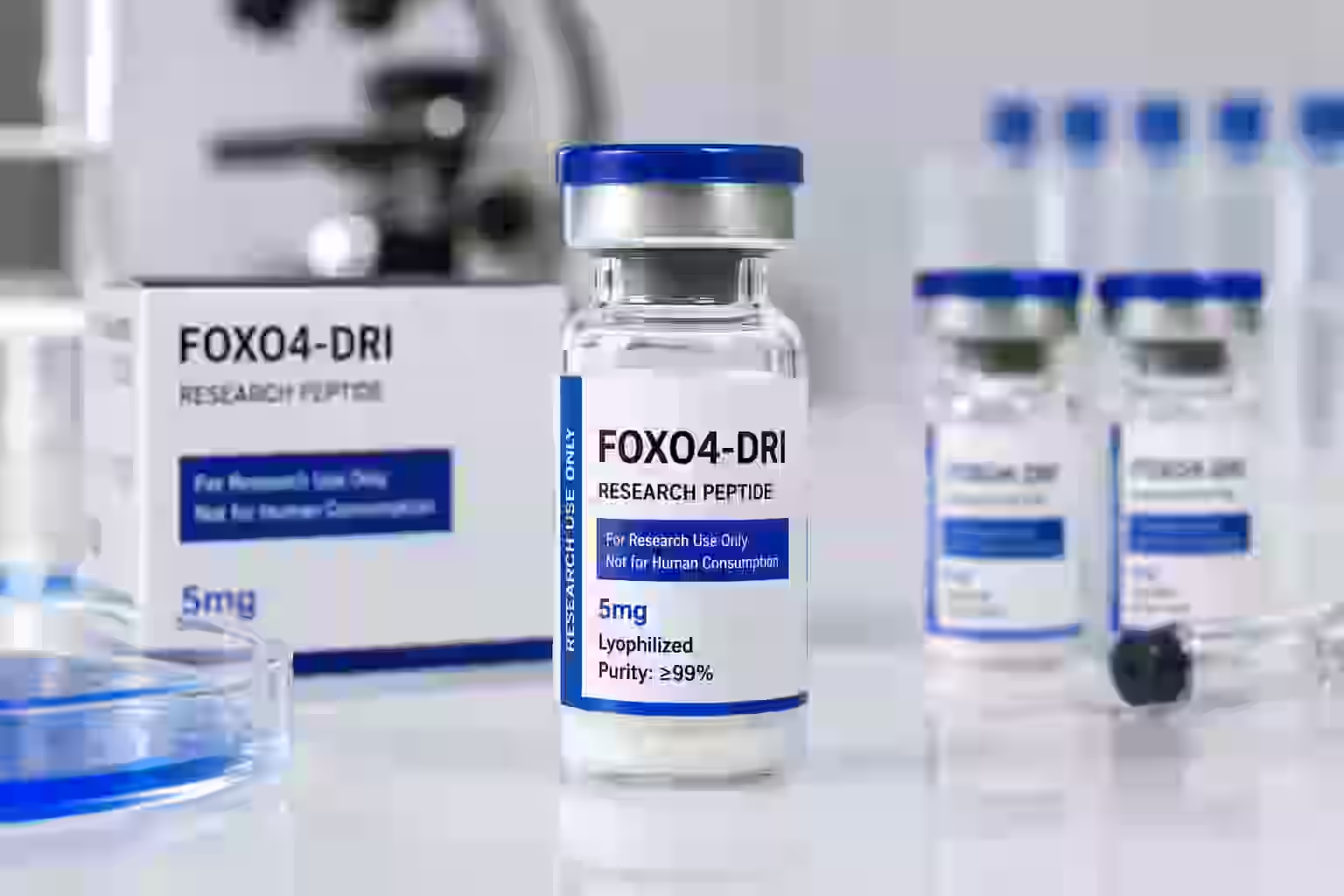
FOXO4-DRI: Research Overview, Mechanism, Potential Applications, and Current Evidence
FOXO4-DRI is an experimental peptide studied for its potential senolytic activity—the ability to selectively promote the removal of certain senescent cells. Research has focused on the interaction between the proteins FOXO4 and p53, which can influence whether senescent cells remain viable or undergo programmed cell death. Dihexa Peptide
Interest in FOXO4-DRI has grown because preclinical studies have reported effects in models of aging, fibrosis, cellular senescence, and other age-associated conditions. However, these findings remain primarily preclinical, and FOXO4-DRI is not an established human anti-aging treatment or FDA-approved medication. ACE-031
What Is FOXO4-DRI?
FOXO4-DRI is a synthetic D-retro-inverso peptide derived from a region of the FOXO4 protein. The compound was designed to interfere with the interaction between FOXO4 and p53.
The “DRI” designation refers to the D-retro-inverso configuration, a peptide-design approach intended to alter stability and biological properties while preserving aspects of the original peptide’s interaction with its target.
Researchers developed FOXO4-DRI as a tool for investigating whether selectively targeting senescent cells could have beneficial effects in aging-related disease models.
The original research published in Cell reported that disrupting the FOXO4-p53 interaction could restore p53-associated apoptosis in senescent cells and improve several age-related outcomes in mice. Bronchogen
What Does FOXO4-DRI Do?
The central research interest in FOXO4-DRI is its potential ability to disrupt the FOXO4-p53 interaction in senescent cells.
Cellular senescence is a state in which cells stop dividing but remain metabolically active. Senescent cells can accumulate with age and may release signaling molecules collectively associated with the senescence-associated secretory phenotype (SASP).
FOXO4 can interact with p53 in the nucleus of senescent cells. Research suggests that FOXO4-DRI can interfere with this interaction, allowing p53 to contribute to apoptosis—the programmed elimination of the cell.
This is why FOXO4-DRI is often described as a senolytic research peptide.
How Does FOXO4-DRI Work?
The proposed mechanism centers on the FOXO4-p53 signaling axis.
In simplified terms:
- Cellular stress can contribute to cellular senescence.
- Senescent cells can maintain survival despite being unable to divide normally.
- FOXO4 can bind to p53 and help maintain p53 within the nucleus.
- FOXO4-DRI is designed to interfere with the FOXO4-p53 interaction.
- This can alter p53 localization and signaling.
- In experimental models, this can promote apoptosis of certain senescent cells.
A 2025 Nature Communications study provided additional structural information about how FOXO4-DRI interacts with the p53 transactivation domain, helping clarify the molecular basis of the peptide’s activity. Glow Blend (TB 10mg + BPC 10mg + GHK 50mg)
FOXO4-DRI and Senescent Cells
Senescent cells are one of the primary targets of FOXO4-DRI research.
Senescence can be a normal biological response to cellular damage, stress, or aging. Rather than continuing to divide, a senescent cell enters a persistent growth-arrest state.
Although senescence can have beneficial functions, the accumulation of senescent cells has been associated with chronic tissue dysfunction and age-related disease processes.
This has led researchers to investigate senolytics, compounds designed to selectively eliminate senescent cells.
FOXO4-DRI is one experimental approach being studied in this field. Reviews of senolytic research identify FOXO4-DRI as a peptide-based strategy for disrupting FOXO4-p53 signaling in senescent cells. Glow Peptide
FOXO4-DRI and Aging Research
One of the most significant areas of interest is biological aging.
The original FOXO4-DRI research reported that treatment in mouse models reduced senescent-cell-associated effects and improved measures including physical fitness, fur density, and renal function.
These findings helped establish FOXO4-DRI as an important experimental tool in senescence research.
However, results observed in mice do not establish that FOXO4-DRI reverses aging or extends lifespan in humans.
Human clinical studies would be necessary to determine whether the mechanism translates into meaningful health benefits and whether the compound can be administered safely. 5 amino 1mq benefits
FOXO4-DRI and Cellular Rejuvenation
The term “cellular rejuvenation” is frequently associated with FOXO4-DRI in online discussions.
Scientifically, it is more accurate to describe the compound as a research tool for studying the selective elimination of senescent cells.
Removing senescent cells could potentially change the cellular environment of tissues, but this does not mean that FOXO4-DRI literally reverses the biological age of every cell.
The distinction between clearing senescent cells and reversing aging is important when evaluating commercial descriptions of FOXO4DRI. Bpc-157 + TB-500
FOXO4DRI and Cognitive Aging
Researchers have also investigated whether targeting cellular senescence could affect brain aging and cognitive decline.
A recent 2026 review discusses FOXO4DRI research in models of brain aging and neurodegenerative disease, including reported effects on cerebral blood flow, blood-brain barrier integrity, hippocampal changes, and cognitive measures in animal models.
These findings remain preclinical. They should not be interpreted as evidence that FOXO4DRI is an established treatment for dementia, Alzheimer’s disease, or age-related cognitive decline in humans. TB-500
FOXO4DRI and Fibrosis Research
Fibrosis is another area in which senescent cells have been investigated.
Experimental studies have examined whether eliminating senescent fibroblasts could influence pathological tissue remodeling. FOXO4DRI has been studied in models involving radiation-induced pulmonary fibrosis and other fibrotic processes.
The results provide researchers with information about the potential relationship between cellular senescence and tissue fibrosis.
However, these studies do not establish FOXO4DRI as a clinical treatment for pulmonary fibrosis or other fibrotic diseases.
FOXO4-DRI and Reproductive Aging Research
Researchers have also investigated FOXO4-DRI in models of reproductive aging.
For example, a study in aged mice reported that FOXO4DRI reduced senescent-cell-associated effects in Leydig cells and was associated with improvements in testosterone secretion and the testicular microenvironment.
Another mouse study reported improvements in sperm quality and spermatogenesis following FOXO4DRI treatment.
Again, these findings are from experimental models and cannot be assumed to demonstrate fertility or hormonal benefits in humans. Cerebrolysin
New Research on FOXO4DRI
FOXO4DRI continues to be investigated.
A 2025 Nature Communications study examined the molecular structure of FOXO4-DRI bound to the p53 transactivation domain. The research provided additional insight into how the peptide competes with FOXO4 for interaction with p53.
Researchers are also developing newer peptide approaches based on the FOXO4-p53 interaction. A 2025 study reported an optimized peptide inhibitor designed to target senescent cancer cells and induce apoptosis in laboratory models.
These developments demonstrate that FOXO4-p53 signaling remains an active area of senescence and therapeutic research.
Potential Research Applications of FOXO4DRI
Current research involving FOXO4-DRI has examined several areas, including:
- Cellular senescence
- Senolytic drug development
- Biological aging
- Tissue homeostasis
- Fibrosis
- Vascular aging
- Reproductive aging
- Brain aging
- Neurodegenerative disease models
- Cancer-associated senescence
These should be viewed as research applications rather than established medical uses.
Is FOXO4DRI FDA Approved?
No. FOXO4DRI is not an FDA-approved medication.
It remains an experimental research peptide. The available evidence does not establish FOXO4DRI as an approved treatment for aging, longevity, fibrosis, cognitive decline, cancer, infertility, or other medical conditions.
The distinction between experimental research and approved medical therapy is particularly important when evaluating websites that market FOXO4DRI as a “longevity peptide” or “anti-aging peptide.”
Is FOXO4DRI Safe?
The safety of FOXO4DRI in humans has not been established through adequate clinical research.
Most published research has involved cells and animal models. Although some studies have reported that FOXO4DRI was tolerated under experimental conditions, those results cannot establish an appropriate human dose or long-term safety profile.
Potential questions that require further investigation include:
- Human pharmacokinetics
- Appropriate dosing
- Long-term exposure
- Immune reactions
- Off-target effects
- Effects on healthy cells
- Drug interactions
- Reproductive effects
- Effects on normal tissue repair
Because senescent cells can also perform beneficial biological functions in certain contexts, selectively eliminating them is a complex research problem. Tesamorelin + Ipamorelin
Reviews
There are no reviews yet.