5-Amino-1MQ Benefits: What the Research Actually Shows
5-Amino-1MQ benefits, you will find many claims about fat loss, metabolism, glucose control, energy, and muscle performance. But it is important to separate promising scientific findings from claims that have not yet been demonstrated in humans. 5-Amino-1MQ
5-Amino-1MQ (5-amino-1-methylquinolinium) is a small-molecule inhibitor of nicotinamide N-methyltransferase (NNMT). It has primarily been investigated in laboratory and animal studies, where researchers have observed potentially interesting effects on body composition, metabolic function, liver health, and skeletal muscle regeneration. 5 amino 1mq dosage
However, these 5 amino 1mq benefits findings are predominantly preclinical. They do not establish 5-Amino-1MQ as an approved treatment for obesity, diabetes, muscle loss, or any other medical condition. 5-Amino-1MQ — Certificate of Analysis
What Is 5-Amino-1MQ?
5-Amino-1MQ is a synthetic small molecule that inhibits the enzyme nicotinamide N-methyltransferase, or NNMT.
Despite frequently being called a “research peptide” online, 5-Amino-1MQ is not technically a peptide. It is a small-molecule NNMT inhibitor.
NNMT participates in cellular metabolism by converting nicotinamide into 1-methylnicotinamide (1-MNA) while using S-adenosylmethionine (SAM) as a methyl donor. Researchers have become interested in NNMT because changes in its activity have been associated with metabolic dysfunction and obesity.
By inhibiting NNMT, researchers are investigating whether compounds such as 5-Amino-1MQ can influence metabolic pathways involving NAD+, SAM, energy expenditure, and lipid metabolism. Glow Blend (TB 10mg + BPC 10mg + GHK 50mg)
What Are the Potential 5 amino 1mq benefits?
The potential benefits reported in research include several areas:
- Body-weight and fat-mass regulation
- Improved glucose tolerance
- Improved insulin sensitivity
- Changes in lipid metabolism
- Potential improvements in obesity-associated liver abnormalities
- Effects on skeletal muscle regeneration
- Potential improvements in muscle function in aged animals
The important qualification is that these effects have primarily been observed in cells and animal models, not established through large human clinical trials. GHK-CU 100mg
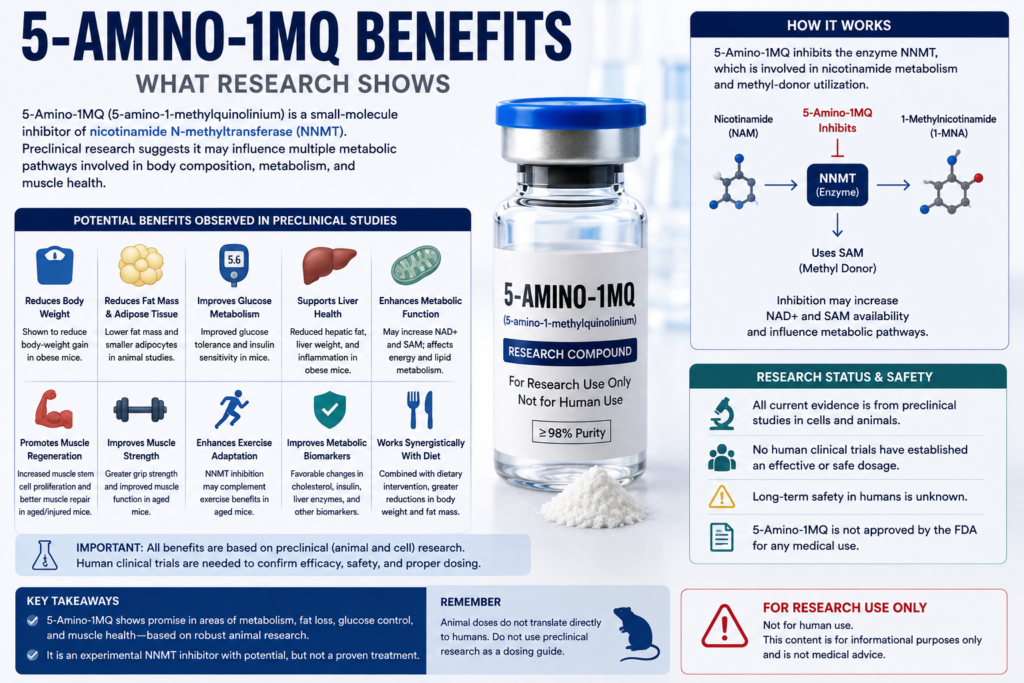
1. Potential Effects on Body Weight and Fat Mass
One of the main reasons 5 amino 1mq benefits has attracted scientific interest is its potential effect on body composition.
An early study investigated 5-Amino-1MQ and related NNMT inhibitors in diet-induced obese mice. Researchers reported that treatment with a potent NNMT inhibitor reduced body weight, white adipose tissue mass, adipocyte size, and plasma total cholesterol.
Importantly, the researchers did not observe a corresponding reduction in food intake, suggesting that the effects were not simply explained by the animals eating less.
A later study specifically examining 5 amino 1mq benefits in diet-induced obese mice found dose-dependent limitations in body-weight and fat-mass gain over 28 days.bpc 157 benefits
What does this mean for humans?
It provides a scientific rationale for investigating NNMT inhibition as a potential metabolic strategy, but it does not prove that 5 amino 1mq benefits causes weight loss in humans.
Human clinical trials would be required to determine whether the same effects occur in people. bpc 157 peptide
2. Potential Reduction in Adipose Tissue
Another frequently discussed 5 amino 1mq benefits is its potential influence on adipose tissue.
In preclinical research, NNMT inhibition has been associated with reductions in white adipose tissue and adipocyte size. The original 5-Amino-1MQ research reported significant reductions in white adipose mass and adipocyte size in diet-induced obese mice.
This is potentially important because adipose tissue is not simply a passive storage site. It is metabolically active and influences numerous processes involving hormones, inflammation, lipid metabolism, and energy regulation.
Nevertheless, results in mice cannot automatically be translated into a human fat-loss effect.
3. Potential Improvements in Glucose Metabolism
Researchers have also investigated 5 amino 1mq benefits in relation to glucose metabolism.
A 2024 study using 5A1MQ in diet-induced obese mice reported improvements in oral glucose tolerance and insulin sensitivity, along with suppression of elevated insulin levels.
These findings are particularly interesting because insulin resistance is closely connected with obesity and metabolic dysfunction.
However, 5-Amino-1MQ has not been established as a treatment for diabetes or insulin resistance in humans. what is BPC-157?
Why this research matters
If NNMT inhibition can consistently improve glucose handling in additional preclinical models and eventually in humans, it could potentially represent a new approach to metabolic disease research.
At present, however, this remains an area of investigation rather than an established therapeutic benefit.
4. Potential Effects on Liver Health
Another interesting area of research involves metabolic dysfunction in the liver.
In the 2024 mouse study, 5 amino 1mq benefits treatment was associated with reduced hepatic steatosis and macrophage infiltration, as well as reductions in liver weight, size, and triglyceride levels. The researchers also reported normalization of several circulating liver-related biomarkers.
These findings suggest that NNMT inhibition may influence more than body weight alone.
The potential relationship between NNMT activity, obesity, adipose metabolism, and liver health is therefore an active area of preclinical research.
Again, these findings should not be interpreted as evidence that 5-Amino-1MQ can treat fatty liver disease in humans. Sermorelin
5. Potential Effects on Metabolic Function
One proposed mechanism behind NNMT inhibition involves changes in cellular metabolic pathways.
Earlier research found that 5 amino 1mq benefits reduced intracellular levels of 1-MNA while increasing intracellular NAD+ and SAM in cultured adipocytes. The researchers also observed suppression of lipogenesis.
These observations are important because NAD+ and SAM participate in multiple cellular processes.
Researchers are therefore investigating whether NNMT inhibition can shift cellular metabolism toward a state that is more favorable for energy expenditure and metabolic health.
The exact clinical significance of these changes in humans remains unknown. Selank
6. Potential Benefits for Muscle Regeneration
5-Amino-1MQ and other NNMT inhibitors have also attracted attention in skeletal muscle research.
A study in aged mice investigated NNMT inhibition after muscle injury. Researchers found increased muscle stem-cell proliferation and fusion, larger muscle-fiber cross-sectional area, and improved contractile function in treated animals.
The findings suggested that NNMT inhibition might help counter some age-related impairments in muscle regeneration.
This is particularly interesting because skeletal muscle regeneration becomes less efficient with age.
However, this was an animal study. It does not demonstrate that 5 amino 1mq benefits improves muscle recovery or regeneration in humans.
7. Potential Effects on Muscle Strength
More recent research has continued to investigate the relationship between NNMT inhibition and muscle function.
In aged mice, researchers reported that NNMT inhibitor treatment was associated with improvements in measures of muscle function. In one study, aged sedentary mice receiving NNMT inhibition showed approximately 40% greater grip strength than sedentary controls.
Researchers also investigated NNMT inhibition alongside exercise to determine whether the effects could complement exercise-related adaptations.
These findings are scientifically interesting, but they should not be interpreted as evidence that 5-Amino-1MQ is a proven muscle-building or performance-enhancing compound for humans.
8. Potential Effects on Exercise-Related Muscle Adaptation
The relationship between NNMT inhibition and exercise is another emerging research area.
The 2024 aged-mouse study compared NNMT inhibition, intensive exercise, and their combination. Researchers examined outcomes including grip strength, running capacity, muscle torque, muscle mass, muscle-fiber characteristics, and intramyocellular lipid content.
This research suggests that NNMT signaling may influence how aging muscle responds to metabolic and exercise-related stress.
More research is necessary to determine whether this pathway has meaningful therapeutic potential in humans.
9. Potential Changes in Lipid Metabolism
5-Amino-1MQ has also been investigated for its effects on lipid-related pathways.
Early research showed that NNMT inhibition suppressed lipogenesis in cultured adipocytes and reduced white adipose tissue in obese mice.
The 2024 5A1MQ study similarly reported reductions in fat-mass gain in diet-induced obese mice.
These findings support continued research into NNMT as a metabolic target.
They do not, however, establish a human fat-burning effect.
10. Potential Effects When Combined With Dietary Changes
Research has also examined NNMT inhibition together with dietary intervention.
A study involving obese mice found that combining NNMT inhibition with a reduced-calorie or lean diet accelerated improvements in body weight and fat mass compared with dietary intervention alone. Researchers also reported improvements in liver adiposity and whole-body lean-mass-to-body-weight ratio.
Another study found that combining NNMT inhibition with a lean diet substantially altered body weight and adiposity in diet-induced obese mice.
These results suggest that NNMT signaling may interact with nutritional status.
However, mouse dietary models are not equivalent to human weight-management programs. What Does Ipamorelin Do?
How Does 5 amino 1mq benefits Work?
The potential benefits of 5-Amino-1MQ are linked to its ability to inhibit NNMT.
A simplified pathway looks like this:
5-Amino-1MQ → NNMT inhibition → changes in 1-MNA, NAD+ and SAM metabolism → altered cellular metabolic signaling
NNMT has been linked to processes involving:
- Nicotinamide metabolism
- NAD+ salvage
- Methyl-donor metabolism
- Energy expenditure
- Lipid metabolism
- Adipose tissue biology
- Muscle-cell function
Research has suggested that increased NNMT activity can contribute to metabolic changes associated with obesity, while inhibition may reverse some of these effects in experimental models.
The actual biology is considerably more complex, and researchers are still working to determine which mechanisms are most important. how much bpc 157 peptide per day
5 amino 1mq benefits vs. Proven Human Benefits
It is useful to separate potential research benefits from clinically established benefits.
| Potential benefit | Evidence |
|---|---|
| Reduced body-weight gain | Observed in obese mice |
| Reduced fat mass | Observed in animal studies |
| Improved glucose tolerance | Observed in obese mice |
| Improved insulin sensitivity | Observed in animal studies |
| Liver metabolic improvements | Observed in obese mice |
| Muscle regeneration | Observed in aged/injured mice |
| Increased muscle strength | Observed in aged mice |
| Human weight loss | Not established |
| Human muscle growth | Not established |
| Human diabetes treatment | Not established |
| Long-term human safety | Not established |
This distinction is essential when evaluating online claims about 5 amino 1mq benefits. ipamorelin peptide
Is 5 amino 1mq benefits Approved for Human Use?
There is currently no established FDA-approved therapeutic use or validated human dosage for 5 amino 1mq benefits.
The available evidence discussed above is primarily preclinical.
That means there is not enough evidence to determine a reliable human dose, long-term safety profile, or clinical effectiveness for weight loss, metabolic disease, muscle regeneration, or other proposed applications.
Is 5-Amino-1MQ Safe?
Human safety data remain a major limitation.
Animal studies can provide valuable information about biological activity and potential toxicity, but they cannot establish that a compound is safe for people.
Important unanswered questions include:
- What dose is safe in humans?
- What dose produces meaningful NNMT inhibition?
- What are the effects of long-term NNMT inhibition?
- How does the compound interact with medications?
- How does it affect people with liver or kidney disease?
- What are the effects in pregnancy or breastfeeding?
- What adverse effects might occur with prolonged exposure?
Until properly designed human clinical trials answer these questions, the safety of 5 amino 1mq benefits in humans remains uncertain. how many mg of semax a day
Is 5-Amino-1MQ a Peptide?
No.
5-Amino-1MQ is a small-molecule NNMT inhibitor, not a peptide.
It is frequently categorized alongside research peptides online because both types of compounds may be sold through research-chemical channels, but chemically they are different.
This distinction is useful when researching dosage, pharmacology, administration, and safety. 5 amino 1mq benefits cjc 1295
What About 5 amino 1mq benefits for Weight Loss?
Weight loss is arguably the most frequently discussed potential application of 5-Amino-1MQ.
There is legitimate scientific interest in this area because multiple studies have demonstrated effects on body weight and adipose tissue in obese mice.
However, animal weight loss does not prove human weight loss.
A compound can produce substantial effects in a mouse model and still fail to demonstrate meaningful efficacy or acceptable safety during human development.
Therefore, it is more accurate to describe 5-Amino-1MQ as a potential metabolic research compound than as a proven weight-loss treatment. 5 amino 1mq benefits PEG-MGF