
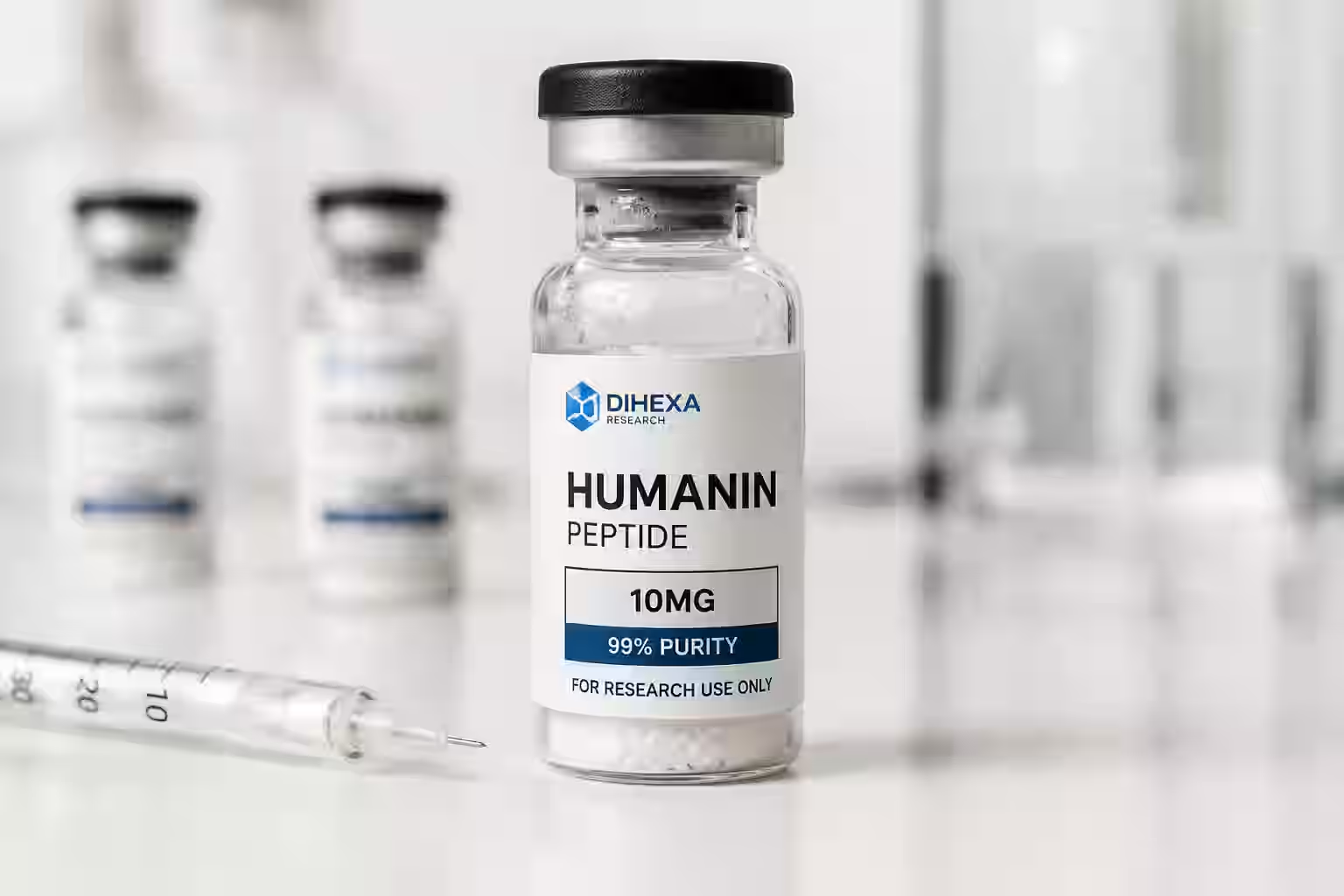
Humanin Peptide buy: What It Is, Benefits, Research, and Safety
Humanin peptide buy is a small peptide encoded by mitochondrial DNA that has attracted scientific interest because of its potential role in cellular stress responses, metabolism, aging, and neuroprotection. cartalax peptide
Unlike conventional pharmaceutical drugs, Humanin peptide buy is primarily a research molecule at this stage. Studies have investigated Humanin peptide buy and related mitochondrial-derived peptides in cellular, animal, and some human research, but many of the health benefits discussed online remain experimental and require further clinical investigation. L-carnitine
This guide explains what Humanin peptide buy is, how it may work, what researchers are studying, and what is currently known about Humanin peptide research. thymosin alpha-1
Important: Humanin should not be presented as an established treatment for aging, Alzheimer’s disease, diabetes, cardiovascular disease, or other medical conditions. Research findings—particularly from laboratory and animal studies—do not automatically establish safety or effectiveness in humans.
What Is Humanin Peptide buy?
Humanin peptide buy is a short mitochondria-derived peptide (MDP) encoded within the mitochondrial genome.
Mitochondria are best known for producing cellular energy, but research has shown that mitochondrial DNA can also encode small biologically active peptides. Humanin peptide buy was the first mitochondrial-derived peptide identified, and subsequent research has identified additional peptides such as MOTS-c and the small humanin-like peptides (SHLPs).
Researchers are particularly interested in Humanin peptide buy because experimental studies suggest that it can participate in cellular pathways associated with:
- Cellular stress responses
- Apoptosis, or programmed cell death
- Mitochondrial function
- Metabolic regulation
- Oxidative stress
- Neuroprotective signaling
These findings have made Humanin peptide buy a subject of ongoing basic and translational research.
How Does Humanin peptide buy Work?
The precise mechanisms of Humanin peptide buy are still being investigated.
Research indicates that Humanin peptide buy can interact with signaling pathways involved in cell survival and stress responses. Depending on the experimental model, Humanin has been associated with changes in pathways related to apoptosis, mitochondrial function, inflammation, and metabolism.
This is one reason Humanin peptide buy is being studied as a potential mitochondrial signaling molecule rather than simply as a conventional peptide hormone.
However, mechanisms observed in cultured cells or animal models should not be interpreted as proof that administering Humanin to humans will produce the same effects. Humanin peptide buy how much bpc 157 peptide per day
Humanin Peptide and Mitochondria
The connection between Humanin and mitochondria is central to current research.
Mitochondria have their own genome, and scientists have discovered that portions of mitochondrial DNA can produce small peptides with biological activity.
Humanin is one of these mitochondrial-derived peptides. Researchers are investigating whether these molecules help cells respond to metabolic or physiological stress.
This research has expanded the traditional understanding of mitochondria from simple cellular “powerhouses” to important signaling centers. do you inject ace-031 peptide every day
Potential Humanin Peptide Benefits: What Does the Research Show?
Humanin is sometimes marketed online with claims involving longevity, brain health, metabolism, cardiovascular health, and other outcomes.
It is important to separate research interest from clinically demonstrated benefits.
Neuroprotection
Humanin has been extensively investigated in experimental models of neuronal stress.
For example, laboratory research has examined Humanin and Humanin analogues in connection with amyloid-beta-related cellular injury and neuroprotective mechanisms.
These findings have contributed to interest in Humanin as a possible research target for neurodegenerative disease.
However, laboratory findings do not establish that Humanin supplements or injections prevent or treat Alzheimer’s disease or other neurological disorders in people.
Metabolic Research
Humanin has also been studied in relation to metabolism and metabolic disease.
Mitochondrial-derived peptides are being investigated for their potential involvement in energy balance, insulin sensitivity, oxidative stress, and metabolic adaptation.
Human studies have also examined circulating Humanin levels in connection with exercise and metabolic physiology. One study found that acute endurance and resistance exercise affected circulating mitochondrial-derived peptides in humans.
These observations are scientifically interesting, but they do not demonstrate that taking exogenous Humanin produces the same effects.
Cardiovascular Research
Researchers are investigating Humanin in relation to cardiovascular biology, vascular aging, oxidative stress, and cellular protection.
Recent reviews describe mitochondrial-derived peptides including Humanin as potential research targets for vascular aging and cardiovascular disease.
Much of this field remains preclinical, meaning that additional research is needed before potential therapeutic applications can be established.
Aging and Longevity Research
Humanin is frequently discussed in the context of healthy aging and longevity.
Researchers have identified relationships between mitochondrial-derived peptides and biological processes associated with aging, cellular stress, and metabolic health.
However, there is currently a substantial difference between studying a molecule’s relationship with aging biology and demonstrating that administering that molecule extends human lifespan.
Claims that Humanin is a proven anti-aging treatment therefore go beyond the available evidence.
Humanin Peptide and Alzheimer’s Disease
Humanin has received attention in Alzheimer’s disease research because of experimental evidence involving neuronal protection and amyloid-beta-related cellular stress.
Some laboratory studies have investigated Humanin analogues such as S14G-humanin, which demonstrated neuroprotective effects in experimental models.
These results are useful for understanding possible biological mechanisms, but they should not be interpreted as evidence that Humanin is an established Alzheimer’s treatment.
Developing an experimental peptide into an approved therapy requires appropriately designed human clinical trials demonstrating safety, efficacy, dosing, and an acceptable benefit-risk profile.
Is Humanin Peptide FDA Approved?
The FDA’s Substance Registration System contains an entry identifying HUMANIN as an ingredient substance. However, the FDA specifically notes that the existence of a UNII does not imply regulatory review or approval.
Therefore, an FDA substance listing should not be confused with FDA approval of Humanin as a drug or treatment.
People considering an experimental peptide should distinguish between:
- A scientific research molecule
- A substance listed in a regulatory database
- An investigational drug
- An FDA-approved medication
These categories are not interchangeable.
Is Humanin Peptide Available for Human Use?
Availability depends on the product, jurisdiction, and intended use.
Humanin is widely discussed in the research-peptide market, but the presence of a product labeled “Humanin” online does not establish that the product is an approved medicine or that it has been evaluated for human safety and effectiveness.
The FDA explains that investigational drugs are products being studied to determine whether they are safe and effective and how they should be used.
Anyone considering an investigational compound for personal use should discuss the situation with a qualified healthcare professional rather than assuming that a commercially available research product has been clinically validated.
Humanin Peptide Safety
One of the most important unanswered questions surrounding Humanin is the safety of exogenous Humanin administration in humans.
Research on a biological molecule does not automatically establish:
- An appropriate human dose
- Long-term safety
- Drug interactions
- Contraindications
- Effects during pregnancy
- Effects in people with chronic diseases
- Manufacturing or purity standards for commercially sold research products
The safety profile of an experimental peptide therefore cannot be inferred simply from promising laboratory results.
Humanin Peptide Dosage
There is no universally established, clinically validated Humanin dosage for treating aging, weight management, Alzheimer’s disease, cardiovascular disease, or other conditions.
Online sources may provide dosing protocols for research peptides, but these should not be treated as established medical dosing recommendations.
For an investigational compound, appropriate dosing depends on the specific research protocol, formulation, route of administration, pharmacokinetics, and available safety data.
Humanin vs. MOTS-c
Humanin and MOTS-c are both classified as mitochondria-derived peptides, but they are different molecules.
| Feature | Humanin | MOTS-c |
|---|---|---|
| Origin | Mitochondrial genome | Mitochondrial genome |
| Classification | Mitochondria-derived peptide | Mitochondria-derived peptide |
| Research areas | Cellular stress, neuroprotection, metabolism, aging biology | Metabolism, exercise physiology, stress adaptation |
| Clinical status | Research/investigational | Research/investigational |
Both peptides are being investigated for their roles in mitochondrial signaling and metabolic biology.
Humanin Peptide vs. Traditional Peptide Therapies
Humanin should not automatically be grouped with established peptide medications.
Some peptide-based medicines have undergone extensive clinical development and regulatory review. Humanin research, by contrast, remains focused largely on understanding its biological functions and therapeutic potential.
That distinction matters when evaluating claims made by online peptide sellers.
A molecule can have compelling biological research behind it while still lacking sufficient clinical evidence for a particular medical use.
What Does Current Human Research Tell Us?
Human research into mitochondrial-derived peptides is growing, but the evidence remains limited compared with that available for established medications.
For example, research has measured Humanin in people and investigated how circulating levels may change in response to physiological conditions such as exercise.
A 2026 systematic review examining exercise and mitochondrial-derived peptides concluded that evidence is still limited, particularly in human studies, and called for additional controlled clinical research.
This distinction is important for anyone researching Humanin online: evidence that Humanin exists in humans or is associated with a biological process is not the same as evidence that taking Humanin as a treatment improves a disease or extends lifespan.
Reviews
There are no reviews yet.