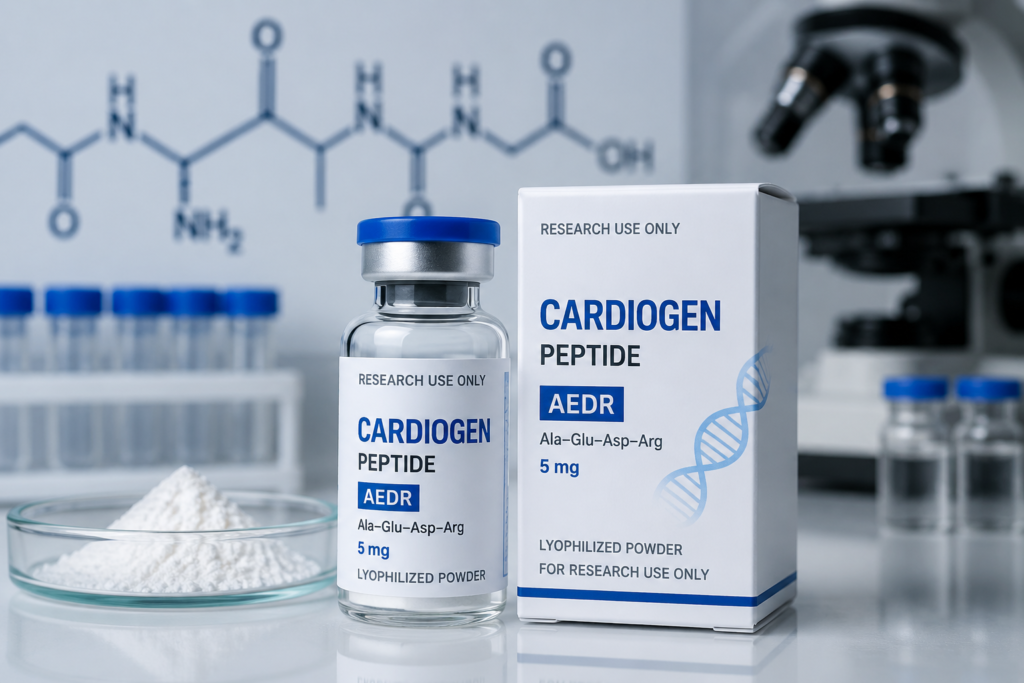
Cardiogen Peptide Benefits: What Does the Research Actually Show?
What are the benefits of Cardiogen peptide? Cardiogen is an experimental short peptide commonly identified as Ala-Glu-Asp-Arg (AEDR). It belongs to the broader research field of short peptide bioregulators and has attracted interest because of studies investigating its potential effects on myocardial tissue, cellular regulation, proliferation, and apoptosis-related pathways. Cardiogen Peptide
However, it is important to distinguish potential research applications from proven health benefits. Most available cardiogen peptide benefits research is preclinical, and there is not enough high-quality human clinical evidence to establish Cardiogen as an effective treatment for cardiovascular disease, heart failure, heart damage, or aging. what is cardiogen
This article examines the potential Cardiogen peptide benefits, what researchers have actually studied, proposed mechanisms, limitations of the evidence, and frequently asked questions. cardiogen peptide dosage
Research disclaimer: Cardiogen is an experimental peptide and is not an FDA-approved medication. This article is for educational and informational purposes only and should not be interpreted as medical advice or a recommendation for human use.
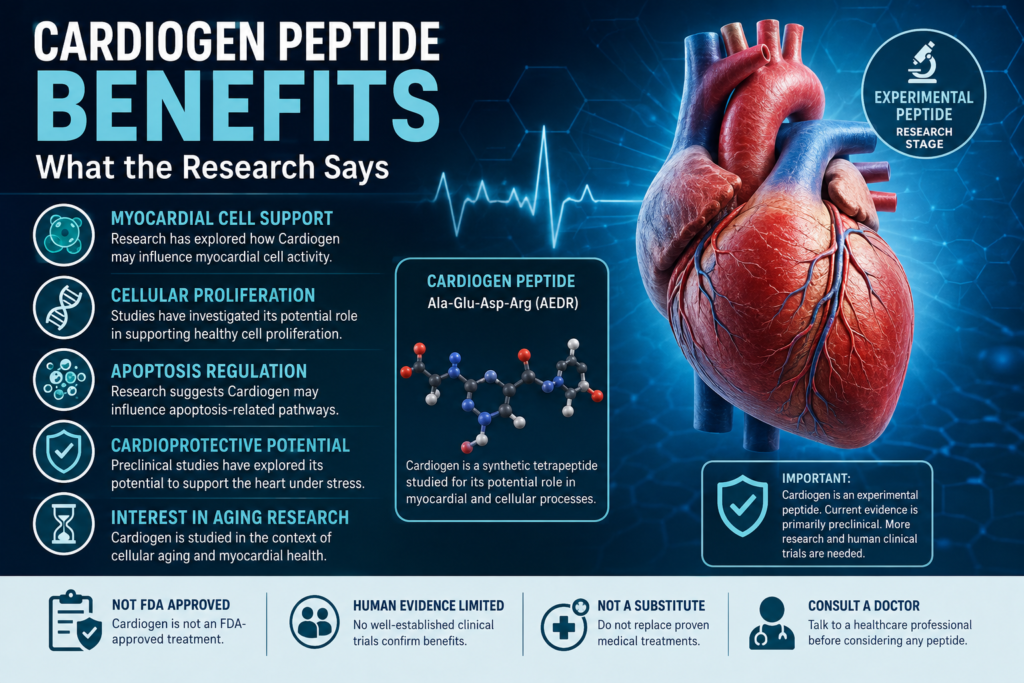
What Is Cardiogen Peptide?
Cardiogen is generally described as a synthetic tetrapeptide consisting of four amino acids:
Ala-Glu-Asp-Arg (AEDR)
It is associated with the Khavinson family of peptide bioregulators, a research area investigating whether short amino-acid sequences may influence cellular regulatory processes.
Cardiogen has received particular attention because research has examined its relationship with myocardial tissue and cellular processes associated with cardiac biology.
The peptide should not, however, be confused with an approved cardiovascular drug. cardiogen peptide benefits Bronchogen
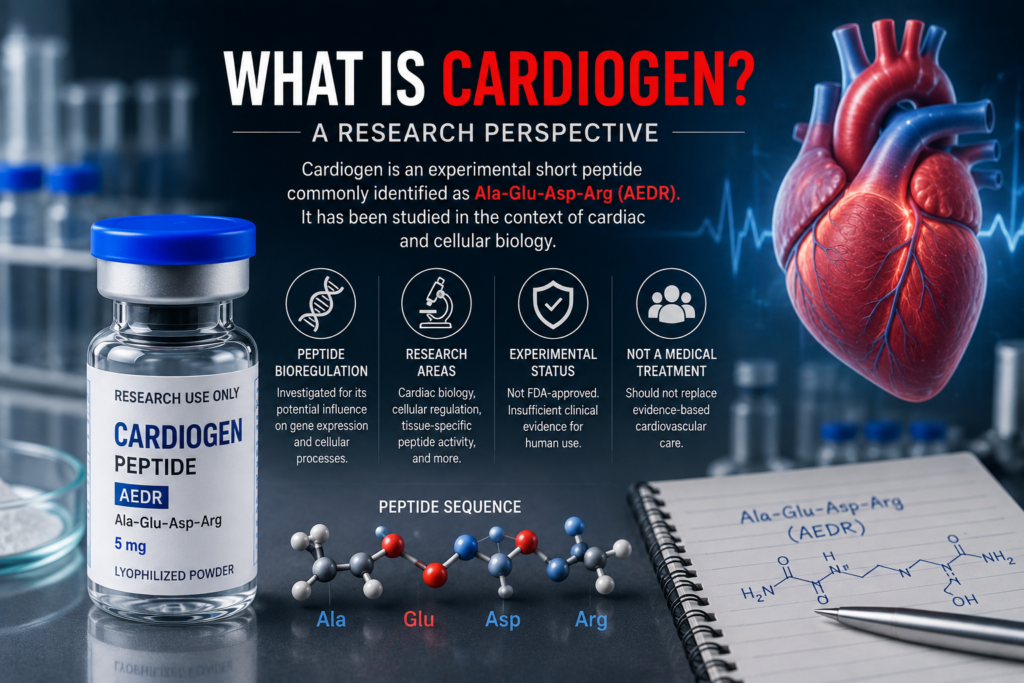
Cardiogen Peptide at a Glance
| Characteristic | Information |
|---|---|
| Name | Cardiogen |
| Common abbreviation | AEDR |
| Type | Synthetic tetrapeptide |
| Length | 4 amino acids |
| Research focus | Myocardial and cellular biology |
| Evidence level | Primarily preclinical |
| FDA approved | No |
| Established human dosage | No |
What Are the Potential Cardiogen Peptide Benefits?
When people search for Cardiogen peptide benefits, they are often looking for information about heart health, regeneration, cellular aging, or cardiovascular protection.
The available evidence does not establish these as proven human benefits.
Instead, Cardiogen has been investigated in several research areas that may help explain why the peptide has attracted scientific interest.
1. Myocardial Tissue Research
One of the most prominent areas of Cardiogen research involves myocardial tissue.
Experimental studies have investigated Cardiogen in organotypic cultures of myocardial tissue, including tissue obtained from young and older animals. Researchers have examined cellular processes such as proliferation and apoptosis-related activity.
These experiments are potentially relevant to understanding how short peptides might influence cardiac-cell biology.
However, a finding in cultured tissue does not demonstrate a therapeutic effect in humans.
2. Research Into Cellular Proliferation
Another potential area of interest is cellular proliferation.
Cell proliferation refers to the process through which cells divide and produce new cells. Because maintaining healthy tissue requires appropriate regulation of cell growth, researchers have investigated whether peptide bioregulators can influence these processes.
Cardiogen has been studied in myocardial tissue models in connection with cellular proliferation.
This research may be useful for understanding basic cellular mechanisms.
It does not, however, establish that Cardiogen can regenerate the human heart.
3. Apoptosis-Related Research
Apoptosis is a naturally regulated form of programmed cell death.
Healthy tissues require a balance between cellular proliferation and cell death. Disruptions in this balance can contribute to various biological processes.
Research involving Cardiogen has examined markers associated with apoptosis, including pathways involving proteins such as p53.
These findings have contributed to interest in Cardiogen as a research tool for studying cellular regulation.
It would be premature to translate these observations into claims that Cardiogen prevents heart-cell death or treats cardiovascular disease.
4. Research Into Cardiac Aging
Cardiogen has also attracted interest because some experimental studies have compared young and aged myocardial tissues.
This makes the peptide relevant to research exploring how aging affects:
- Cellular proliferation
- Cellular signaling
- Gene expression
- Tissue maintenance
- Apoptosis-related pathways
The broader concept of peptide bioregulation proposes that short peptides may have tissue-associated regulatory effects.
However, there is currently insufficient evidence to establish Cardiogen as an anti-aging treatment or cardiovascular longevity therapy in humans.
5. Peptide–Protein Interaction Research
Another area of interest involves the potential interaction of short peptides with proteins involved in cellular regulation.
AEDR has appeared in biochemical research examining interactions between short peptides and histones, which are proteins involved in organizing DNA.
These investigations may provide clues about how short peptides could potentially influence molecular processes.
However, biochemical interaction in a laboratory setting does not automatically demonstrate a physiological effect in humans.
6. Peptide–DNA Research
Researchers have also investigated short peptides in connection with DNA-associated structures.
The proposed peptide-bioregulator model suggests that some short peptide sequences may interact with nuclear proteins and influence gene-expression processes.
AEDR has been investigated within this broader area of research.
cardiogen peptide benefits This is scientifically interesting but remains an area of investigation rather than an established clinical mechanism. ACE-031
Does Cardiogen Improve Heart Health?
There is currently insufficient human evidence to conclude that Cardiogen improves heart health.
The peptide’s association with myocardial research has led to numerous claims about cardiovascular benefits, but those claims should be interpreted cautiously.
There is no established clinical evidence demonstrating that Cardiogen:
- Treats heart failure
- Repairs damaged heart muscle
- Prevents heart attacks
- Improves ejection fraction
- Reverses cardiomyopathy
- Prevents atherosclerosis
- Reduces cardiovascular mortality
Research in animal or tissue models cannot establish these outcomes in humans. cardiogen peptide benefits 5-Amino-1MQ
Can Cardiogen Regenerate the Heart?
One of the most frequently repeated claims about Cardiogen is that it may support heart regeneration.
Current evidence does not justify making that claim as a proven human benefit.
Some preclinical studies have investigated cellular proliferation in myocardial tissue. That is an interesting research finding, but heart regeneration involves considerably more than cell proliferation.
A functioning human heart requires coordinated:
- Cardiomyocyte activity
- Blood-vessel formation
- Electrical conduction
- Structural organization
- Extracellular matrix remodeling
- Mechanical function
Demonstrating that Cardiogen influences one cellular pathway would not establish regeneration of functional heart tissue. cardiogen peptide benefits tesamorelin vs ipamorelin
Cardiogen Peptide and Cardiovascular Research
The primary scientific interest in Cardiogen comes from its potential role as a research compound for studying cellular regulation in myocardial tissue.
Researchers have investigated questions such as:
- How do myocardial cells respond to short peptides?
- Does aging alter peptide responsiveness?
- Can short peptides influence cellular proliferation?
- Are apoptosis-related pathways affected?
- Can peptide–protein interactions help explain biological activity?
These questions remain relevant to basic research, but they should not be confused with evidence that Cardiogen is an effective cardiovascular treatment. cardiogen peptide benefits Glow Peptide
Cardiogen Peptide Benefits vs. Marketing Claims
A useful way to evaluate Cardiogen information is to separate research observations from clinical claims.
| Claim | Evidence status |
|---|---|
| Studied in myocardial tissue | Preclinical evidence |
| Investigated for cellular proliferation | Preclinical evidence |
| Studied in apoptosis-related pathways | Preclinical evidence |
| Investigated in aging-related tissue models | Preclinical evidence |
| May support heart regeneration | Not established in humans |
| Treats heart disease | Not established |
| Prevents heart attacks | Not established |
| Improves heart function | Not established |
| Extends lifespan | Not established |
| FDA-approved cardiovascular therapy | No |
This distinction is especially important when evaluating online peptide marketing.
Is Cardiogen FDA Approved?
No.
Cardiogen is not an FDA-approved medication for cardiovascular disease or any other medical indication.
Available evidence reviews characterize Cardiogen as an experimental peptide, with research primarily conducted in preclinical models.
Consequently, Cardiogen should not be marketed as a proven treatment for heart disease. cardiogen peptide benefits Glow Blend (TB 10mg + BPC 10mg + GHK 50mg)
Cardiogen Peptide Safety
Another important consideration is the limited amount of human safety data.
Because controlled human clinical trials have not established Cardiogen’s therapeutic profile, researchers do not have enough evidence to determine:
- Long-term safety
- Optimal exposure
- Human pharmacokinetics
- Drug interactions
- Immunogenicity
- Dose-related adverse effects
- Appropriate treatment duration
Preclinical findings can help identify potential mechanisms and safety signals, but they cannot replace human clinical research. cardiogen peptide benefits
Cardiogen Peptide Dosage
There is currently no established human therapeutic dosage for Cardiogen.
This is an important point for anyone searching for both “Cardiogen peptide benefits” and “Cardiogen peptide dosage.”
A laboratory concentration or animal-study amount should not be interpreted as a human dosing recommendation.
Without controlled human dose-ranging studies, there is no scientifically validated standard for:
- Daily dosage
- Injection dosage
- Oral dosage
- Dosing frequency
- Treatment duration
How Does Cardiogen Compare With Other Peptide Bioregulators?
Cardiogen is often discussed alongside other short peptides associated with the Khavinson research field.
| Peptide | Common research association |
|---|---|
| Cardiogen | Myocardial/cardiac research |
| Bronchogen | Bronchial/respiratory research |
| Cortagen | Nervous-system research |
| Epitalon | Aging/pineal research |
These peptides are often described as tissue-specific bioregulators.
However, the evidence supporting their proposed effects varies considerably, and tissue-specific biological activity has not been established as a clinically validated therapeutic principle for Cardiogen. cardiogen peptide benefits
What Does the Research Actually Tell Us?
The current evidence suggests that Cardiogen is an interesting preclinical research compound, but there is a substantial gap between experimental observations and clinical applications.
What researchers have observed
Research has investigated Cardiogen in:
- Myocardial tissue cultures
- Animal models
- Cellular proliferation
- Apoptosis-related pathways
- Molecular interactions
- Aging-related tissue research
What remains unknown
Researchers still need reliable human evidence concerning:
- Clinical effectiveness
- Optimal dosage
- Pharmacokinetics
- Long-term safety
- Cardiovascular outcomes
- Appropriate patient populations
This is why Cardiogen should currently be viewed as an experimental research peptide. cardiogen peptide benefits tesamorelin peptide