
How Peptides Are Used in Scientific Research: Applications, Benefits, and Limitations
Peptides play an important role in modern scientific research, helping researchers investigate biological processes, understand diseases, explore potential treatments, and develop new diagnostic technologies. From molecular biology and biochemistry to pharmaceutical development and biotechnology, these small chains of amino acids provide valuable tools for studying how living systems function. how peptides are used in scientific research? what is mod grf 1 29
As laboratory techniques continue to advance, peptides are being investigated in areas such as drug discovery, cell signaling, immunology, cancer research, and biomaterials science. Understanding how peptides are used in scientific research helps explain why they have become an important part of modern laboratory investigations. how peptides are used in scientific research What Does Peptide Purity Mean in Laboratory Research?
In this guide, we explore what research peptides are, how peptides are used in scientific research, how researchers evaluate their quality, and the limitations that scientists must consider. how peptides are used in scientific research? How to Read a Peptide Certificate of Analysis (COA)
What Are Peptides in Scientific Research?
Peptides are short chains of amino acids connected by peptide bonds. Amino acids are the basic building blocks of proteins, and peptides can function as signaling molecules, biological regulators, research probes, or components of larger molecular systems.
Although how peptides are used in scientific research and proteins are closely related, peptides are generally shorter than proteins. However, there is no universally accepted length cutoff that separates every peptide from every protein.
In scientific research, how peptides are used in scientific research may be obtained from natural biological sources, produced through chemical synthesis, or generated using biological production methods. Researchers can also modify peptide structures to investigate how changes in their amino acid sequences influence biological activity. how peptides are used in scientific research? Mod GRF 1-29
how peptides are used in scientific research? Synthetic peptides are particularly useful because scientists can design molecules with specific sequences and use them to study defined biological questions.
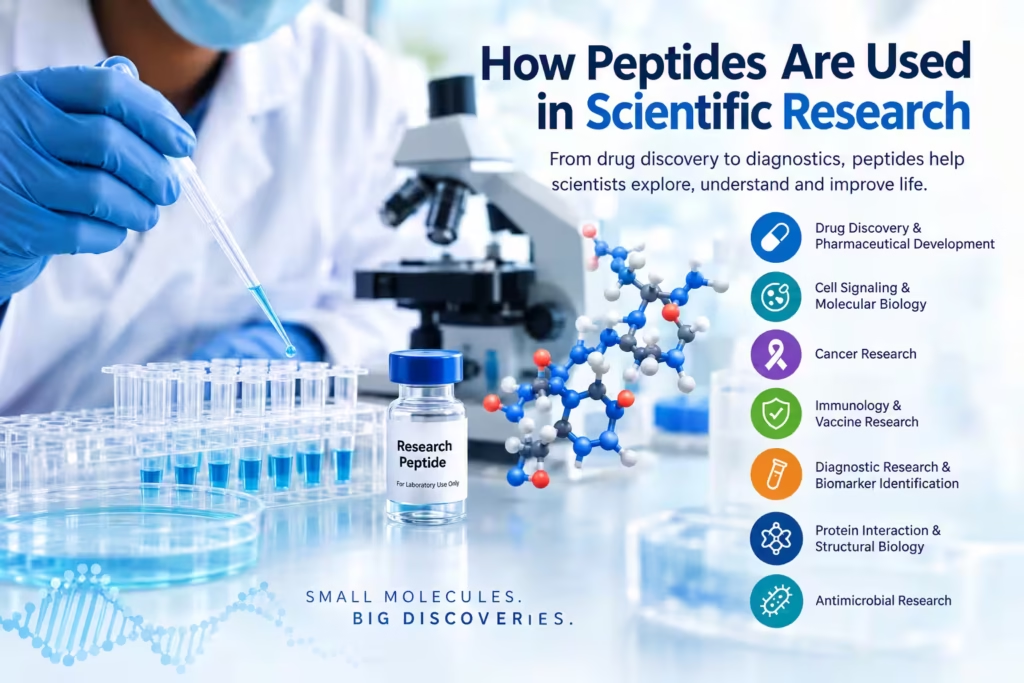
7 Major Ways how peptides are used in scientific research
1. Drug Discovery and Pharmaceutical Development
One of the most important applications of how peptides are used in scientific research is drug discovery. Researchers investigate whether particular peptide structures can interact with biological targets involved in disease.
These targets may include receptors, enzymes, proteins, or other molecules associated with specific cellular processes.
Peptides can help scientists:
- Identify potential therapeutic candidates.
- Investigate interactions between molecules and biological targets.
- Study how changes in amino acid sequences affect activity.
- Explore ways to improve molecular stability and selectivity.
- Evaluate the potential of peptide-based medicines during preclinical development.
For example, researchers may design a series of related how peptides are used in scientific research and compare their interactions with a particular receptor. The resulting information can help identify structural features that influence molecular recognition. how peptides are used in scientific research?
how peptides are used in scientific research? Peptide-based medicines have already demonstrated their importance in several areas of medicine, including metabolic and endocrine disorders. However, a peptide being investigated in a laboratory is not automatically a safe or effective treatment.
2. Cell Signaling and Molecular Biology
Cells communicate through complex networks of chemical signals. Peptides can act as signaling molecules or help researchers investigate the pathways through which cells respond to their surroundings.
Scientists use peptides to examine processes such as receptor activation, intracellular signaling, gene regulation, and cellular communication.
For example, a laboratory may investigate how a peptide interacts with a cell-surface receptor and whether that interaction changes a measurable cellular response.
These studies can help researchers understand how cells coordinate their activities and how disruptions in signaling pathways may contribute to disease.
Peptides can also serve as experimental probes that help scientists investigate specific molecular interactions under controlled conditions.
3. Cancer Research
Peptides are studied in cancer research for several purposes, including tumor biology, biomarker development, immune recognition, and the investigation of potential therapeutic approaches.
Some research focuses on peptide sequences derived from tumor-associated proteins. These sequences may help scientists investigate how the immune system recognizes particular molecular features.
Other studies examine peptides as potential components of targeted drug-delivery systems or as candidates for interacting with molecular targets involved in cancer development.
Research applications include:
- Studying tumor-associated antigens.
- Investigating immune responses to specific peptide sequences.
- Exploring peptide-based drug-delivery technologies.
- Identifying molecular interactions associated with cancer progression.
- Evaluating candidate molecules in laboratory models.
These applications remain dependent on the specific peptide and experimental design. Results from cell cultures or animal models do not necessarily predict effectiveness in humans.
4. Immunology and Vaccine Research
Peptides are valuable tools in immunology because immune cells recognize specific molecular features of proteins, including short sequences known as epitopes.
Researchers can synthesize selected peptide sequences to investigate how antibodies or immune cells recognize particular targets.
This approach is useful for studying immune responses, mapping protein epitopes, and developing experimental diagnostic methods.
Peptide research also contributes to vaccine development. Some vaccine strategies use selected antigenic peptides to investigate whether an immune response can be directed toward a particular biological target.
Scientists may examine how peptide sequence, molecular presentation, and formulation affect immune recognition.
However, not every peptide can trigger a useful immune response, and the development of a functional vaccine requires extensive testing of safety, effectiveness, and formulation.
5. Diagnostic Research and Biomarker Identification
Another important application of peptides is the development and evaluation of diagnostic tools.
A biomarker is a measurable biological characteristic that can provide information about a physiological process, disease, or response to an intervention.
Researchers may use peptides to investigate whether specific antibodies, proteins, or other biological components can be detected reliably in a sample.
For example, a synthetic peptide representing part of a viral protein may be evaluated as a reagent in an experimental antibody-detection assay.
Peptides may also be studied as analytical targets when researchers investigate changes in biological samples associated with particular diseases.
In these applications, scientists must assess factors such as sensitivity, specificity, reproducibility, and the possibility of cross-reactivity.
A promising laboratory result is only an early step toward establishing a reliable diagnostic method.
6. Protein Interaction and Structural Biology
Understanding how biological molecules interact is central to biochemistry and molecular biology. Peptides provide relatively small and manageable systems for investigating these interactions.
Researchers can synthesize selected sequences from larger proteins to examine which regions contribute to binding, recognition, or molecular activity.
This can help scientists identify important binding sites and investigate structure–activity relationships.
For example, researchers may compare several peptides that differ by one amino acid to determine whether that change affects their interaction with a target protein.
Such experiments can contribute to a better understanding of molecular recognition and help guide the design of future research compounds.
Peptides are also investigated in biomaterials science, where their ability to assemble into organized structures may be useful for studying hydrogels, scaffolds, and other materials intended for biomedical research.
7. Antimicrobial Research
Antimicrobial peptides are another important subject of scientific investigation. These molecules occur naturally in many organisms and are studied for their roles in biological defense.
Researchers investigate how antimicrobial peptides interact with microbial membranes, influence microbial survival, and respond to different experimental conditions.
Potential research applications include:
- Investigating mechanisms of microbial resistance.
- Comparing the activity of different peptide sequences.
- Studying interactions between peptides and microbial membranes.
- Exploring potential approaches to antimicrobial development.
- Examining how molecular structure affects biological activity.
This field is particularly relevant as scientists continue to investigate alternatives and complementary approaches to existing antimicrobial strategies.
Nevertheless, activity observed in a laboratory assay does not establish clinical effectiveness. Further studies are needed to assess toxicity, stability, selectivity, and performance in relevant biological environments.
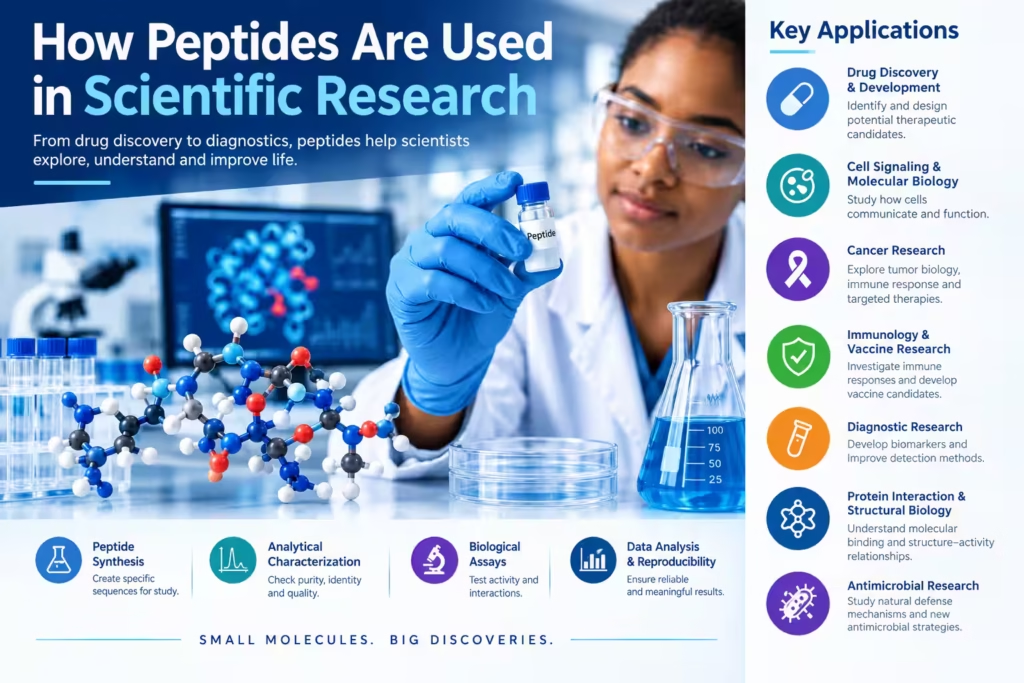
How Are Peptides Studied in Laboratory Research?
The methods used to investigate how peptides are used in scientific research depend on the scientific question, the molecular properties of the peptide, and the type of biological system being examined.
Common research approaches include the following.
Peptide Synthesis
Peptide synthesis is the process of producing a peptide with a specified amino acid sequence.
One widely used technique is solid-phase peptide synthesis (SPPS), in which amino acids are assembled sequentially while the growing peptide remains attached to a solid support. Synthesis Methods
Researchers may use synthetic peptides to investigate molecular interactions, compare related sequences, or prepare reagents for analytical experiments.
Other production approaches include solution-phase synthesis and biological methods, depending on the peptide and the research requirements.
Analytical Characterization
Before a peptide is used in an experiment, researchers may evaluate its identity, purity, and relevant chemical properties.
Two commonly used analytical techniques are high-performance liquid chromatography (HPLC) and liquid chromatography–mass spectrometry (LC-MS).
HPLC can help separate components in a sample and assess chromatographic purity. Mass spectrometry can provide information about molecular mass and support the identification of the target peptide.
These techniques answer different questions, and neither should be interpreted as a complete assessment of every property that could influence experimental performance.
Biological Assays
Biological assays are used to investigate how a peptide behaves in a particular experimental system.
Depending on the research objective, scientists may examine receptor binding, enzyme activity, cell viability, immune recognition, or other measurable outcomes.
Appropriate controls and validated methods are essential for interpreting these results.
Researchers must also consider whether the assay accurately represents the biological process they intend to study.
Data Analysis and Reproducibility
Experimental data must be analyzed systematically to determine whether observed differences are meaningful and reproducible.
Researchers may compare experimental groups, assess variability, evaluate statistical significance, and repeat experiments under appropriate conditions.
Accurate records of peptide identity, sample handling, analytical results, and experimental conditions help other scientists evaluate and reproduce the findings.
Why Are Peptide Purity and Quality Important in Research?
Peptide quality can directly affect the interpretation of laboratory findings.
A sample may contain the intended peptide alongside related sequences, residual synthesis reagents, degradation products, or other impurities. These components may interfere with measurements or make it difficult to determine which substance produced an observed result.
Several factors are important when evaluating research peptides:
Identity: Does the sample contain the intended amino acid sequence and molecular structure?
Purity: What proportion of the measured sample corresponds to the target peptide under the stated analytical method?
Concentration: Is the amount of peptide in the sample accurately established?
Stability: Does the peptide remain sufficiently intact under the intended storage and experimental conditions?
Solubility: Can the peptide be prepared appropriately for the planned experiment?
Documentation: Are analytical results, batch information, and relevant handling requirements available?
Purity alone does not guarantee that a sample is suitable for every experiment. A highly pure sample may still have an incorrect concentration, poor stability, or properties that make it unsuitable for a particular assay.
For more information, researchers can consult scientific literature on how peptides are used in scientific research.
What Are the Limitations of how peptides are used in scientific research?
Despite their usefulness, how peptides are used in scientific research present several challenges.
Stability and Degradation
Some peptides are susceptible to degradation by enzymes or may undergo chemical changes during storage and handling. Researchers must consider these properties when designing experiments and interpreting results.
Solubility and Delivery
A peptide’s solubility depends on factors such as its amino acid sequence, charge, and hydrophobicity. Some peptides may be difficult to prepare in a form suitable for a particular experimental system.
Biological Complexity
A peptide may produce different results depending on the cell type, biological environment, experimental model, or assay conditions.
Cost and Production Challenges
The cost of producing a peptide depends on its sequence, length, chemical modifications, synthesis difficulty, purification requirements, and production scale.
Translating Laboratory Findings Into Medical Applications
An effect observed in a test tube or cell culture does not necessarily translate into a useful treatment in humans.
Potential medicines must undergo appropriate development, safety evaluation, and clinical testing. Research-grade peptides should not be assumed to be approved medicines or suitable for human use.
Research Peptides vs. Therapeutic Peptides: What Is the Difference?
The distinction between research peptides and therapeutic peptides is important.
Research peptides are materials used to investigate scientific questions. They may be intended for analytical testing, molecular studies, or controlled laboratory experiments.
Therapeutic peptides are developed for medical use and must meet the applicable quality, safety, and regulatory requirements for their intended purpose.
Some therapeutic candidates begin as research compounds, but many never progress to clinical use. The transition requires evidence that the compound can be manufactured consistently, used safely, and provide a meaningful benefit for its intended indication.
A product described as a research peptide should not be assumed to be approved for diagnosis, prevention, or treatment of disease.
What Is the Future of Peptide Research?
how peptides are used in scientific research continues to evolve alongside advances in chemistry, biotechnology, analytical instrumentation, and computational molecular design. nad+
Emerging research directions include improved peptide synthesis methods, strategies for enhancing molecular stability, peptide-based diagnostic technologies, targeted delivery systems, and the investigation of new molecular targets. Semax + Selank Blend
Computational approaches may also help scientists identify candidate sequences and prioritize compounds for experimental evaluation. However, predictions must be tested using appropriate laboratory methods. how peptides are used in scientific research? ipamorelin peptide
As these technologies develop, peptides are likely to remain valuable tools for exploring biological mechanisms and investigating potential biomedical applications.
Their long-term scientific value will depend on rigorous experimental design, reliable analytical characterization, reproducible results, and appropriate evaluation of safety and effectiveness.