
How to Verify a Certificate of Analysis for Peptides: A Step-by-Step Guide
A certificate of analysis for peptides (COA) is an important document used to communicate the results of laboratory testing for a particular material or batch. When evaluating research peptides, a certificate of analysis for peptides can provide information about the compound’s identity, purity, testing methods, and other quality characteristics. Sermorelin
However, simply finding a certificate of analysis for peptides on a supplier’s website does not automatically mean the document is authentic, complete, or relevant to the product being evaluated. A certificate of analysis for peptides may relate to a different batch, omit important testing details, or present results that are difficult to verify independently. tesamorelin peptide
Understanding how to verify a certificate of analysis for peptides can help researchers, laboratory professionals, and quality assurance teams evaluate analytical documentation more critically. Tesamorelin + Ipamorelin
In this guide, we explain how to check a certificate of analysis for peptides, verify laboratory information, interpret common analytical results, and identify warning signs that deserve further investigation. what are peptides and how do they work
What Is a Certificate of Analysis for Peptides?
A certificate of analysis for peptides is a document that records the results of specified tests performed on a sample or batch of material. Depending on the laboratory, manufacturer, and product specification, it may include identity testing, purity measurements, quantitative assays, and additional quality tests.
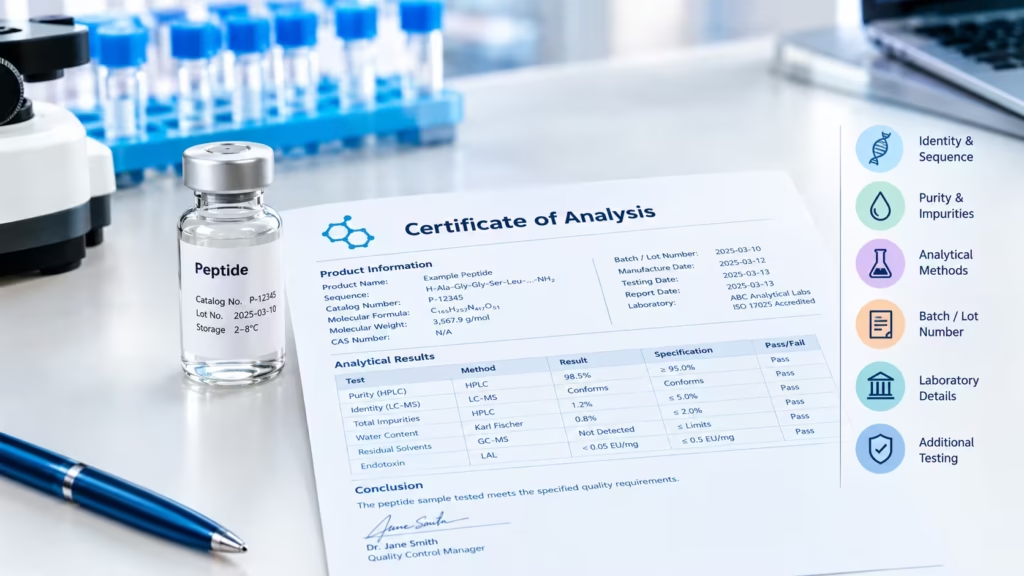
A typical peptide COA may contain:
- The peptide or material name
- A batch or lot number
- The laboratory or manufacturer responsible for testing
- The date of testing and report issuance
- Analytical methods used
- Test specifications and acceptance criteria
- Numerical results and pass-or-fail determinations
- Laboratory report identifiers or authorization details
The exact contents vary depending on the material and the purpose of the analysis.
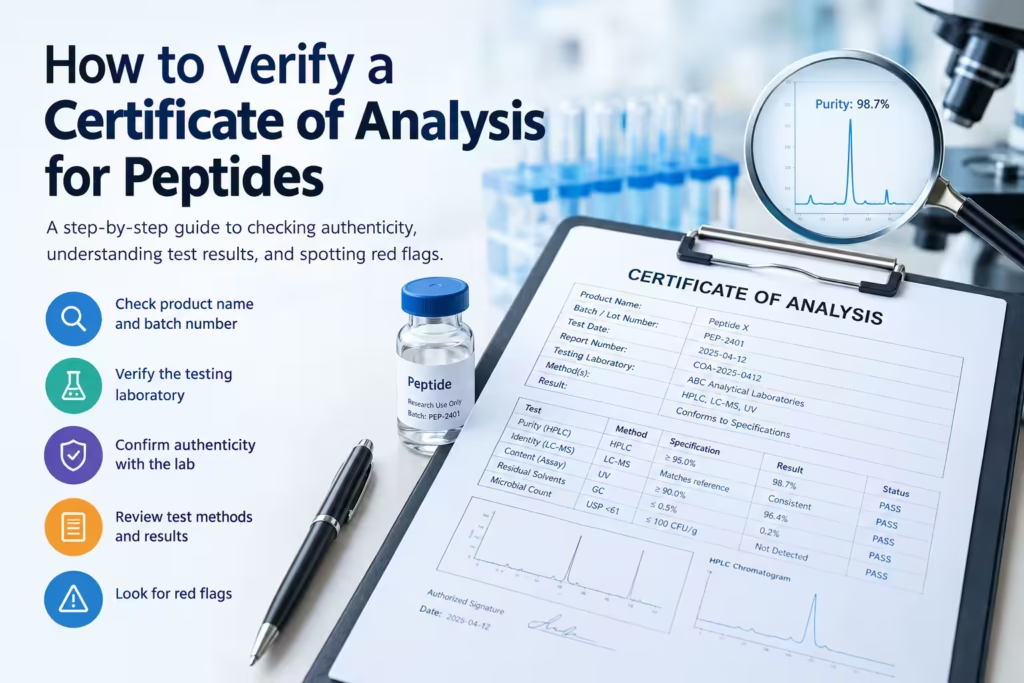
It is important to remember that a certificate of analysis for peptides is not automatically proof of every quality characteristic. Its value depends on the tests performed, the reliability of the laboratory, the traceability of the sample, and the accuracy of the reported information. How to Read a Peptide Certificate of Analysis (COA)
Why Is It Important to Verify a certificate of analysis for peptides?
Verifying a certificate of analysis for peptides helps determine whether the document provides credible evidence about the specific material it claims to describe.
Without verification, readers may mistakenly assume that a published report establishes the identity, purity, quantity, or safety of every product carrying the same name.
There are several reasons to examine a certificate of analysis for peptides carefully. Semax
1. Confirming material identity
A purity result alone does not establish that the main component is the intended peptide. Separate identity testing is needed to support that conclusion.
2. Checking batch traceability
A certificate should be associated with an identifiable batch or lot. A report for one batch cannot automatically establish the characteristics of another.
3. Understanding analytical results
Laboratory percentages and pass-or-fail statements are meaningful only when the underlying methods and measurements are understood.
4. Evaluating laboratory credibility
Confirming who issued a report and whether it can be independently authenticated helps distinguish traceable analytical evidence from unsupported claims.
5. Identifying documentation gaps
A certificate of analysis for peptides may omit important details, such as the analytical method, testing date, or numerical results. Identifying these omissions helps determine whether further documentation is necessary. thymosin alpha-1
How to Verify a Certificate of Analysis for Peptides
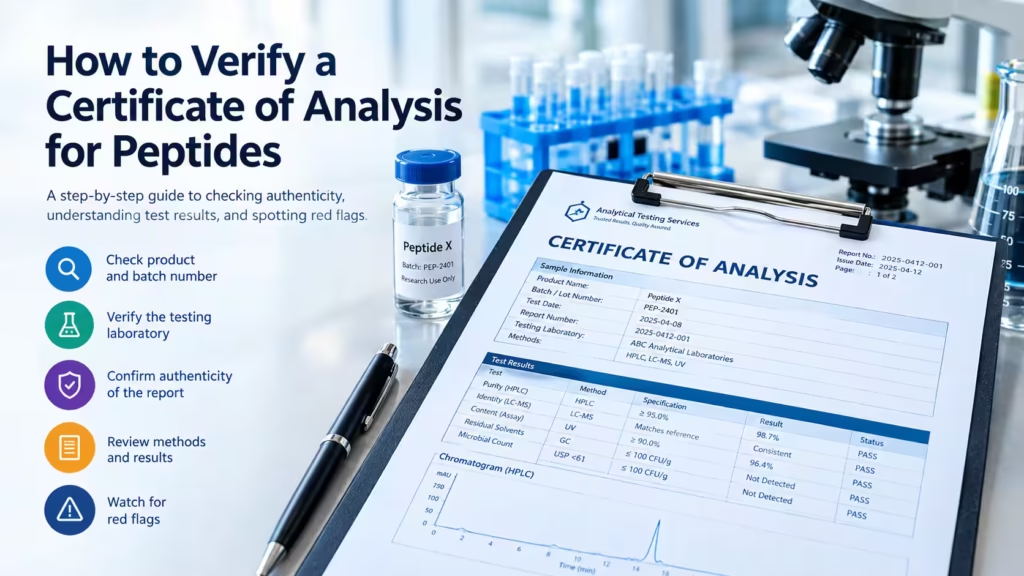
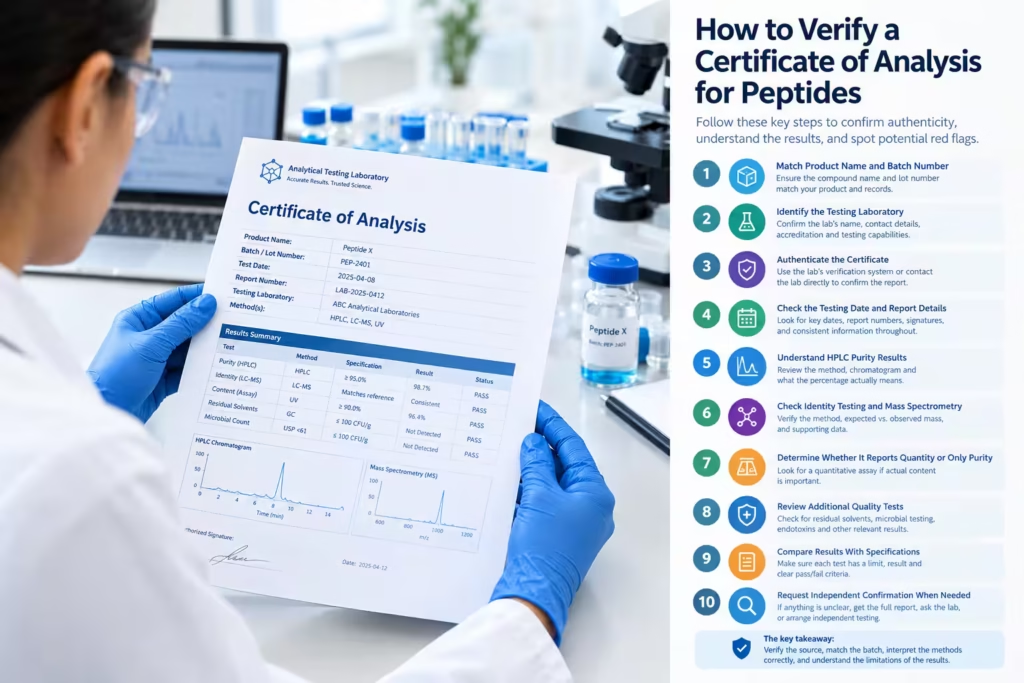
The following steps provide a systematic way to review a certificate of analysis for peptides.
Step 1: Match the Product Name and Batch Number
Start by checking whether the product name and batch or lot number on the certificate match the corresponding information on the material’s label and associated documentation.
The batch number is especially important because a certificate of analysis for peptides generally applies to the particular sample or batch identified in the report.
For example, a certificate issued for batch PEP-2401 should not automatically be accepted as evidence for batch PEP-2402.
Check the following details:
- Does the compound name match?
- Is the batch or lot number identical?
- Does the certificate identify the relevant material form or specification?
- Is the document associated with the actual batch being evaluated?
- Do the report and product records contain consistent identifiers?
If the batch number is missing or does not match, request clarification and supporting documentation before treating the certificate of analysis for peptides as evidence for that material. ara-290
Step 2: Identify the Testing Laboratory
Next, locate the name of the laboratory that performed the analysis.
A credible report should identify the responsible laboratory or provide enough information to establish who issued it. Depending on the report, this may include the laboratory’s address, report number, contact information, or other identifying details.
Do not rely exclusively on statements such as “lab tested” or “third-party verified.” These phrases do not identify who performed the work.
Instead, establish:
- The laboratory’s full name
- Whether the laboratory can be independently contacted
- Whether the report identifies the tests it performed
- Whether the laboratory has relevant analytical capabilities
- Whether any claimed accreditation can be confirmed
If the laboratory is accredited to ISO/IEC 17025, verify the accreditation through the relevant accreditation body’s records and check whether its scope covers the testing in question. Accreditation should not be assumed simply because a certificate displays a logo. humanin peptide
An in-house laboratory can produce legitimate quality-control results, but those results should not be confused with independent third-party testing.
Step 3: Authenticate the certificate of analysis for peptides With the Issuing Laboratory
One of the most useful verification steps is to determine whether the laboratory recognizes the certificate as an authentic report.
Some laboratories provide online report verification, searchable report numbers, QR codes, or unique verification codes. Others may confirm report details through an official contact channel.
If a verification system is available:
- Obtain the report number or verification code directly from the certificate.
- Navigate to the laboratory’s official website independently.
- Locate its report verification page.
- Enter the relevant identifier.
- Compare the retrieved report with the document supplied by the manufacturer or distributor.
Check whether the product name, batch number, report date, analytical results, and laboratory details agree.
A QR code should not be treated as proof of authenticity merely because it opens a webpage. Confirm that it directs to the legitimate laboratory or its authorized verification service. foxo4-dri peptide
If no online verification system exists, contact the laboratory using independently obtained contact information. Ask whether it issued the report and whether the identifiers and results correspond to its records.
If the laboratory cannot confirm the report, treat its authenticity as unresolved rather than assuming it is genuine. Dihexa Peptide
Step 4: Check the Testing Date and Report Details
A certificate of analysis for peptides should provide sufficient information to establish when the analysis took place and which material was examined.
Look for the sample receipt date, testing date, report issuance date, and any revision or approval date provided.
These dates can help reveal inconsistencies. For example, a report may require clarification if it appears to have been issued before the relevant sample was received or tested.
Also examine the report number, page numbering, laboratory details, and any signatures or electronic approvals.
Look for inconsistent fonts, unexplained alterations, missing pages, conflicting identifiers, or results that do not agree between sections.
These features are not conclusive proof of falsification on their own. They are reasons to request the original report or obtain confirmation directly from the laboratory.
Step 5: Understand HPLC Purity Results
High-performance liquid chromatography (HPLC) is commonly used to separate components in a sample and assess their relative abundance under a specified analytical method.
A peptide certificate of analysis for peptides may report a result such as 98.5% purity by HPLC.
Before interpreting this figure, check:
- Whether HPLC or another method was used
- Whether the method is identified clearly
- Whether the reported percentage is explained
- Whether a chromatogram or supporting analytical data is available
- Whether the result is evaluated against a stated specification
A chromatogram displays detector responses associated with separated components. The main peak and other detected peaks can help an analyst assess the sample’s composition under the method used.
However, HPLC peak-area purity is not necessarily the same as the percentage of peptide by total weight. Detector response, water content, counterions, residual solvents, and other substances may affect how the result should be interpreted.
A high purity percentage also does not, by itself, establish molecular identity, exact peptide content, sterility, or suitability for a particular application.
For that reason, avoid evaluating acertificate of analysis for peptides based on its purity percentage alone. Tesofensine Peptide
Step 6: Check Identity Testing and Mass Spectrometry Results
Identity testing addresses a different question from purity testing: does the analytical evidence support the claim that the material is the intended compound?
Mass spectrometry (MS), including liquid chromatography–mass spectrometry (LC-MS), is frequently used to support peptide identity by measuring mass-related properties.
When reviewing a certificate, look for:
- The identity-testing method
- The expected molecular mass or relevant reference information
- The observed mass or reported identity result
- An explanation of the comparison, where appropriate
- Supporting spectra or other analytical data, if available
The observed result should be consistent with the expected result within the limits of the method and the characteristics of the molecule.
Interpretation may require accounting for charge states, adducts, molecular form, and instrument conditions. Consequently, a mass value should not be judged without the relevant analytical context.
Mass spectrometry can support identity, but a molecular-mass match alone may not distinguish every possible structural variant or establish the complete sequence. Additional methods may be needed depending on the peptide and the required level of confirmation.
Step 7: Determine Whether the certificate of analysis for peptides Reports Quantity or Only Purity
Another important distinction is the difference between purity and quantity.
Purity describes a sample’s composition according to a specified measurement. Quantity or content testing addresses how much of the target substance is present.
A certificate can report high chromatographic purity without establishing that the sample contains the amount stated on its label.
For instance, a report showing 99% HPLC area purity does not automatically demonstrate that a container labeled as containing 10 mg holds 10 mg of the target peptide.
If quantitative content is important to the evaluation, look for an appropriate assay that reports the measured quantity and explains the method used.
Check whether the result refers to total sample mass, peptide content, concentration, or another defined measurement. These are not interchangeable.
Step 8: Review Additional Quality Tests
Depending on the intended laboratory application and material specification, a COA may include additional tests for relevant quality attributes.
Examples include:
- Residual solvents
- Water content
- Counterion content
- Elemental impurities
- Microbial contamination
- Endotoxin levels
- Other specified impurities
Not every test is necessary for every material. The appropriate analytical panel depends on the compound, manufacturing process, intended application, and applicable quality requirements.
A report that includes one or two analytical methods should not be assumed to cover all these characteristics.
In particular, chemical purity results do not establish sterility or endotoxin compliance. Those require suitable, separate testing where applicable.
If a specific quality characteristic is important, confirm that the certificate of analysis for peptides explicitly reports the relevant test and result.
Step 9: Compare Results With Specifications and Acceptance Criteria
A laboratory result becomes more informative when it is compared with an appropriate specification or acceptance criterion.
Look for a clear relationship between each test, its method, the applicable limit, and the measured result.
For example, a certificate might report a numerical purity result alongside a minimum purity specification. That allows the reader to understand how the laboratory reached its pass-or-fail determination.
Be cautious when a report displays only the word “PASS” without identifying the test, applicable limit, or result.
A pass statement may be valid, but without supporting information it is difficult to independently evaluate.
Also remember that a result meeting one specification does not prove that every other quality requirement has been met.
Step 10: Request Independent Confirmation When Necessary
If a report cannot be authenticated, contains unexplained inconsistencies, or does not provide enough information for the intended evaluation, additional evidence may be necessary.
Depending on the situation, this could involve requesting the complete laboratory report, clarifying the analytical methods, confirming the report with the issuing laboratory, or arranging suitable independent testing through a qualified laboratory.
Independent confirmation is particularly relevant when decisions depend on a material’s identity, content, or other critical quality attributes.
Testing should be selected according to the question being investigated. A purity test alone will not answer every question about identity, quantity, contamination, or microbial quality.
The goal is not simply to obtain another certificate. It is to obtain evidence that addresses the specific uncertainty.
Common Red Flags on a Peptide Certificate of Analysis
When reviewing a peptide COA, pay attention to warning signs that may indicate incomplete documentation or a need for further verification.
| Potential red flag | Why it matters |
|---|---|
| Missing batch or lot number | The report may not be traceable to the material being evaluated. |
| Unidentified testing laboratory | The issuer and source of the results are difficult to establish. |
| No identifiable report number | Independent authentication may be more difficult. |
| Purity percentage without a named method | The measurement cannot be interpreted adequately. |
| No supporting identity results | Purity alone does not establish the intended compound’s identity. |
| Unexplained differences between documents | The certificate and product records may refer to different material or contain errors. |
| A generic certificate used for multiple batches | The evidence may not apply to the specific batch in question. |
| A QR code that leads to an unrelated website | The destination does not establish that the issuing laboratory recognizes the report. |
| Only pass-or-fail statements with no useful detail | The basis for the conclusions is difficult to evaluate. |
| Missing or contradictory dates | The testing history may need clarification. |
A single warning sign does not necessarily prove that a certificate is fraudulent. However, unresolved discrepancies should not be dismissed simply because the document looks professional or displays a high purity figure.
What Does a Verified certificate of analysis for peptides Actually Prove?
A properly authenticated certificate of analysis for peptides can provide credible evidence that a laboratory issued a report containing specific results for an identified sample.
What those results establish depends on the methods used, the sample tested, and the scope of the analysis.
For example, a report may support a conclusion about molecular identity or chromatographic purity without establishing the exact amount of peptide present.
Likewise, testing one sample does not automatically establish the characteristics of every container in a batch, particularly if sample collection and traceability have not been adequately controlled.
A certificate of analysis for peptides also does not automatically establish clinical effectiveness, safety for human use, regulatory approval, or suitability for a particular medical application.
The most reliable evaluation considers the certificate alongside laboratory verification, batch traceability, appropriate testing methods, and other relevant quality documentation.
Frequently Asked Questions about certificate of analysis for peptides
1. How do I verify a certificate of analysis for peptides?
Start by matching the compound name and batch number to the relevant product records. Identify the issuing laboratory, authenticate the report through its official verification system or contact channel, and review the analytical methods and results.
Check purity and identity separately, confirm the dates and report identifiers, and investigate any inconsistencies before relying on the document.
2. What should a peptide certificate of analysis include?
A useful COA generally identifies the material, batch or lot, testing laboratory, report date, analytical methods, specifications, and results. Depending on the testing scope, it may also include chromatograms, mass spectra, quantitative measurements, and other quality results.
The necessary details depend on the material and the purpose of the analysis.
3. Is a 99% peptide purity result always reliable?
No. A reported 99% purity result must be interpreted in the context of the analytical method and the sample tested.
For example, a 99% HPLC area result does not necessarily mean that 99% of the sample’s total weight consists of the target peptide. It also does not independently confirm identity, quantity, sterility, or overall product quality.
4. Can a peptide COA be fake?
Yes. A document can be altered, misrepresented, or presented in a way that obscures its original context.
To reduce this risk, verify the report directly with the issuing laboratory when possible. Compare report identifiers, batch details, dates, and results, and investigate discrepancies rather than relying on the appearance of a PDF.
5. What is the difference between HPLC and mass spectrometry?
HPLC separates components in a sample and can be used to estimate relative purity under a specified method.
Mass spectrometry measures mass-to-charge ratios and can provide evidence supporting molecular identity.
These techniques answer different analytical questions. Using one does not automatically replace the other when both purity and identity need to be established.
6. Does a third-party COA guarantee peptide quality?
No. Third-party testing can provide valuable independent evidence, but its significance depends on the laboratory’s independence, the sample tested, the methods used, and the scope of the report.
A third-party certificate does not automatically guarantee that every quality attribute has been tested or that the material is suitable for every application.