
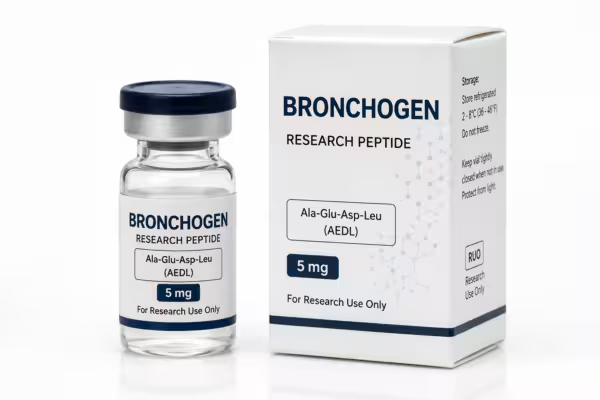
Bronchogen Peptide: What It Is, Research, Benefits, and Current Evidence
Bronchogen is a synthetic short peptide that has been investigated in laboratory and animal research involving bronchial tissue, epithelial biology, gene expression, and peptide–DNA interactions. Often identified as Ala-Glu-Asp-Leu (AEDL), Bronchogen belongs to the family of short peptide bioregulators associated with the Khavinson research program. Glow Peptide
Interest in Bronchogen has grown among researchers studying respiratory tissue biology and experimental peptide bioregulation. However, the evidence remains preclinical, with research consisting primarily of cell studies and animal models rather than controlled clinical trials in humans. Glow Blend (TB 10mg + BPC 10mg + GHK 50mg)
Research-use notice: Bronchogen is not an FDA-approved medication, and the available evidence does not establish it as a treatment for COPD, asthma, lung disease, or any other human medical condition. This page is intended for informational and research-education purposes.
What Is Bronchogen?
Bronchogen is generally described as a synthetic tetrapeptide, meaning it consists of four amino acids. The sequence most commonly reported is:
Ala-Glu-Asp-Leu (AEDL)
Bronchogen has also appeared under slightly different sequence notation in portions of the literature, so researchers should verify the identity, sequence, salt form, and analytical documentation of any material being studied rather than relying solely on the product name. Bpc-157 + TB-500
The peptide is associated with the short-peptide bioregulator research program developed by Vladimir Khavinson and colleagues. Within this research framework, different short peptides have been investigated for potential tissue-specific effects.
Bronchogen has primarily attracted interest because of research involving bronchial epithelial cells, DNA interactions, and experimental models of obstructive lung pathology.
Bronchogen Peptide Research
The scientific literature surrounding Bronchogen is relatively small compared with extensively studied pharmaceutical peptides.
Research has investigated several areas, including:
- Bronchial epithelial cell differentiation
- Gene-expression activity
- Peptide–DNA interactions
- DNA thermostability
- Bronchial epithelial structure
- Experimental obstructive lung pathology
- Local respiratory immune markers
- Inflammatory signaling in animal models
Importantly, these findings should be interpreted according to the experimental model in which they were observed. Results from cultured cells or rodents do not establish that the same effects occur in humans. where to buy bpc 157 and tb 500
How Does Bronchogen Work?
The proposed mechanism of Bronchogen is different from that of conventional receptor-targeted medications.
Research involving short peptides from this family has investigated whether these molecules can enter cells and interact with nucleic acids. In one study, Bronchogen was among the peptides investigated for interactions with DNA sequences, with the researchers reporting preferential interactions involving particular nucleotide sequences.
Another study examined Bronchogen in cultured human bronchial cells and reported changes in the expression of differentiation-associated factors including CXCL12 and Hoxa3. The effect was more pronounced in older cell cultures in that experimental setting.
These findings provide a basis for further research into peptide-mediated gene regulation, but they do not demonstrate that Bronchogen produces a therapeutic effect in people. Mod GRF 1-29
Bronchogen and Bronchial Epithelial Research
One of the more relevant areas of Bronchogen research involves bronchial epithelial cells.
The bronchial epithelium forms an important protective interface within the respiratory tract. Researchers have therefore investigated whether short peptides could influence cellular differentiation and tissue-associated gene expression.
In a 2012 study, Bronchogen was tested in cultures of human bronchial cells. The researchers reported stimulation of CXCL12 and Hoxa3 expression following exposure to the peptide. ACE-031
Because this was a cell-culture experiment, the findings demonstrate biological activity under laboratory conditions rather than clinical efficacy.
Bronchogen and Lung Research
Animal research has provided another area of interest.
A 2015 study examined Bronchogen in rats with experimentally induced obstructive lung pathology. The researchers reported changes involving bronchial epithelial remodeling, including goblet-cell hyperplasia, squamous metaplasia, lymphocytic infiltration, emphysematous changes, and ciliated-cell populations. The study also reported changes in secretory IgA and inflammatory markers following experimental peptide administration.
These results are interesting from a preclinical respiratory-biology perspective, but they should not be interpreted as evidence that Bronchogen treats COPD or reverses lung disease in humans.
Animal models are useful for generating hypotheses, but human clinical trials are required to determine whether a compound is safe and effective for people.
Potential Broncho-gen Benefits: What Does the Research Suggest?
Searches for Broncho-gen frequently focus on terms such as “Broncho-gen benefits” or “Bronchogen peptide benefits.” It is important to distinguish research observations from proven health benefits.
The research has explored possible effects involving:
Bronchial Cell Differentiation
Laboratory research has reported changes in differentiation-associated gene expression in human bronchial cell cultures following exposure to Bronchogen.
Bronchial Tissue Structure
In a rat model of experimentally induced obstructive lung pathology, researchers reported improvements in several histological characteristics of bronchial tissue following experimental Bronchogen treatment.
Respiratory Inflammatory Markers
The same animal study reported changes in inflammatory cell composition and pro-inflammatory cytokine profiles in bronchoalveolar samples.
DNA and Gene-Regulation Research
Broncho-gen has also been studied in laboratory experiments examining interactions between short peptides and DNA.
These findings make Bronchogen an interesting subject for continued research, but none of these laboratory findings establishes a clinically proven benefit in humans.
Is Broncho-gen a Peptide?
Yes. Broncho-gen is generally described as a short synthetic peptide or tetrapeptide.
The most commonly reported identity is:
Ala-Glu-Asp-Leu (AEDL)
Its short four-amino-acid structure places it within the class of ultra-short peptide bioregulators investigated in the Khavinson research tradition. GHK-CU 100mg
Bronchogen Molecular Information
For researchers evaluating Broncho-gen as a laboratory compound, commonly reported molecular information includes:
| Property | Research information |
|---|---|
| Compound | Broncho-gen |
| Common sequence | Ala-Glu-Asp-Leu (AEDL) |
| Peptide type | Synthetic tetrapeptide |
| Amino acids | 4 |
| Molecular formula | C18H30N4O9 |
| Molecular weight | Approximately 446.45 g/mol |
| Research category | Short peptide bioregulator |
| Primary research area | Bronchial and respiratory tissue biology |
| Human clinical evidence | No established clinical efficacy data |
Sequence and molecular-identity information should always be verified against the analytical documentation associated with the specific research material being evaluated. is thymosin beta 4 the same as tb500
Broncho-gen vs. Other Research Peptides
Broncho-gen is distinct from many popular metabolic or growth-related peptides because its research focus is primarily bronchial and respiratory tissue biology.
Unlike peptides investigated for GLP-1 signaling, growth-hormone pathways, or tissue repair more broadly, Broncho-gen has been studied within a short-peptide bioregulator framework focused on gene expression and bronchial epithelial biology.
This makes it particularly relevant to researchers investigating:
- Respiratory tissue models
- Bronchial epithelial biology
- Short peptide–DNA interactions
- Cellular differentiation
- Experimental lung pathology
- Gene-expression mechanisms
Does Broncho-gen Have Human Clinical Trials?
At present, there is no established body of controlled human clinical evidence demonstrating that Broncho-gen is safe or effective for treating respiratory disease.
The identifiable literature includes human cell-culture experiments, animal studies, and biochemical research. A human cell experiment should not be confused with a human clinical trial involving patients.
This distinction is especially important when evaluating online claims about Broncho-gen’s ability to improve breathing, lung function, COPD, asthma, inflammation, or respiratory recovery.
Is Broncho-gen FDA Approved?
No. Broncho-gen is not FDA-approved as a medication.
It should not be presented as an FDA-approved treatment for COPD, asthma, lung inflammation, respiratory infections, or other medical conditions.
Products marketed online as Broncho-gen may be labeled for research use only. Researchers should review the applicable regulatory requirements in their jurisdiction before acquiring or using experimental peptide materials.
Broncho-gen Safety and Side Effects
A major limitation of the current Broncho-gen evidence base is the lack of comprehensive human safety data.
Because controlled human safety studies have not established a clinical safety profile, it is not possible to reliably characterize:
- Long-term safety
- Human pharmacokinetics
- Drug interactions
- Appropriate clinical dosing
- Contraindications
- Effects during pregnancy
- Effects in people with chronic respiratory disease
- Rare or serious adverse events
For that reason, animal or cell-study findings should not be used to establish a human safety profile.
Broncho-gen Dosage
There is no established, evidence-based human dosage for Broncho-gen.
Published research protocols may use experimental concentrations or animal-administration schedules, but those conditions are not equivalent to a medically validated human dosing regimen.
Consequently, research literature describing an experimental amount should not be interpreted as a recommendation for self-administration. Semax
What Is Broncho-gen Used For?
In an appropriate laboratory context, Broncho-gen may be investigated as a research compound for studying:
- Bronchial epithelial biology
- Cellular differentiation
- Gene-expression mechanisms
- Peptide–DNA interactions
- Respiratory tissue models
- Experimental obstructive lung pathology
These are research applications, not established medical indications. cjc-1295+ ipamorelin



Reviews
There are no reviews yet.