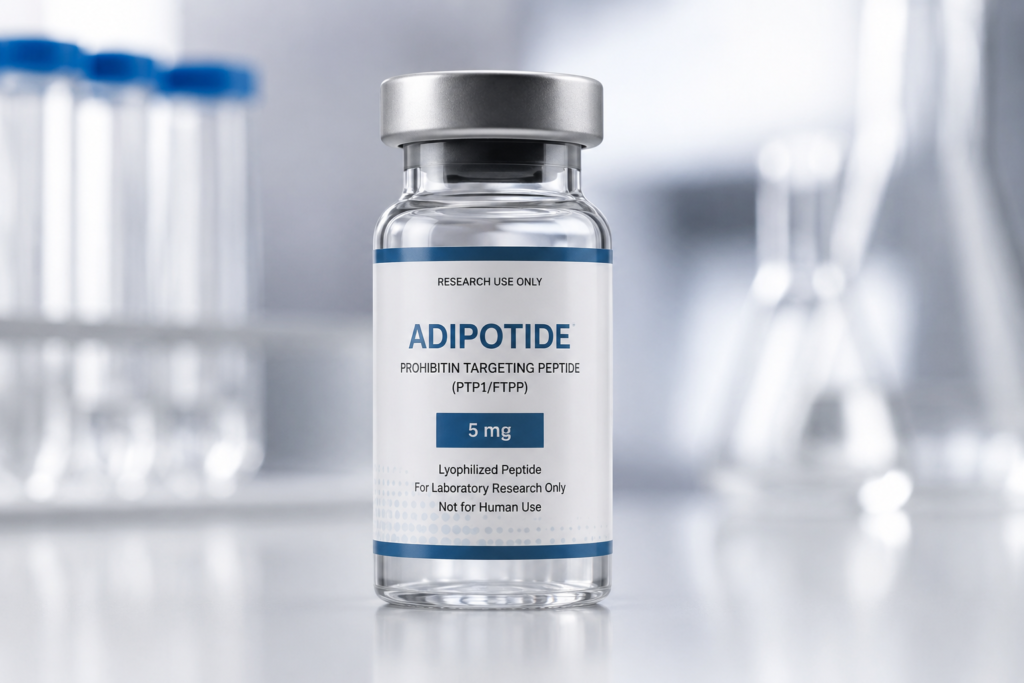
What Is Adipotide? A Complete Guide to This Experimental Research Peptide
Adipotide is an experimental peptide that has attracted attention because of its potential role in obesity and adipose-tissue research. Unlike many compounds investigated for weight management, What Is Adipotide was designed to target the blood vessels associated with white adipose tissue. Adipotide
But what exactly What Is Adipotide, how does it work, and what does the research actually show? Glow Peptide
In this guide, we explain what adipotide is, how adipotide works, its potential research applications, safety considerations, and how it differs from established weight-management medications. Glow Peptide
What Is Adipotide?
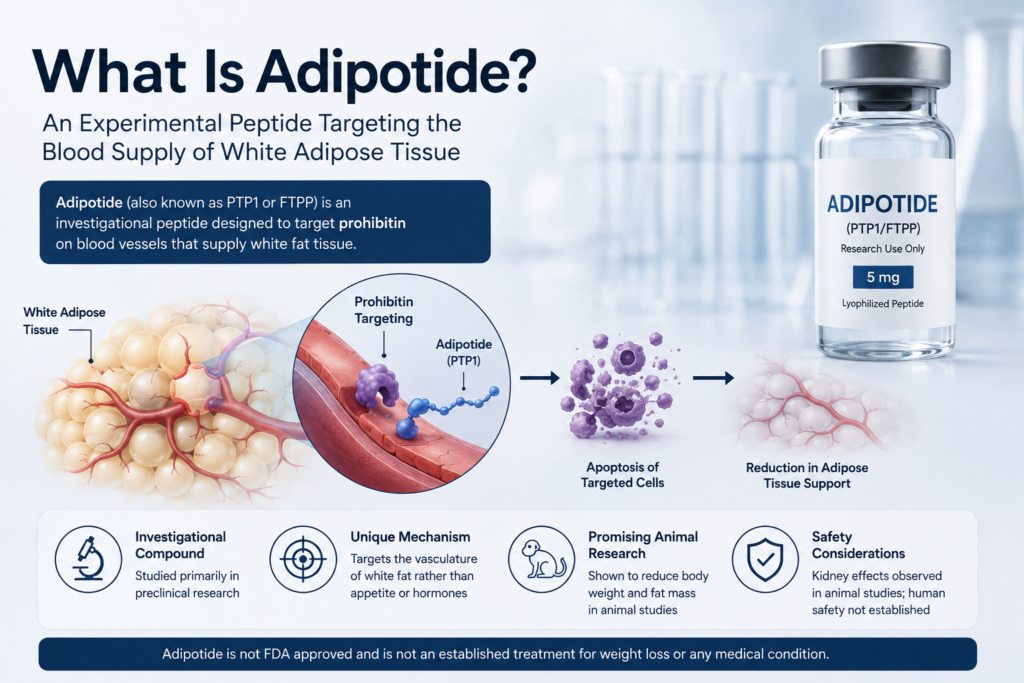
Adipotide is a synthetic proapoptotic peptidomimetic that was developed as an experimental approach to targeting white adipose tissue.
The compound is designed with two functional components. One portion is intended to recognize prohibitin-1 (PHB1) associated with the vasculature of adipose tissue, while another portion has proapoptotic activity.
The goal of this design is to investigate whether selectively affecting blood vessels associated with white adipose tissue could influence fat-tissue survival and ultimately affect body weight and metabolic function.
Adipotide has primarily been studied in preclinical research, including animal models of obesity.
How Does Adipotide Work?
The proposed mechanism of adipotide is different from that of appetite-regulating medications.
Adipotide was designed as a targeted molecule. Its targeting component recognizes prohibitin-1, which has been investigated as a marker associated with the blood vessels supplying white adipose tissue.
After targeting, the proapoptotic component is intended to promote cellular processes associated with apoptosis.
In simplified terms, researchers have investigated adipotide through the following mechanism:
Target recognition → adipose-associated vascular targeting → proapoptotic activity → changes in adipose tissue
This approach is particularly interesting because it focuses on the vascular support of adipose tissue rather than directly stimulating or suppressing appetite. What Is Adipotide ACE-031
What Is Adipotide Used For?
Adipotide is primarily relevant to scientific and preclinical research involving:
- Adipose-tissue biology
- Obesity research
- Metabolic research
- Proapoptotic peptides
- Targeted peptide delivery
- Vascular biology
- Insulin resistance research
It is important to distinguish these research applications from medical treatment.
Adipotide is not an FDA-approved medication for weight loss or obesity.
Research findings involving animals also cannot automatically be translated into equivalent effects in humans.
Adipotide and Weight-Loss Research
One reason adipotide became widely discussed is research investigating its effects on body weight and adipose tissue.
A study published in Science Translational Medicine investigated adipotide in obese nonhuman primates. Researchers reported reductions in body weight and white adipose tissue, along with improvements in insulin resistance. The study also identified renal effects, demonstrating the importance of safety evaluation.
These findings helped generate interest in adipotide as a potential experimental strategy for studying obesity.
However, the results should be interpreted within their proper context: animal research does not establish that adipotide is a safe or effective human weight-loss treatment. What Is Adipotide 5-Amino-1MQ
What Are the Potential Benefits of Adipotide?
When discussing adipotide benefits, it is important to use research-focused language rather than treating experimental findings as established medical benefits.
Studies have investigated adipotide for its potential to:
Target Adipose-Tissue Vasculature
Adipotide’s targeting mechanism is one of its most distinctive characteristics. Researchers designed the compound to recognize prohibitin-1 associated with blood vessels in white adipose tissue.
Influence White Adipose Tissue
Preclinical research has investigated whether targeting adipose-associated vasculature could contribute to reductions in white adipose tissue.
Affect Body Weight in Animal Models
Animal studies have reported body-weight reductions following adipotide treatment.
Improve Certain Metabolic Measurements
Research in obese nonhuman primates also reported improvements in insulin resistance alongside reductions in body weight and adipose tissue.
These findings are scientifically interesting, but additional research is required to establish the potential clinical relevance of What Is Adipotide. tesamorelin vs ipamorelin
Is Adipotide a Fat-Burning Peptide?
Calling adipotide a simple “fat-burning peptide” can be misleading.
Traditional descriptions of fat burning generally refer to increased fat oxidation or changes in energy expenditure. Adipotide’s proposed mechanism is different.
Instead, researchers have investigated adipotide as a targeted proapoptotic compound that may affect the vascular support of white adipose tissue.
Therefore, adipotide is better understood as an experimental adipose-tissue-targeting peptide than as a conventional fat burner.
Adipotide vs. GLP-1 Peptides
Adipotide is sometimes compared with modern weight-management peptides, but the two approaches are fundamentally different.
| Feature | Adipotide | GLP-1-Based Treatments |
|---|---|---|
| Research status | Investigational | Some are FDA-approved |
| Primary mechanism | Targeted proapoptotic activity | GLP-1 receptor signaling |
| Main research area | Adipose tissue and vascular biology | Appetite, glucose regulation and metabolism |
| Human clinical evidence | Limited | Extensive for approved therapies |
| Approved weight-loss treatment | No | Yes, for certain medications |
This difference is important when evaluating information about experimental peptides online. What Is Adipotide BPC-157 vs GHK-Cu
Is Adipotide FDA Approved?
No. Adipotide is not FDA approved.
It should not be marketed or described as an approved treatment for:
- Obesity
- Weight loss
- Diabetes
- Insulin resistance
- Metabolic syndrome
- Other medical conditions
The fact that a compound has been investigated in scientific studies does not mean that it has received regulatory approval for human use.
Adipotide Safety and Side Effects
Safety is an important consideration when discussing adipotide.
In preclinical research involving obese nonhuman primates, investigators reported renal effects involving the proximal tubules. These findings are particularly relevant because kidney function is an important consideration when evaluating experimental compounds.
Because clinical evidence remains limited, the full human safety profile of adipotide has not been established.
Researchers and readers should therefore be cautious about claims that present adipotide as a proven or risk-free weight-loss compound. What Is Adipotide GHK-CU 100mg
Is Adipotide Safe for Humans?
There is not enough clinical evidence to establish adipotide as a safe and effective treatment for humans.
Animal studies can provide useful information about mechanisms and potential biological effects, but they cannot establish the complete safety profile of a compound in people.
Anyone considering an investigational compound should consult a qualified healthcare professional rather than relying on online dosing recommendations or marketing claims.
Adipotide Research Status
Adipotide has been investigated in both preclinical and early clinical research. A review of adipose-targeting approaches identifies adipotide as a proapoptotic peptide targeting prohibitin-1 and notes a Phase 1 clinical program associated with NCT01262664 that was subsequently discontinued.
This history highlights an important distinction between scientific interest and clinical validation.
A compound can be scientifically significant without becoming an approved pharmaceutical.
Why Are Researchers Interested in Adipotide?
The scientific interest in adipotide comes largely from its unusual targeting strategy.
Many obesity treatments focus on:
- Appetite regulation
- Hormonal signaling
- Glucose metabolism
- Gastrointestinal signaling
- Energy expenditure
Adipotide represents a different research concept: targeting the biological infrastructure associated with adipose tissue.
This makes it relevant to researchers studying the relationship between blood vessels, adipose tissue, metabolism, and obesity. What Is Adipotide Tesofensine Peptide