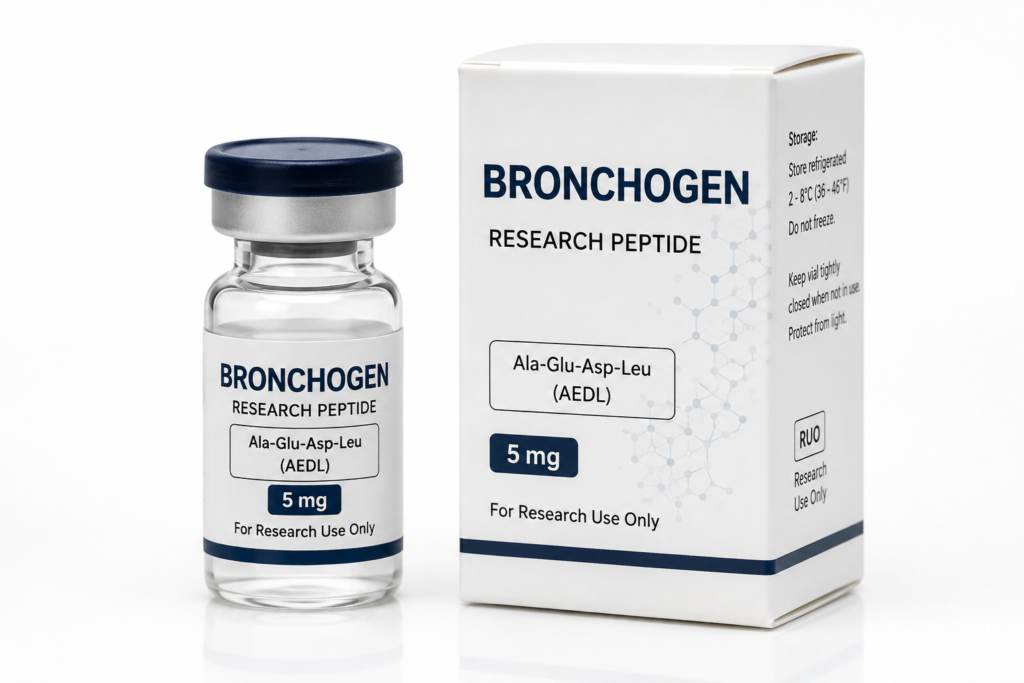
What Is Bronchogen Peptide? A Research-Based Guide to Bronchogen
What is Bronchogen peptide? Bronchogen is a synthetic, ultra-short peptide that has been investigated in preclinical research involving DNA interactions, bronchial epithelial biology, gene expression, and respiratory tissue models. Bronchogen
Bronchogen is generally described as a four-amino-acid peptide associated with the Khavinson short-peptide bioregulator research program. However, an important scientific detail is that the published literature contains an inconsistency regarding the exact order of the amino acids. One PubMed-indexed paper names Bronchogen as Ala-Asp-Glu-Leu (ADEL), while other sources and publications use Ala-Glu-Asp-Leu (AEDL). bronchogen dosage
Most importantly, What Is Bronchogen Peptide remains an experimental research compound. The available evidence does not establish it as an approved treatment for COPD, asthma, bronchitis, lung injury, or other human diseases. bronchogen peptide benefits
Research disclaimer: This article is for educational and informational purposes. Preclinical findings should not be interpreted as proof of human safety or effectiveness.
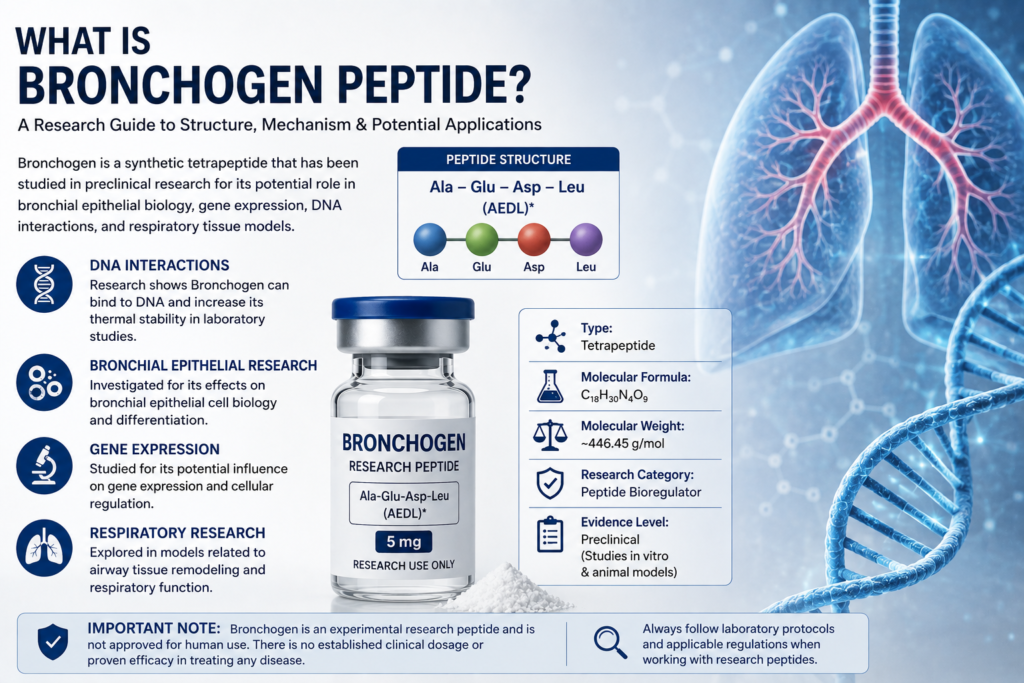
What Is Bronchogen Peptide?
Bronchogen is generally classified as a synthetic tetrapeptide, meaning it contains four amino-acid residues.
The commonly reported identity is:
Ala-Glu-Asp-Leu (AEDL)
The amino acids are:
- Ala — alanine
- Glu — glutamic acid
- Asp — aspartic acid
- Leu — leucine
A PubMed-indexed study, however, identifies Bronchogen as Ala-Asp-Glu-Leu (ADEL) in its title. This discrepancy is worth noting when comparing scientific papers, databases, and research-product specifications.
What Is Bronchogen Peptide is associated with the broader group of short peptide bioregulators developed through research attributed to Vladimir Khavinson and colleagues. Glow Peptide
What Is Bronchogen Peptide Used For in Research?
Bronchogen has primarily attracted research interest because of its proposed relationship with bronchial and respiratory tissue biology.
Research involving Bronchogen has explored areas including:
- DNA–peptide interactions
- DNA thermostability
- Bronchial epithelial biology
- Cellular differentiation
- Gene-expression activity
- Respiratory tissue remodeling
- Experimental pulmonary models
The available evidence is predominantly preclinical, meaning it does not establish clinical effectiveness in humans for What Is Bronchogen Peptide. Glow Blend (TB 10mg + BPC 10mg + GHK 50mg)
How Does Bronchogen Work?
The proposed mechanism of Bronchogen differs from conventional pharmaceutical drugs.
Researchers studying short peptide bioregulators have investigated whether these small molecules can interact with cellular components such as DNA and chromatin-associated structures, potentially influencing gene-expression processes.
There is experimental evidence supporting the ability of Bronchogen to interact with DNA under controlled laboratory conditions. A 2011 study used differential scanning microcalorimetry to investigate Bronchogen and DNA and reported an increase in DNA melting temperature under a specific range of experimental peptide-to-DNA ratios.
However, demonstrating a biochemical interaction in a laboratory experiment does not establish that the same mechanism produces a therapeutic effect in humans.
What Is Bronchogen Peptide and DNA Research
One of the clearest primary research records involving Bronchogen examines its interaction with DNA.
Researchers investigated DNA from calf thymus and mouse liver in the presence of Bronchogen. The study reported that Bronchogen increased DNA melting temperature by approximately 3.1°C within a particular experimental range.
The authors characterized Bronchogen as having a DNA-stabilizing effect under their experimental conditions.
This finding is scientifically interesting because it provides a biochemical basis for investigating how short peptides may interact with nucleic acids.
It should not, however, be interpreted as evidence that Bronchogen modifies human DNA or provides a clinical respiratory benefit. tesamorelin vs ipamorelin
Bronchogen and Bronchial Research
The name Bronchogen is associated with research focused on the bronchial epithelium.
The bronchial epithelium is a specialized cellular lining that contributes to the airway’s protective barrier and participates in processes involving mucus production, cellular differentiation, immune signaling, and responses to environmental exposure.
Because of these functions, researchers have investigated whether short peptides could influence bronchial epithelial biology.
Some secondary research summaries describe Bronchogen as a respiratory or bronchial bioregulator, but the strongest claims should be limited to what has actually been demonstrated experimentally. Current evidence does not establish Bronchogen as a clinically proven lung-repair or respiratory-treatment peptide.
Bronchogen and Gene Expression
Gene expression is another area associated with research into Bronchogen and related short peptides.
The underlying hypothesis is that ultra-short peptides may influence cellular regulation through interactions with DNA or other nuclear components.
This is one reason Bronchogen is sometimes described as a peptide bioregulator rather than simply a conventional signaling peptide.
However, proposed mechanisms should be distinguished from established mechanisms. Much of the bioregulator framework remains a research hypothesis, and there is not enough human evidence to establish how Bronchogen behaves therapeutically in people. What Is Bronchogen Peptide ACE-031
Bronchogen Peptide Benefits: What Does Research Suggest?
Searches for Bronchogen peptide benefits often produce claims about lung health, airway repair, inflammation, and respiratory function.
A more scientifically cautious interpretation is that preclinical research has investigated Bronchogen in relation to:
Bronchial epithelial biology
Researchers have examined whether Bronchogen and related peptides influence characteristics associated with bronchial epithelial cells.
Gene-expression processes
Experimental research has explored changes in cellular gene-expression markers following exposure to short peptides.
DNA interactions
Bronchogen has demonstrated measurable interactions with DNA under specific laboratory conditions.
Respiratory tissue models
Bronchogen has been investigated within experimental models related to bronchial and pulmonary tissue.
These findings may justify additional research about What Is Bronchogen Peptide, but they should not be presented as established health benefits in humans.

Is Bronchogen a Lung Peptide?
Bronchogen is often referred to online as a lung peptide, bronchial peptide, or respiratory peptide because its research program is associated with bronchial tissue.
That terminology describes its research focus rather than an FDA-approved medical indication.
There is currently insufficient human clinical evidence to conclude that Bronchogen improves lung function, treats respiratory disease, or repairs damaged lung tissue.
Is Bronchogen the Same as a Conventional Peptide Drug?
No.
There is an important difference between an experimental peptide such as Bronchogen and an approved peptide-based medication.
Approved pharmaceutical peptides generally undergo extensive development involving:
- Preclinical laboratory studies
- Toxicology research
- Pharmacokinetic studies
- Human safety studies
- Dose-ranging trials
- Controlled efficacy trials
- Regulatory review
- Ongoing safety monitoring
Bronchogen does not currently have an established clinical evidence base comparable to approved pharmaceutical products. What Is Bronchogen Peptide
Is Bronchogen FDA Approved?
No. Bronchogen is not FDA-approved as a medication.
There is no established FDA-approved indication for Bronchogen to treat COPD, asthma, bronchitis, emphysema, lung inflammation, or other respiratory conditions.
Research summaries available in 2026 continue to characterize Bronchogen as an experimental or preclinical compound rather than an approved medicine.
Has Bronchogen Been Studied in Humans?
This question requires an important distinction.
Bronchogen-related research may involve human-derived cells or human bronchial cell cultures, but that is not the same thing as a human clinical trial.
A laboratory experiment using cultured human cells cannot establish:
- Human safety
- Human pharmacokinetics
- Clinical efficacy
- Appropriate dosing
- Long-term effects
Current evidence does not establish a clinical trial program demonstrating that Bronchogen is effective for treating respiratory disease in humans. TB-500
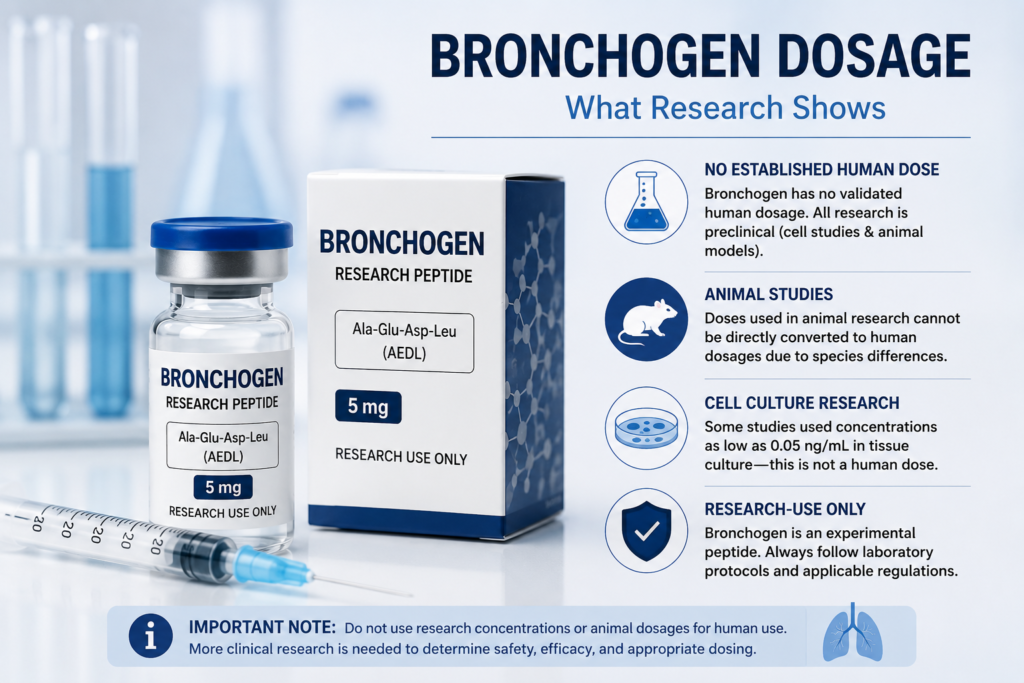
Bronchogen Dosage
There is no established human therapeutic dosage for Bronchogen.
Experimental concentrations used in cell or animal studies are specific to those research models and should not be interpreted as human dosing recommendations.
A validated human dose would require appropriate pharmacokinetic, safety, and clinical studies. What Is Bronchogen Peptide
Bronchogen Safety
Because robust human clinical studies are lacking, the complete human safety profile of Bronchogen remains unknown.
Important unanswered questions include:
- Long-term safety
- Human pharmacokinetics
- Potential drug interactions
- Appropriate route of administration
- Potential adverse effects
- Safety in people with respiratory conditions
- Effects during pregnancy
- Appropriate therapeutic exposure
For these reasons, preclinical research should not be used to establish a personal treatment protocol.
Bronchogen vs. Other Research Peptides
Bronchogen has a relatively specialized research profile.
While many experimental peptides are investigated for metabolic signaling, growth-hormone pathways, neurological activity, or tissue repair, Bronchogen is primarily associated with bronchial and respiratory research.
This makes it particularly interesting to researchers studying:
- Airway epithelial biology
- Respiratory tissue models
- Short peptide–DNA interactions
- Gene expression
- Cellular differentiation
- Experimental lung pathology
What Is Bronchogen Peptide 5-Amino-1MQ