
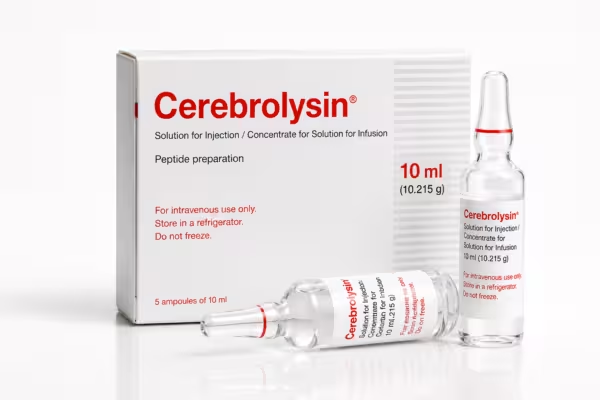
Cerebrolysin: What It Is, Benefits, Uses, Mechanism, and Research
Cerebrolysin is a prescription neuropeptide preparation derived from purified porcine brain proteins. It has been investigated for its potential effects on neuroprotection, neuroplasticity, cognitive function, and neurological recovery. Bronchogen
Unlike many compounds marketed online as “research peptides,” Cerebrolysin has been used clinically in a number of countries, although its regulatory status varies by country. It is not approved for use in the United States. A review of the literature notes that Cerebrolysin has been used clinically in more than 50 countries while remaining unapproved in the U.S. PEG-MGF
Research has focused particularly on ischemic stroke, traumatic brain injury (TBI), and dementia-related conditions. Evidence is mixed by indication, with some systematic reviews reporting improvements in neurological or functional outcomes while other studies have found limited clinical benefit. aod-9604 peptide
Important: Cerebrolysin is a pharmaceutical product, not a conventional synthetic peptide supplement. This page is intended for informational purposes and does not provide instructions for self-administration, dosing, or treatment of neurological disease.
What Is Cerebrolysin?
Cerebrolysin is a parenterally administered preparation containing low-molecular-weight peptides and amino acids derived from purified porcine brain proteins. Its development is based on the idea that these peptides may reproduce some biological activities associated with endogenous neurotrophic factors.
Researchers have investigated Cerebrolysin for its potential influence on processes involved in:
- Neuroplasticity
- Neuroprotection
- Neurogenesis
- Angiogenesis
- Inflammation
- Neuronal survival
- Neurological recovery
The compound is therefore sometimes described as a neurotrophic peptide preparation. ACE-031
Cerebrolysin at a Glance
| Property | Information |
|---|---|
| Name | Cerebrolysin |
| Type | Peptide preparation |
| Source | Purified porcine brain proteins |
| Administration | Parenteral |
| Primary research areas | Stroke, TBI, dementia |
| Proposed biological activity | Neurotrophic/neuroprotective |
| FDA approved in the U.S.? | No |
| Human research | Yes |
| Clinical evidence | Mixed and indication-dependent |
How Does Cerebrolysin Work?
Cerebro-lysin’s proposed mechanism is more complex than that of a single peptide acting on one receptor.
Research suggests that Cerebro-lysin may influence biological pathways associated with neurotrophic factors, neuroplasticity, neuronal survival, and inflammatory processes. A 2023 review described evidence suggesting that Cerebro-lysin can resemble some activities of neurotrophic factors and modulate endogenous neurotrophic-factor expression.
Researchers have investigated effects involving:
Neuroplasticity
Neuroplasticity refers to the brain’s ability to modify connections and adapt following learning, injury, or disease.
Cerebro-lysin research has explored whether the preparation can support processes associated with neurological recovery and remodeling.
Neuroprotection
Preclinical research suggests potential effects on pathways involved in neuronal survival and protection from cellular stress.
Neurogenesis
Research has examined whether Cerebro-lysin may influence processes associated with the formation and development of new neurons.
Angiogenesis
Studies have also investigated effects related to the development of new blood vessels, which may be relevant to recovery following neurological injury.
Inflammation
Neuroinflammatory pathways have been another area of interest in Cerebro-lysin research.
These mechanisms remain areas of scientific investigation rather than proof that Cerebro-lysin produces the same effects in every patient.
Cerebrolysin Benefits
Interest in Cerebro-lysin benefits largely comes from clinical and preclinical research involving neurological disorders.
The strongest areas of research include stroke recovery and traumatic brain injury, while evidence in dementia and other neurological conditions is more variable. cjc-1295+ ipamorelin
Cerebro-lysin for Stroke Recovery
Cerebrolysin has been extensively studied as an adjunctive treatment following acute ischemic stroke.
A meta-analysis published in 2018 evaluated nine randomized, double-blind, placebo-controlled trials involving 1,879 patients. The analysis reported improvements in early neurological outcomes and found comparable safety to placebo in the included trials.
More recent evidence remains mixed but continues to support research interest.
A 2025 systematic review and meta-analysis evaluated 14 randomized controlled trials involving 2,884 patients. It found a statistically significant improvement in neurological recovery measured by NIHSS, although functional independence did not reach statistical significance. The researchers concluded that additional high-quality trials are needed to clarify long-term functional benefits.
What does this mean?
Cerebrolysin may have potential as an adjunct in stroke recovery, but evidence does not establish it as a replacement for established acute stroke treatment.
Stroke is a medical emergency, and treatment decisions should be made by qualified medical professionals.
Cerebrolysin and Traumatic Brain Injury
Another important area of research is traumatic brain injury.
A systematic review and meta-analysis published in 2019 evaluated five studies involving more than 5,600 participants. The analysis reported improvements in Glasgow Outcome Scale scores and a reduction in modified Rankin Scale scores among patients receiving Cerebro-lysin. However, substantial heterogeneity was present between studies.
A later systematic review covering 10 clinical studies and 8,749 patients similarly reported associations with improved Glasgow Coma Scale and Glasgow Outcome Scale outcomes, although mortality and hospital length of stay were not significantly affected.
These findings suggest potential for further investigation, but they do not establish Cerebrolysin as a universally effective treatment for TBI.
Cerebrolysin and Cognitive Function
Cerebro-lysin has also been studied in dementia and cognitive impairment, including Alzheimer’s disease.
Earlier clinical studies reported improvements in certain global and cognitive outcomes compared with placebo.
However, the broader evidence base has limitations, including differences in study design, treatment protocols, patient populations, and outcome measures.
A 2021 literature review concluded that Cerebro-lysin research across stroke, neurodegenerative disease, and TBI produced inconsistent results, emphasizing the need for stronger clinical evidence to establish its role for specific neurological conditions.
Therefore, it is more accurate to describe Cerebrolysin as a studied neuropeptide preparation rather than a universally proven cognitive-enhancement treatment.
Cerebrolysin for Neuroprotection
One of the central concepts behind Cerebro-lysin research is neuroprotection.
Neuroprotection refers broadly to strategies intended to preserve neuronal structure and function when the nervous system is exposed to injury or disease.
Researchers have investigated whether Cerebro-lysin can influence pathways involving:
- Oxidative stress
- Neuronal survival
- Neurotrophic signaling
- Inflammation
- Synaptic plasticity
- Cellular repair
These mechanisms are particularly relevant to stroke and traumatic brain injury, where neurological tissue can be damaged by both the original injury and secondary biological processes.
Cerebrolysin and Neuroplasticity
Neuroplasticity is another major research area.
After neurological injury, the nervous system can reorganize connections and recruit alternative pathways. This process can contribute to recovery.
Cerebro-lysin has been investigated for potential effects on signaling pathways associated with neuroplasticity and neurotrophic factors. A 2023 review discussed Cerebro-lysin in relation to neuroplasticity, neurogenesis, angiogenesis, and inflammation.
These findings provide a biological rationale for studying Cerebrolysin during neurological rehabilitation.
However, laboratory evidence cannot by itself establish a predictable clinical outcome.
Is Cerebrolysin FDA Approved?
No. Cerebrolysin is not approved by the U.S. Food and Drug Administration.
Its regulatory status differs internationally. Cerebro-lysin has been used clinically in numerous countries, but it does not have FDA approval for use in the United States.
This distinction is important for anyone researching Cerebro-lysin online.
The fact that a pharmaceutical product is approved or used in one country does not mean that it has received approval from every regulatory authority.
Is Cerebrolysin a Peptide?
Cerebro-lysin is often described as a peptide preparation, but it is different from a single synthetic peptide such as many experimental research compounds.
It is a complex mixture derived from purified porcine brain proteins and contains low-molecular-weight peptides and amino acids.
Therefore, referring to Cerebro-lysin simply as “one peptide” can be misleading.
A more accurate description is:
Cerebrolysin is a complex neuropeptide preparation derived from purified porcine brain proteins.
Cerebrolysin vs. Synthetic Research Peptides
Cerebrolysin differs from many peptides commonly sold through research-chemical suppliers.
| Characteristic | Cerebro-lysin | Typical synthetic research peptide |
|---|---|---|
| Composition | Peptide/amino-acid preparation | Usually a defined peptide sequence |
| Source | Purified porcine brain proteins | Chemically synthesized |
| Research | Extensive clinical research | Often primarily preclinical |
| Main research area | Neurological recovery | Depends on peptide |
| Regulatory status | Varies by country | Generally experimental |
| U.S. FDA approval | No | Usually no |
This distinction is important when evaluating product descriptions and scientific claims.
Cerebrolysin Safety and Research Evidence
Safety is an important part of evaluating any neurological pharmaceutical.
A systematic review and meta-analysis of 12 randomized controlled trials involving 2,202 patients with acute ischemic stroke found no statistically significant differences between Cerebrolysin and placebo across the main safety outcomes analyzed.
However, a favorable result in one clinical population does not mean that Cerebrolysin is risk-free or appropriate for every person.
Safety can depend on:
- Medical history
- Underlying neurological condition
- Other medications
- Route of administration
- Clinical setting
- Individual patient characteristics
For that reason, Cerebrolysin should be evaluated and administered according to applicable medical and regulatory standards.
Cerebrolysin Dosage
Because Cerebrolysin is a pharmaceutical product with country-specific labeling and clinical indications, dosage should not be generalized into a single internet protocol.
Clinical studies have used different regimens depending on the condition being investigated. For example, one meta-analysis of ischemic-stroke trials included protocols using 30–50 mL once daily for 10–21 days, but these were study-specific protocols and should not be interpreted as a universal dosing recommendation.
Anyone considering Cerebrolysin for a medical condition should follow the prescribing information applicable in their country and the direction of a qualified healthcare professional.
What Conditions Has Cerebrolysin Been Studied For?
Research has examined Cerebro-lysin in several neurological conditions, including:
Ischemic Stroke
One of the most extensively studied applications, particularly as an adjunct to standard treatment and rehabilitation.
Traumatic Brain Injury
Clinical studies and meta-analyses have examined neurological and functional outcomes following TBI.
Dementia
Cerebrolysin has been investigated in Alzheimer’s disease and other dementia-related conditions, although evidence remains mixed.
Neurodegenerative Disease
Reviews have considered Cerebro-lysin as a potential neurotrophic intervention in neurodegenerative conditions.
The strength of evidence varies substantially among these indications.
Does Cerebrolysin Improve Memory?
Research has investigated Cerebro-lysin in patients with dementia and cognitive impairment, and some studies have reported improvements in cognitive or global outcome measures.
However, this does not establish Cerebro-lysin as a general-purpose memory enhancer for healthy individuals.
There is a significant difference between investigating a pharmaceutical in patients with neurological disease and demonstrating cognitive enhancement in healthy people.
Does Cerebro-lysin Help Brain Recovery?
Potentially, depending on the condition—but the evidence is not definitive.
Cerebro-lysin has been investigated for neurological recovery following stroke and TBI. Several meta-analyses report improvements in selected neurological or functional outcomes, while other reviews emphasize inconsistent findings and the need for stronger trials.
This makes Cerebro-lysin an interesting research subject, but it would be inappropriate to guarantee a specific recovery outcome.
Reviews
There are no reviews yet.