What Is Cerebrolysin? Uses, Benefits, How It Works, and Research
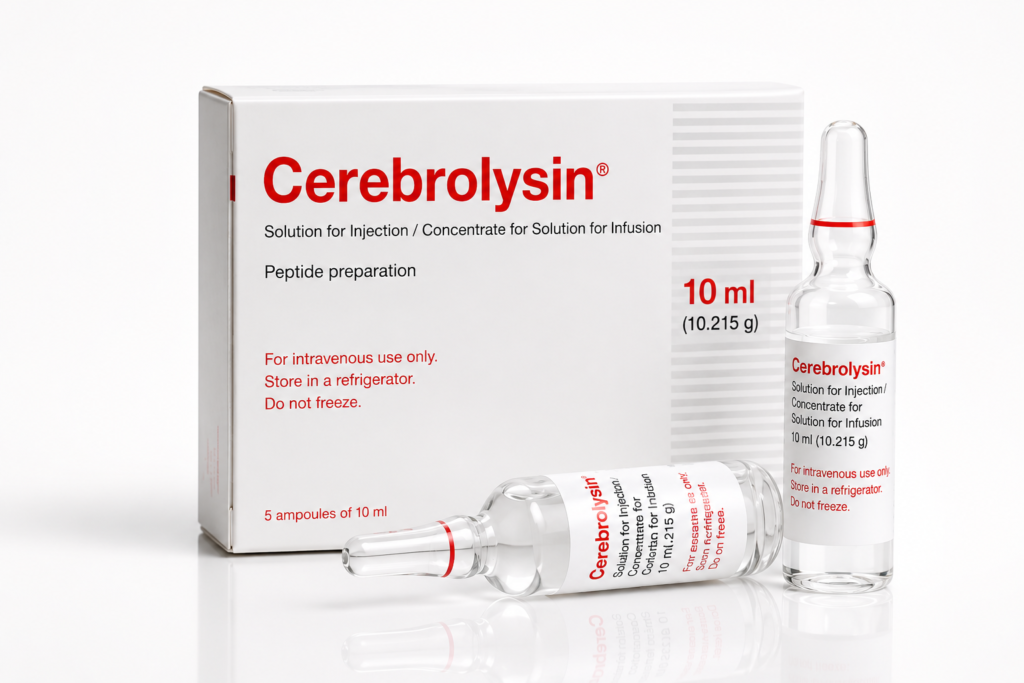
What is Cerebrolysin? Cerebrolysin is a pharmaceutical neuropeptide preparation derived from purified porcine brain proteins. It contains a mixture of low-molecular-weight peptides and amino acids and has been studied for its potential effects on neuroprotection, neuroplasticity, neuronal survival, and neurological recovery.
Cerebrolysin has been investigated in conditions including ischemic stroke, traumatic brain injury, Alzheimer’s disease, and other neurological disorders. It is used clinically in some countries, but its regulatory status varies internationally and it is not approved by the U.S. Food and Drug Administration (FDA). Cerebrolysin
Because Cerebrolysin is sometimes grouped together with experimental peptides and nootropics online, understanding exactly what it is—and what the research actually shows—is important. ACE-031
Medical disclaimer: This article is for educational and informational purposes only. What Is Cerebrolysin does not provide medical advice, treatment recommendations, or instructions for self-administration.
What Is Cerebrolysin?
Cerebrolysin is a complex neuropeptide preparation produced from purified porcine brain proteins.
Unlike a conventional synthetic peptide that contains one defined amino-acid sequence, Cerebrolysin contains multiple low-molecular-weight peptides and amino acids.
Researchers believe some of these compounds may mimic or influence biological processes associated with naturally occurring neurotrophic factors.
Neurotrophic factors are signaling proteins involved in processes such as:
- Neuronal growth
- Neuronal survival
- Synaptic plasticity
- Differentiation
- Repair and adaptation of nervous tissue
These properties have made Cerebrolysin a subject of research in neurological medicine. What Is Cerebrolysin Sermorelin
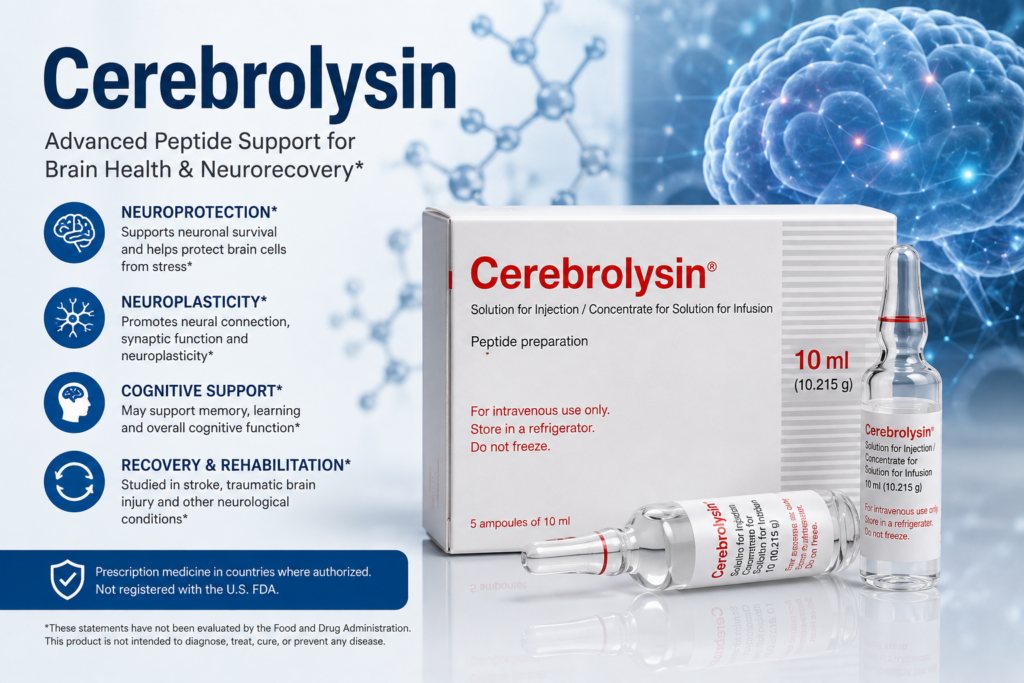
Cerebrolysin at a Glance
| Characteristic | Description |
|---|---|
| Name | Cerebrolysin |
| Category | Neuropeptide preparation |
| Source | Purified porcine brain proteins |
| Composition | Low-molecular-weight peptides and amino acids |
| Primary research area | Neurology |
| Research indications | Stroke, TBI, dementia and other neurological disorders |
| U.S. FDA approved? | No |
| Clinical research? | Yes |
| Administration | Parenteral |
How Does Cerebrolysin Work?
The proposed mechanism of Cerebrolysin is complex and is not fully understood.
Research suggests that it may influence several pathways associated with neurotrophic signaling and neuronal survival.
What Is Cerebrolysin A review of Cerebrolysin research describes potential effects involving neuroplasticity, neurogenesis, angiogenesis, inflammation, and neuroprotection.
Neuroprotection
Neuroprotection refers to processes that help preserve neurons and their function when the nervous system is exposed to injury or disease.
Laboratory research has investigated whether Cerebrolysin can influence pathways involved in neuronal survival and cellular stress. What Is Cerebrolysin Bronchogen
Neuroplasticity
Neuroplasticity is the nervous system’s ability to modify its connections and organization.
This process is particularly important after neurological injury because the brain can reorganize some functions through changes in neural networks.
Cerebrolysin has been investigated for its potential effects on pathways involved in neuroplasticity.
Neurogenesis
Neurogenesis refers to the development of new neurons.
Preclinical studies have explored whether Cerebrolysin can influence processes associated with neurogenesis, although this should not be interpreted as evidence that the treatment regenerates a damaged human brain.
Angiogenesis
Angiogenesis is the formation of new blood vessels.
Because adequate blood flow is important for neurological recovery, researchers have investigated whether Cerebrolysin may influence angiogenic pathways.
Inflammatory pathways
Neuroinflammation can play an important role in neurological injury and disease.
Cerebrolysin research has examined whether the preparation affects certain inflammatory mechanisms. What Is Cerebrolysin 5-Amino-1MQ
What Is Cerebrolysin Used For?
Cerebrolysin has been investigated for several neurological conditions.
The largest areas of research include:
- Ischemic stroke
- Traumatic brain injury
- Alzheimer’s disease
- Dementia
- Other neurodegenerative disorders
The strength of evidence varies considerably depending on the condition.
Cerebrolysin and Stroke
One of the most extensively researched applications of Cerebrolysin is ischemic stroke.
A stroke can damage brain tissue by interrupting blood flow and oxygen delivery. Even after blood flow is restored, secondary biological processes can contribute to neurological injury.
Researchers have investigated whether Cerebrolysin could support neurological recovery as an adjunct to conventional stroke treatment and rehabilitation.
A meta-analysis of randomized controlled trials reported improvements in some early neurological outcomes among patients treated with Cerebrolysin compared with placebo.
More recent research continues to produce mixed results, particularly when examining long-term functional independence.
This means Cerebrolysin should be considered a research-supported but still debated adjunctive therapy, rather than a replacement for established acute stroke treatment. What Is Cerebrolysin GHK-CU 100mg
Cerebrolysin and Traumatic Brain Injury
Another major research area is traumatic brain injury (TBI).
TBI can result from falls, vehicle accidents, sports injuries, and other forms of trauma.
Researchers have investigated whether Cerebrolysin may influence recovery following brain injury through mechanisms involving:
- Neuroplasticity
- Neuronal survival
- Neurotrophic signaling
- Cellular repair
- Inflammation
Systematic reviews have reported improvements in some neurological and functional outcome measures, although differences among studies make it difficult to draw definitive conclusions.
More high-quality clinical research is needed to determine which patients, if any, are most likely to benefit.
Cerebrolysin and Alzheimer’s Disease
Cerebrolysin has also been investigated in people with Alzheimer’s disease and dementia.
Research has examined outcomes including:
- Cognitive function
- Global clinical status
- Activities of daily living
- Neurological symptoms
Some clinical studies have reported improvements in certain measures, but evidence across trials has been inconsistent.
A major review of Cerebrolysin research concluded that results across neurological indications have varied and that additional well-designed clinical trials are necessary.
Therefore, Cerebrolysin should not be described as a proven cure or disease-modifying treatment for Alzheimer’s disease. What Is Cerebrolysin Adipotide
Cerebrolysin Benefits
People searching “Cerebrolysin benefits” commonly encounter claims about brain repair, memory enhancement, neuroprotection, and cognitive improvement.
The evidence supports investigating Cerebrolysin in several areas, but it is important to distinguish potential benefits observed in clinical research from proven outcomes.
Potential areas of interest include:
Neurological recovery
Clinical trials have investigated Cerebrolysin following stroke and TBI.
Neuroplasticity
Research suggests that Cerebrolysin may influence pathways associated with neural adaptation and remodeling.
Neuroprotection
Preclinical evidence supports further investigation into its effects on neuronal survival.
Cognitive outcomes
Studies have investigated cognitive and global outcomes in dementia.
Neurotrophic activity
Cerebrolysin’s proposed mechanism is partly based on biological activity resembling neurotrophic signaling.
These findings make Cerebrolysin an interesting neurological research compound, but they do not guarantee a particular outcome for an individual. What Is Cerebrolysin
Is Cerebrolysin a Peptide?
Yes, but the terminology requires some clarification.
Cerebrolysin is commonly described as a neuropeptide preparation, but it is not simply one synthetic peptide molecule.
Instead, it contains a complex mixture of low-molecular-weight peptides and amino acids derived from purified porcine brain proteins.
This makes Cerebrolysin different from compounds such as:
- Single-sequence synthetic peptides
- Peptide fragments
- Peptide hormones
- Research peptides produced through chemical synthesis
The term “peptide” therefore describes part of Cerebrolysin’s composition rather than the entire nature of the pharmaceutical product.
Is Cerebrolysin a Nootropic?
Cerebrolysin is sometimes marketed online as a nootropic, particularly because research has examined cognitive outcomes.
However, Cerebrolysin is better understood as a pharmaceutical neuropeptide preparation used in neurological research and clinical settings in certain countries.
It should not automatically be equated with over-the-counter nootropic supplements.
Research involving people with neurological disease also does not establish that Cerebrolysin enhances cognitive performance in healthy individuals. What Is Cerebrolysin
Cerebrolysin vs. Traditional Nootropics
| Feature | Cerebrolysin | Typical nootropic supplement |
|---|---|---|
| Category | Pharmaceutical neuropeptide preparation | Dietary supplement |
| Source | Porcine brain proteins | Varies |
| Clinical research | Yes | Varies |
| Main research focus | Neurological disease | Cognition/general wellness |
| FDA-approved in U.S. | No | Varies by ingredient |
| Medical supervision | Important | Depends on product |
This distinction is particularly important when evaluating online marketing claims.
Is Cerebrolysin FDA Approved?
No.
Cerebrolysin is not approved by the U.S. FDA.
It has been used clinically in a number of countries, but approval and prescribing status vary between jurisdictions. A review published in CNS Drugs noted that Cerebrolysin has been used in more than 50 countries while remaining unapproved in the United States.
Therefore, consumers should not interpret international clinical use as equivalent to FDA approval.
Is Cerebrolysin Safe?
The safety profile of Cerebrolysin has been investigated in clinical trials, but safety must always be considered in relation to the specific medical condition and patient.
A systematic review examining randomized controlled trials in acute ischemic stroke found no significant difference in several major safety outcomes between Cerebrolysin and placebo.
However, this does not mean that Cerebrolysin is appropriate or risk-free for everyone.
Factors that may affect treatment decisions include:
- Existing medical conditions
- Other medications
- Neurological diagnosis
- Allergies
- Route of administration
- Treatment setting
Because Cerebrolysin is administered parenterally, it should be handled and administered within an appropriate medical framework.
What Is the Cerebrolysin Dosage?
There is no single dosage that applies to every situation.
Clinical studies have used different treatment regimens depending on:
- Medical indication
- Severity of disease
- Study protocol
- Treatment duration
- Patient population
For example, clinical trials investigating stroke have used different doses and treatment durations.
Therefore, internet dosing protocols should not be treated as universal medical instructions.
Anyone considering Cerebrolysin should consult the applicable prescribing information and a qualified healthcare professional. What Is Cerebrolysin Glow Peptide
How Is Cerebrolysin Administered?
Cerebrolysin is a parenteral preparation, meaning it is administered through routes that bypass the gastrointestinal tract.
The exact method and treatment regimen depend on the applicable product labeling, indication, and medical setting.
Because administration involves a pharmaceutical preparation rather than a dietary supplement, self-administration based solely on information from an online article is not appropriate. What Is Cerebrolysin
Cerebrolysin Research: What Does the Evidence Show?
The evidence surrounding Cerebrolysin is more extensive than that for many experimental peptides, but it is not uniformly positive.
Research has produced:
Encouraging findings: Some trials and meta-analyses report improvements in neurological or functional outcomes.
Mixed findings: Other analyses find limited or uncertain effects, especially for longer-term functional outcomes.
Important limitations: Studies differ in patient populations, treatment regimens, endpoints, and methodological quality.
What Is Cerebrolysin This is why systematic reviews frequently call for additional high-quality randomized controlled trials.
Cerebrolysin and Neuroprotection
The concept of neuroprotection is central to Cerebrolysin research.
Following neurological injury, neurons can be affected by:
- Oxidative stress
- Excitotoxicity
- Inflammation
- Disrupted cellular signaling
- Reduced blood flow
- Metabolic stress
Researchers have investigated whether Cerebrolysin can influence some of these pathways.
The proposed neuroprotective activity is one reason Cerebrolysin has been studied in stroke and traumatic brain injury.
However, What Is Cerebrolysin mechanistic evidence alone cannot establish clinical effectiveness.
Cerebrolysin and Neuroplasticity
Another important research area is neuroplasticity.
The brain can reorganize neural connections in response to learning, injury, and environmental changes.
After stroke or TBI, neuroplasticity may contribute to rehabilitation and functional recovery.
Cerebrolysin has been investigated for its potential influence on pathways involved in neuroplasticity and neurotrophic signaling.
This provides a biological rationale for further research into its use alongside rehabilitation. What Is Cerebrolysin Bpc-157 + TB-500