What Does Dihexa Do? Uses, Mechanism, Research, and Potential Effects
Dihexa is an experimental compound that has attracted attention in neuroscience research because of its potential effects on learning, memory, and synaptic function. Online discussions sometimes describe Dihexa as a “nootropic peptide,” but its scientific status is more accurately described as an experimental research compound that has not been approved as a medication for human use. Dihexa Peptide
So, what does Dihexa do? Research has primarily focused on whether Dihexa can influence pathways involved in neuroplasticity, synapse formation, and cognitive function. Much of the interest comes from laboratory research involving the hepatocyte growth factor (HGF) and its receptor, c-Met. bpc 157 peptide
What Is Dihexa?
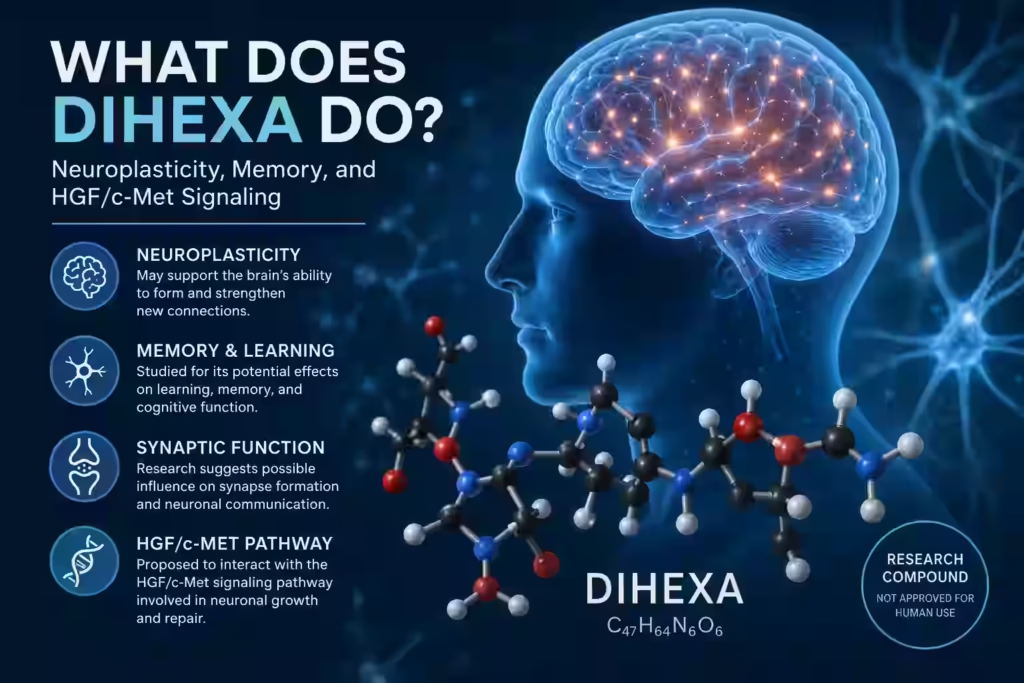
Dihexa is a synthetic compound derived from a sequence related to angiotensin IV, a peptide involved in several biological signaling pathways. It was developed as a compound capable of interacting with the HGF/c-Met signaling system.
The compound has been investigated primarily in preclinical neuroscience research. Researchers have explored its possible effects on neuronal growth and communication, particularly mechanisms associated with memory and learning.
Importantly, Dihexa should not be confused with an established prescription treatment or dietary supplement. Human clinical evidence remains very limited, and its safety, appropriate dosing, long-term effects, and effectiveness in people have not been established. bronchogen dosage
What Does Dihexa Do in Research?
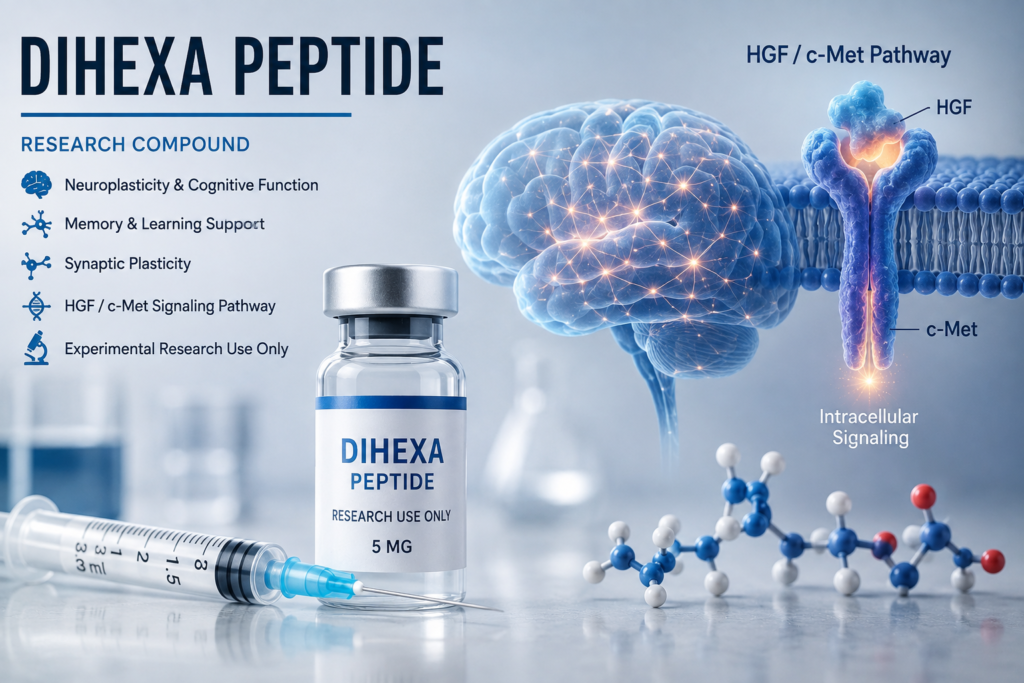
The primary scientific interest in Dihexa concerns its potential influence on neuroplasticity.
Neuroplasticity refers to the brain’s ability to modify connections between neurons. These changes are important for learning, memory, adaptation, and recovery from certain types of neurological injury.
Preclinical research has investigated whether Dihexa may:
- Support the formation of new neuronal connections
- Influence synaptic plasticity
- Affect pathways associated with learning and memory
- Interact with HGF/c-Met signaling
- Promote processes involved in neuronal growth and communication
These findings are interesting about what does dihexa do, but they should not be interpreted as proof that Dihexa improves cognition in humans. Bronchogen
How Does Dihexa Work?
One of the main reasons Dihexa has received attention is its proposed interaction with the HGF/c-Met pathway.
Hepatocyte growth factor, or HGF, is a signaling molecule involved in processes such as cell growth, development, tissue repair, and neuronal function. Its receptor, c-Met, is a receptor tyrosine kinase that transmits signals inside cells.
Researchers have proposed that Dihexa can act as an HGF/c-Met pathway modulator. Through this mechanism, the compound has been studied for possible effects on synaptic development and neuronal connectivity.
In laboratory research, changes in these pathways may have implications for how neurons communicate. This is one reason researchers have investigated what does dihexa do in relation to memory and cognitive processes. what does dihexa do ACE-031
Dihexa and Memory
Memory is one of the most frequently discussed areas of Dihexa research.
Animal and cellular studies have explored whether compounds affecting HGF/c-Met signaling could influence mechanisms involved in memory formation. Dihexa became particularly interesting because some preclinical findings suggested potential effects on cognitive performance and synaptic connectivity.
However, an important distinction needs to be made:
Evidence that a compound affects memory-related pathways in laboratory models does not establish that it improves memory in humans.
Human clinical trials would be necessary to determine whether what does dihexa do produces meaningful cognitive benefits, what doses might be effective, and whether those benefits outweigh potential risks. what does dihexa do ace-031 peptide benefits
Dihexa and Neuroplasticity
Neuroplasticity is another major focus of Dihexa research.
The brain constantly changes its connections in response to experiences, learning, environmental stimuli, and other biological factors. Synapses—the communication points between neurons—are particularly important to this process.
Preclinical studies have investigated whether Dihexa can influence the development or strengthening of neuronal connections. This has led to interest in the compound as a possible research tool for studying disorders involving impaired synaptic function.
At present, however, claims that what does dihexa do can reliably enhance neuroplasticity or cognitive performance in humans remain unproven. what does dihexa doTesofensine Peptide
Is Dihexa a Peptide?
Dihexa is often marketed or discussed online alongside research peptides, but the terminology can be confusing.
Dihexa is a synthetic small molecule derived from a peptide sequence, rather than a conventional peptide supplement or an approved pharmaceutical. Its chemical structure and pharmacological properties distinguish it from many commonly discussed research peptides.
For anyone researching Dihexa, it is therefore important to distinguish between:
- Preclinical scientific research
- Online nootropic claims
- Commercial research-compound descriptions
- Evidence from controlled human clinical trials
These categories should not be treated as equivalent.
What Are the Potential Benefits of Dihexa?
Potential benefits discussed in scientific and research contexts generally center around the nervous system.
Areas that have been investigated include:
Cognitive Function
Preclinical research has examined whether Dihexa could influence learning and memory. These findings are one of the primary reasons the compound has attracted interest.
Synaptic Function
Researchers have investigated its potential role in processes associated with synapse formation and neuronal communication.
Neuroplasticity
Dihexa has been studied for possible effects on signaling pathways involved in neuronal growth and plasticity.
Neurological Research
Because impaired synaptic function is involved in numerous neurological conditions, Dihexa has been investigated as a potential research tool for understanding these mechanisms.
It is important to emphasize that these are areas of investigation rather than established medical benefits. what does dihexa do Cerebrolysin
Is Dihexa Safe?
The safety profile of Dihexa in humans has not been adequately established.
This is one of the most important considerations when evaluating information about experimental compounds. A promising mechanism or positive animal study does not establish that a compound is safe for human use.
Potential concerns include:
- Limited human safety data
- Unknown long-term effects
- Uncertain interactions with medications or other compounds
- Lack of established therapeutic dosing
- Possible effects that have not been identified in preclinical research
Because the HGF/c-Met signaling pathway is involved in cell growth and other important biological processes, researchers have additional reasons to carefully investigate the compound’s pharmacology and safety. what does dihexa do Sermorelin
Is Dihexa FDA Approved?
No. Dihexa is not FDA-approved as a medication or treatment for cognitive impairment or neurological disease.
It is generally discussed as an experimental research compound rather than an established therapeutic. Products sold online under the Dihexa name should therefore not be assumed to have the same quality, purity, identity, or safety standards as FDA-approved medicines.
Does Dihexa Improve Memory?
There is not enough high-quality human evidence to conclude that Dihexa improves memory.
Preclinical findings have generated interest in its effects on memory-related processes, but translating results from laboratory models to humans is a major step in drug development.
A compound can produce interesting results in animal or cellular experiments and still fail to demonstrate meaningful benefits—or acceptable safety—in human clinical trials.
Therefore, claims that Dihexa is a proven memory enhancer should be viewed cautiously.
Dihexa Research vs. Online Claims
Interest in Dihexa has grown partly because online communities frequently discuss it in the context of nootropics and cognitive enhancement. However, online claims can extend far beyond what has actually been demonstrated scientifically.
When evaluating information about Dihexa, look for:
- Peer-reviewed research
- Controlled experimental studies
- Human clinical data
- Clearly identified chemical compounds
- Independent evidence of purity and identity
Be particularly cautious about claims describing Dihexa as a proven treatment, guaranteed cognitive enhancer, or established therapy. Semax
Frequently Asked Questions About Dihexa
What does Dihexa do?
Dihexa has been investigated primarily for its potential effects on neuroplasticity, synaptic function, learning, and memory. Its proposed mechanism involves modulation of HGF/c-Met signaling. Most evidence remains preclinical.
Is Dihexa a nootropic?
Dihexa is sometimes described online as a nootropic because of its proposed cognitive effects. Scientifically, however, it is better characterized as an experimental research compound because its cognitive effects and safety have not been established through adequate human clinical trials.
Does Dihexa increase neuroplasticity?
Preclinical research has investigated Dihexa’s potential influence on pathways associated with synaptic development and neuroplasticity. Whether these effects occur meaningfully in humans remains uncertain.
Does Dihexa improve learning?
Some laboratory research has explored Dihexa in relation to learning and memory, but there is insufficient human evidence to establish it as an effective learning-enhancement compound.