
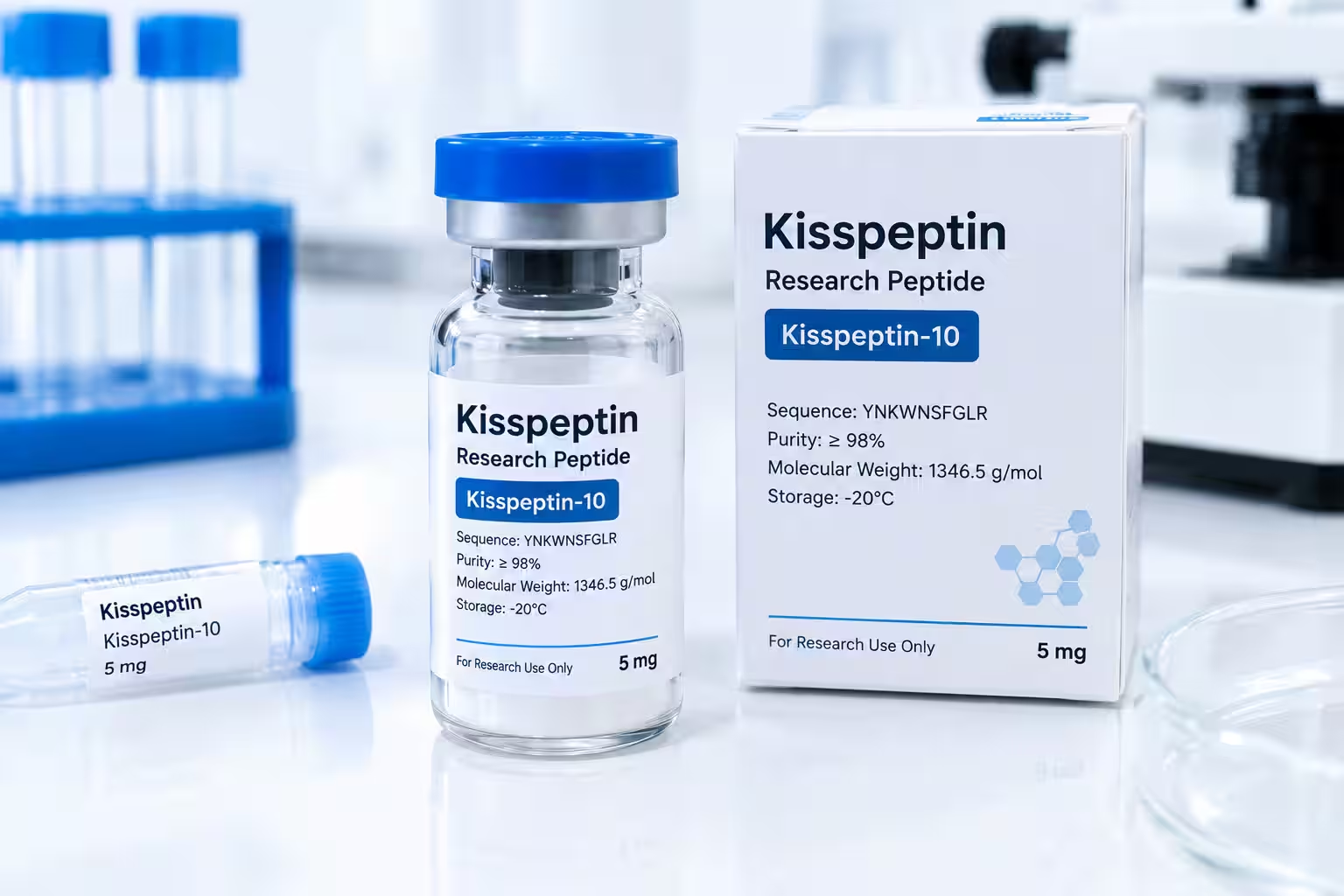
Kisspeptin Peptide
Kisspeptin peptide is a naturally occurring peptide signaling molecule that plays an important role in regulating reproductive hormones. Produced from the KISS1 gene, Kisspeptin peptide helps control the communication between the brain, pituitary gland, and reproductive organs. Scientists have studied this peptide extensively because of its involvement in puberty, fertility, ovulation, and reproductive hormone regulation. what is mod grf 1 29
Interest in Kisspeptin peptidehas grown as researchers investigate how the body’s hormonal systems work and how specific signaling pathways might contribute to reproductive health. Its ability to influence key reproductive hormones makes it an important subject in endocrinology and peptide research. what are peptides and how do they work
For anyone exploring peptide science, understanding Kisspeptin peptide begins with its biological function, the mechanisms through which it acts, and the difference between established scientific findings and potential future applications.
How Does Kisspeptin peptide Work?
Kisspeptin peptide functions as an upstream regulator of the hypothalamic-pituitary-gonadal (HPG) axis, the hormonal system responsible for coordinating many aspects of reproductive function.
Its activity involves a sequence of biological signals:
-
Kisspeptin signaling: Kisspeptin peptide binds to its receptor, known as KISS1R, also called GPR54.
-
GnRH release: This interaction stimulates neurons involved in releasing gonadotropin-releasing hormone (GnRH).
-
Pituitary response: GnRH signals the pituitary gland to release luteinizing hormone (LH) and follicle-stimulating hormone (FSH).
-
Reproductive hormone regulation: LH and FSH influence reproductive functions, including gonadal activity, sex hormone production, and processes involved in fertility.
This signaling pathway explains why Kisspeptin peptide is considered a key regulator of reproductive endocrinology. Rather than acting as a replacement for reproductive hormones, it influences the signals that help control their release. How to Read a Peptide Certificate of Analysis (COA)
Potential Benefits and Biological Roles of Kisspeptin peptide
Scientific research has identified several important physiological roles for Kisspeptin peptide. However, it is essential to distinguish its established biological functions from benefits that remain under investigation.
1. Regulation of Reproductive Hormones
Kisspeptin peptide helps regulate GnRH signaling and the subsequent release of LH and FSH. These hormones play important roles in reproductive development, gonadal function, and the production of sex hormones.
Researchers study this pathway to better understand how the body maintains hormonal balance and what happens when reproductive signaling is disrupted.
2. Puberty and Reproductive Development
Kisspeptin signaling is important for the initiation of puberty. Research has shown that disruptions in the kisspeptin system can interfere with normal reproductive development, demonstrating how essential this pathway is to the body’s hormonal maturation.
Scientists continue to investigate how kisspeptin interacts with other biological signals involved in the timing and progression of puberty.
3. Fertility and Ovulation Research
One of the most extensively studied areas of kisspeptin research is its relationship with fertility.
Kisspeptin influences GnRH and LH signaling, both of which are important for reproductive function. In females, this pathway is involved in the hormonal events surrounding ovulation. In males, it contributes to the regulation of reproductive hormones associated with testicular function.
Clinical research has explored whether manipulating kisspeptin signaling could have future applications in selected reproductive disorders. These findings are promising research directions, not proof that commercially available kisspeptin products improve fertility.
4. Understanding the Hypothalamic-Pituitary-Gonadal Axis
The HPG axis is a complex network of hormonal feedback loops. Kisspeptin helps researchers understand how the brain integrates signals from sex hormones, metabolic conditions, and other regulatory systems.
Studying this pathway provides insight into reproductive physiology and may help scientists identify potential approaches for investigating hormonal disorders.
5. Emerging Endocrinology Research
Beyond its central role in reproductive signaling, kisspeptin has been investigated in relation to other tissues and biological processes, including placental function and aspects of metabolic regulation.
These areas remain subjects of scientific investigation. Their existence should not be interpreted as evidence that kisspeptin is an established treatment for metabolic disorders, general wellness, or other unrelated conditions.
Types of Kisspeptin Peptides
Kisspeptin refers to a family of related peptides derived from the same precursor protein. Different forms have been studied to understand their biological activity and interaction with the kisspeptin receptor.
Kisspeptin-10 (KP-10)
Kisspeptin-10 is a short peptide fragment containing 10 amino acids. It retains the sequence responsible for receptor activation and is frequently discussed in experimental studies of kisspeptin signaling.
Kisspeptin-54 (KP-54)
Kisspeptin-54 is a longer, 54-amino-acid peptide commonly associated with the naturally occurring kisspeptin family. It has been investigated in human research examining reproductive hormone secretion.
Both forms are relevant to understanding kisspeptin biology, but their properties, stability, and behavior can differ depending on the experimental conditions. They should not automatically be considered interchangeable.
Kisspeptin vs. Other Peptides
Kisspeptin is sometimes discussed alongside other peptides involved in hormone signaling. Although these compounds may appear in the same research areas, they can have very different biological targets.
| Peptide or hormone | Primary biological role |
|---|---|
| Kisspeptin | Activates signaling involved in GnRH release |
| GnRH | Stimulates pituitary release of LH and FSH |
| Gonadorelin | Synthetic form of GnRH used in certain clinical settings |
| Oxytocin | Involved in social, reproductive, and physiological processes |
| Growth hormone-releasing hormone (GHRH) | Stimulates growth hormone release |
Understanding these distinctions is important when reviewing peptide literature, evaluating scientific claims, or comparing research compounds.
What Does Current Research Say About Kisspeptin?
Kisspeptin is a well-established regulator of reproductive signaling, but its potential clinical applications are still being investigated in specific contexts.
Researchers have examined its ability to stimulate LH release, influence reproductive hormone patterns, and potentially contribute to future approaches for certain fertility-related conditions. The effects depend on the population studied, the form of kisspeptin used, and the experimental protocol.
A 2023 review in Endocrine Reviews discusses the expanding evidence surrounding kisspeptin and related neuropeptides, including their potential relevance to reproductive and other endocrine conditions.




Reviews
There are no reviews yet.