
What Does Peptide Purity Mean in Laboratory Research?
what does peptide purity mean is an important factor in laboratory research because it helps researchers understand the composition of a peptide sample and assess its suitability for a particular experiment. Whether a laboratory is investigating protein interactions, studying cellular signaling, or examining biochemical pathways, knowing the purity of a peptide can help improve experimental consistency and data interpretation. what does peptide purity mean How to Read a Peptide Certificate of Analysis (COA)
But what does peptide purity mean, how is it measured, and why does it matter in scientific research? Semax
In this guide, we explain the what does peptide purity mean, the analytical methods used to evaluate it, the difference between purity and identity, and the factors researchers should consider when interpreting a peptide purity report. what are peptides and how do they work
what does peptide purity mean?
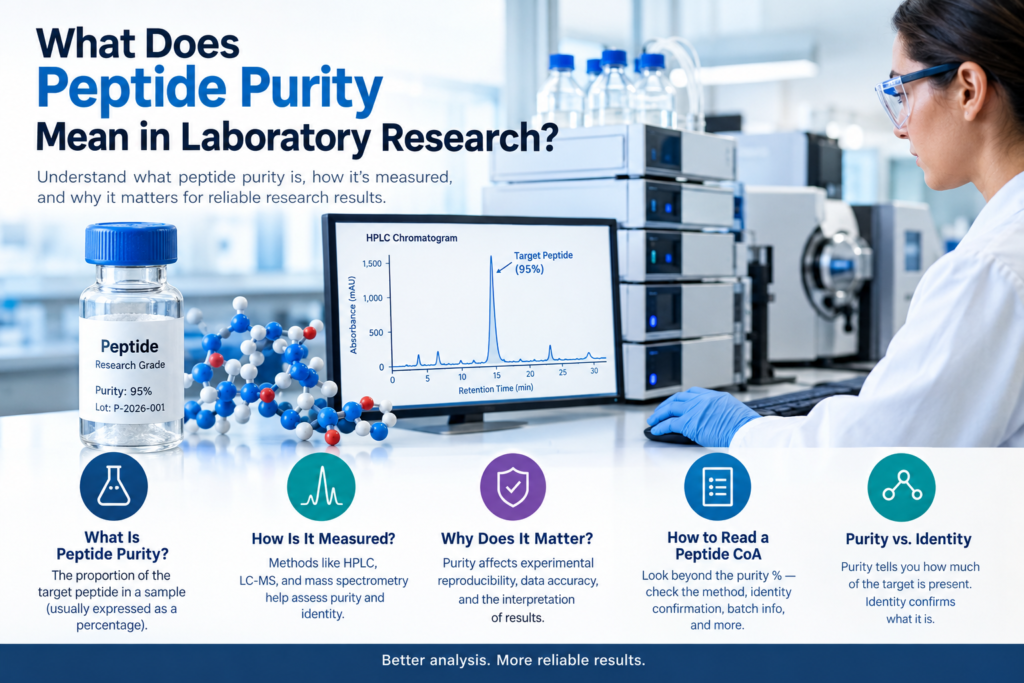
Peptide purity refers to the proportion of the detected peptide-related material in a sample that corresponds to the target peptide, as estimated using a specified analytical method. It is commonly reported as a percentage, such as 90%, 95%, or 98% purity.
During peptide synthesis, the intended peptide may be accompanied by unwanted substances, including incomplete sequences, deletion sequences, truncated peptides, residual reagents, or other related compounds. Purity testing helps characterize the sample and estimate the amount of the target peptide relative to detectable impurities. what does peptide purity mean difference between peptides and proteins
For example, a peptide reported as 95% pure by a particular chromatographic method has a measured target-peptide signal representing approximately 95% of the relevant integrated signal under the stated analytical conditions.
However, this does not necessarily mean that 95% of the sample’s total weight consists of the target peptide. The result depends on the analytical method, detection characteristics, and how the percentage is calculated. what does peptide purity mean Are Peptides the Same as Steroids?
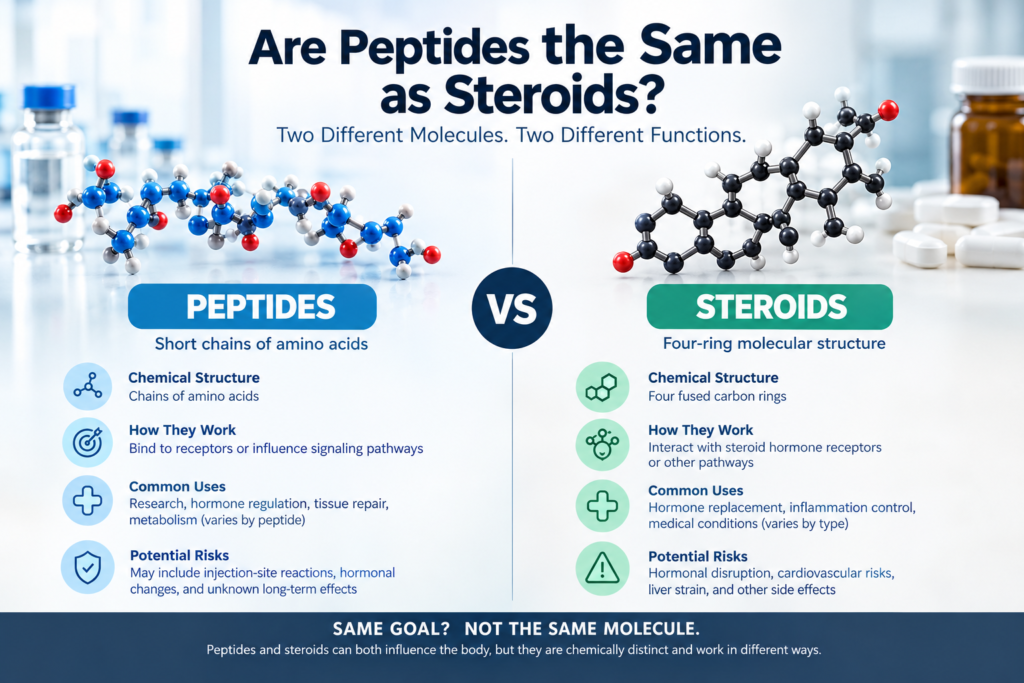
what does peptide purity mean? Understanding this distinction is essential when interpreting peptide specifications in laboratory research. Tesamorelin + Ipamorelin
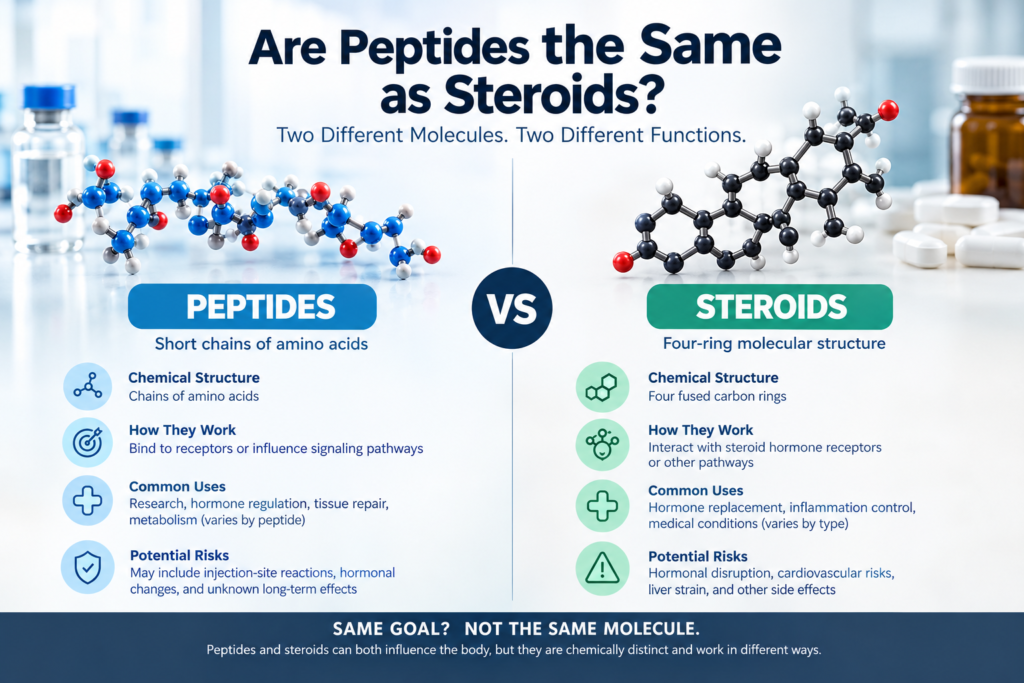
Why Is Peptide Purity Important in Laboratory Research?
Peptide purity can influence experimental reliability, reproducibility, and the interpretation of research findings. Impurities may affect biological activity, introduce unexpected interactions, or make it difficult to determine whether an observed result comes from the target peptide or another component.
what does peptide purity mean? Several aspects of laboratory research make purity assessment particularly important. How to Store Selank Peptides
1. Experimental Reproducibility
Reproducibility means obtaining reasonably consistent results when an experiment is repeated under comparable conditions.
Differences in peptide composition between batches may contribute to variations in experimental outcomes. Evaluating purity and other quality attributes can help researchers identify potential sources of variation and select materials appropriate for their study.
2. Interpretation of Biological Activity
In biochemical and cell-based research, a peptide may be investigated for its interaction with a receptor, enzyme, protein, or other biological target.
If a sample contains related peptide impurities, these compounds may contribute to the observed response. Purity analysis can help researchers assess this possibility, although additional experiments may be needed to establish which component is responsible for an effect.
3. Accurate Sample Characterization
Researchers need to understand the material they are working with before drawing conclusions from experimental data.
Purity analysis, combined with identity confirmation and other characterization tests, provides a clearer picture of a peptide sample’s composition and helps laboratories document material quality.
4. Research Documentation and Quality Control
Laboratories often maintain records of peptide identity, purity, batch numbers, storage conditions, and analytical results.
These records help researchers compare batches, investigate unexpected findings, and maintain consistent laboratory procedures. what does peptide purity mean?
How Is Peptide Purity Measured?
Peptide purity is commonly evaluated using analytical techniques that separate or characterize the target peptide and potential impurities. The most appropriate method depends on the peptide’s properties, the intended research application, and the level of characterization required.
High-Performance Liquid Chromatography (HPLC)
High-performance liquid chromatography, or HPLC, is widely used to evaluate peptide purity.
The method separates sample components based on their interactions with a stationary phase and a mobile phase. Under suitable conditions, the target peptide and some impurities appear as separate peaks in a chromatogram.
Researchers may estimate purity by integrating the target peak and comparing its area with the combined areas of the relevant detected peaks.
A simplified calculation is:
Peptide purity (%) = Target peak area ÷ Total integrated peak area × 100
For example, if the target peptide accounts for 95,000 units of integrated peak area out of 100,000 units, the estimated area-based purity is 95%.
This calculation is valid only for the defined set of integrated peaks and the assumptions of the analytical method. Different compounds can have different detector responses, and some impurities may not be detected or resolved.
Consequently, HPLC area percentage should not automatically be interpreted as absolute mass purity. what does peptide purity mean? thymosin alpha-1
Liquid Chromatography–Mass Spectrometry (LC-MS)
Liquid chromatography–mass spectrometry (LC-MS) combines chromatographic separation with mass spectrometry.
HPLC or another liquid chromatography technique separates components, while mass spectrometry measures their mass-to-charge ratios. This information can help researchers investigate whether a detected component has a mass consistent with the expected peptide and identify certain related impurities.
LC-MS is particularly useful because a chromatographic peak alone does not prove the identity of a compound.
However, LC-MS does not automatically establish complete purity or definitive molecular identity. The results depend on the instrument, analytical conditions, sample properties, and the evidence available for interpretation. what does peptide purity mean? ara-290
Mass Spectrometry
Mass spectrometry can support peptide identity confirmation by providing information about molecular mass and, with appropriate fragmentation analysis, sequence-related characteristics.
It is important to distinguish identity testing from purity testing. A mass spectrum consistent with the expected peptide supports the proposed identity, but it does not necessarily demonstrate that the entire sample consists of that peptide.
what does peptide purity mean? For this reason, laboratories may combine mass spectrometry with chromatographic analysis and other suitable methods. Thymosin Beta-4
Additional Analytical Methods
Depending on the research requirements, laboratories may use other analytical techniques to characterize peptide samples. These may include amino acid analysis, spectroscopy, or specialized methods for investigating particular impurities.
No single analytical technique answers every question about peptide quality. The choice of method should reflect the properties of the peptide and the information needed for the experiment. what does peptide purity mean? Semax + Selank Blend
What Do Different Peptide Purity Percentages Mean?
Peptide products and research materials may be described using purity values such as 90%, 95%, or 98%. These figures indicate an analytical result, but their meaning depends on the test method and the way purity is reported.
The following examples illustrate how such values are commonly discussed.
90% Peptide Purity
A reported purity of 90% indicates that the target peptide accounts for approximately 90% of the relevant measured signal under the specified analytical conditions.
The remaining signal may represent detected impurities or other components included in the calculation. Whether this level is suitable depends on the experimental objectives and the possible effects of those impurities. what does peptide purity mean Glow Peptide
95% Peptide Purity
A reported purity of 95% indicates a higher target-peptide proportion of the measured signal than a 90% result obtained using a comparable method.
This value may be useful when comparing materials tested under similar analytical conditions. Nevertheless, it does not independently establish the peptide’s identity, concentration, stability, or suitability for a particular experiment.
98% Peptide Purity
A reported purity of 98% indicates that the target peptide accounts for approximately 98% of the relevant measured chromatographic signal.
A higher reported percentage can indicate fewer detected impurities under the same method, but it does not guarantee that every possible contaminant has been identified or excluded.
Important: Purity percentages should not be compared without considering the analytical methods, reporting conventions, and detection limitations used to obtain them. what does peptide purity mean Reta + Mots-c
Peptide Purity vs. Peptide Identity: What Is the Difference?
Peptide purity and peptide identity are related but distinct quality attributes.
Peptide identity addresses whether a sample contains the intended peptide. Peptide purity addresses the extent to which the target peptide is present relative to detected impurities under the chosen analytical method.
Consider a sample that produces a mass spectrum consistent with the expected peptide. This supports the sample’s identity, but other compounds may still be present.
Conversely, a chromatogram may show one dominant peak, suggesting a high apparent purity. However, without appropriate identity testing, the peak cannot necessarily be confirmed as the intended peptide.
For more reliable characterization, researchers should consider both identity confirmation and purity analysis.
What Factors Can Affect Peptide Purity?
Several factors can influence the purity of a peptide sample and the results obtained during analysis.
Peptide Synthesis
Synthetic peptides are often produced through multiple chemical steps. Incomplete reactions, deletion sequences, and other synthesis-related by-products may contribute to impurities.
The synthesis strategy and manufacturing controls can influence the composition of the final material.
Purification Procedures
Purification methods are used to separate the target peptide from unwanted components. Their effectiveness depends on factors such as the peptide’s chemical properties, the impurities present, and the separation conditions.
A purification procedure may remove certain impurities more effectively than others.
Peptide Degradation
Peptides can undergo chemical changes during storage or handling. Depending on the sequence and environmental conditions, degradation may produce additional components that affect sample characterization.
Temperature, moisture, pH, light exposure, and repeated handling can influence stability, although the effects vary between peptides.
Analytical Method Limitations
Purity measurements depend on the method used. Some impurities may co-elute with the target peptide, produce weak detector responses, or fall outside the method’s detection capabilities.
Therefore, a reported purity value should always be interpreted in the context of the analytical procedure and its limitations.
How to Read a Peptide Certificate of Analysis (CoA)
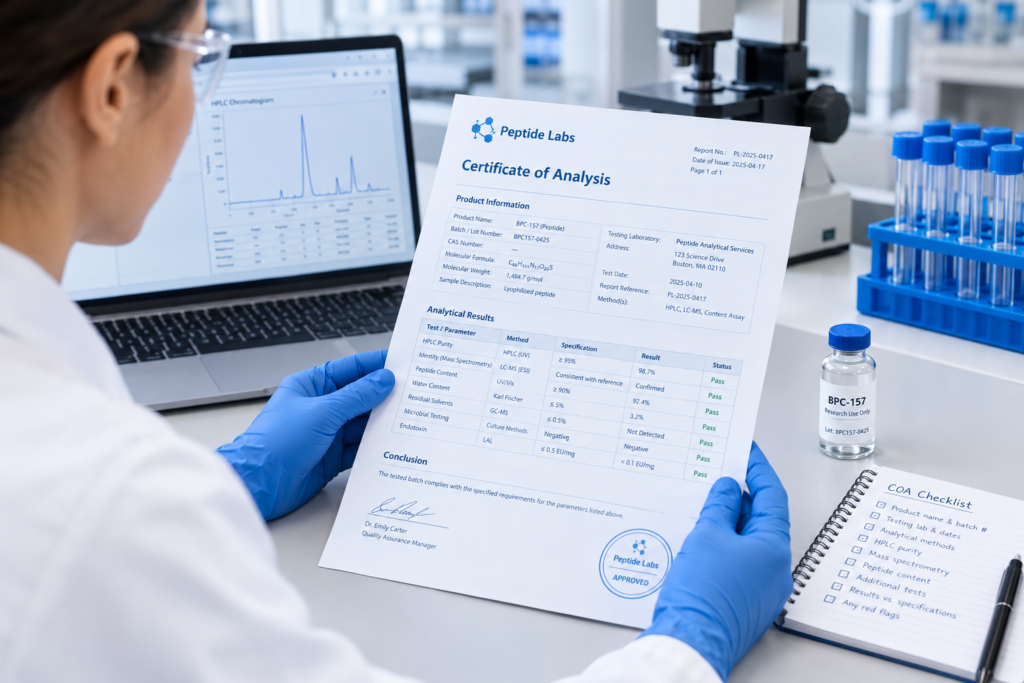
A Certificate of Analysis (CoA) provides information about a specific batch of material and its reported analytical results. When reviewing a peptide CoA, researchers should look beyond the headline purity percentage.
Important details may include:
- Peptide name or sequence: Identifies the intended target material.
- Batch or lot number: Connects the report to a specific batch.
- Purity result: Shows the reported purity percentage and, ideally, the method used.
- Analytical method: Identifies whether purity was evaluated by HPLC or another technique.
- Identity confirmation: Indicates whether mass spectrometry or another suitable method was used.
- Molecular mass: Provides a reference for assessing the expected peptide identity.
- Water content or counterion information: May be relevant when interpreting the amount of peptide in a weighed sample.
- Storage and handling information: Helps researchers understand how the material should be maintained.
Not every CoA contains all these details. Researchers should also check the report date, the laboratory responsible for testing, and whether the results apply to the specific batch being considered.
A high purity percentage alone is not a complete assessment of peptide quality. what does peptide purity mea? How to Read a Peptide Certificate of Analysis (COA)
Does Higher Peptide Purity Always Mean Better Research Quality?
Not necessarily.
A higher reported purity can be beneficial when unwanted compounds could interfere with an experiment. However, purity is only one aspect of peptide quality.
Researchers may also need to consider identity, concentration, solubility, stability, aggregation, residual solvents, counterions, water content, and other relevant characteristics.
For example, a peptide with a high chromatographic purity result may still have an uncertain concentration if the amount of water, salts, or counterions has not been accounted for. Similarly, a sample with a dominant chromatographic peak may contain impurities that the method cannot adequately distinguish.
what does peptide purity mean? The appropriate quality requirements depend on the scientific question, the analytical method, and the consequences of experimental variability. Selank
Frequently Asked Questions About Peptide Purity
What does 95% peptide purity mean?
A 95% peptide purity result commonly means that the target peptide represents 95% of the relevant integrated analytical signal under the specified testing conditions. If the result comes from HPLC, it usually refers to chromatographic peak area rather than automatically representing 95% of the sample’s total mass.
How is peptide purity tested in a laboratory?
Peptide purity is often assessed using HPLC. LC-MS may also be used to support identity confirmation and investigate impurities. Additional methods may be necessary when researchers need information about concentration, water content, residual solvents, or other sample characteristics.
Is peptide purity the same as peptide concentration?
No. Purity describes the target peptide relative to other detected components according to a specified analytical method. Concentration describes the amount of a substance in a defined volume or quantity of material. A highly pure sample may still have a concentration that differs from the expected value.
Can a peptide be highly pure but incorrectly identified?
A purity result alone cannot confirm identity. A sample may contain a dominant compound that has not been conclusively identified as the intended peptide. Appropriate identity testing, such as mass spectrometry, helps address this limitation.
Why can peptide purity results differ between laboratories?
Results can differ because laboratories may use different chromatographic columns, mobile phases, detection wavelengths, integration rules, instruments, and sample preparation procedures. Differences in reference standards and analytical performance can also affect the reported result.
Does a higher purity percentage guarantee better experimental results?
No. Higher reported purity may reduce some sources of interference, but experimental outcomes also depend on peptide identity, concentration, stability, handling, experimental design, and other variables.
What is the difference between HPLC purity and LC-MS analysis?
HPLC is commonly used to separate sample components and estimate purity from chromatographic signals. LC-MS combines liquid chromatography with mass spectrometry, providing separation data alongside mass-related information that can help investigate compound identity. The two approaches provide complementary information, and neither automatically establishes every aspect of sample quality.