
What Information Should a Peptide COA Include? A Complete Guide to Peptide Certificates of Analysis
what should be included in a peptide COA? When researching peptides, understanding product quality and laboratory testing is an important first step. One document that frequently appears in peptide quality discussions is the Certificate of Analysis, commonly known as a COA. what should be included in a peptide COA?
But what information what should be included in a peptide COA, and how can you determine whether a certificate provides meaningful evidence of product quality?
A peptide Certificate of Analysis is a document that reports analytical testing results for a particular sample or batch. Depending on the laboratory, peptide, and intended use, it may contain information about identity, purity, impurities, analytical methods, and other quality characteristics. testagen peptide
However, not all COAs provide the same level of detail. Some contain comprehensive analytical data, while others offer only a purity percentage without enough supporting information to interpret the result. what should be included in a peptide COA? Sermorelin
In this guide, we explain the essential components of what should be included in a peptide COA, how to read common testing results, and which warning signs to look for when evaluating laboratory documentation. what should be included in a peptide COA? How to Read a Peptide Certificate of Analysis (COA)
What Is a Peptide Certificate of Analysis (COA)?
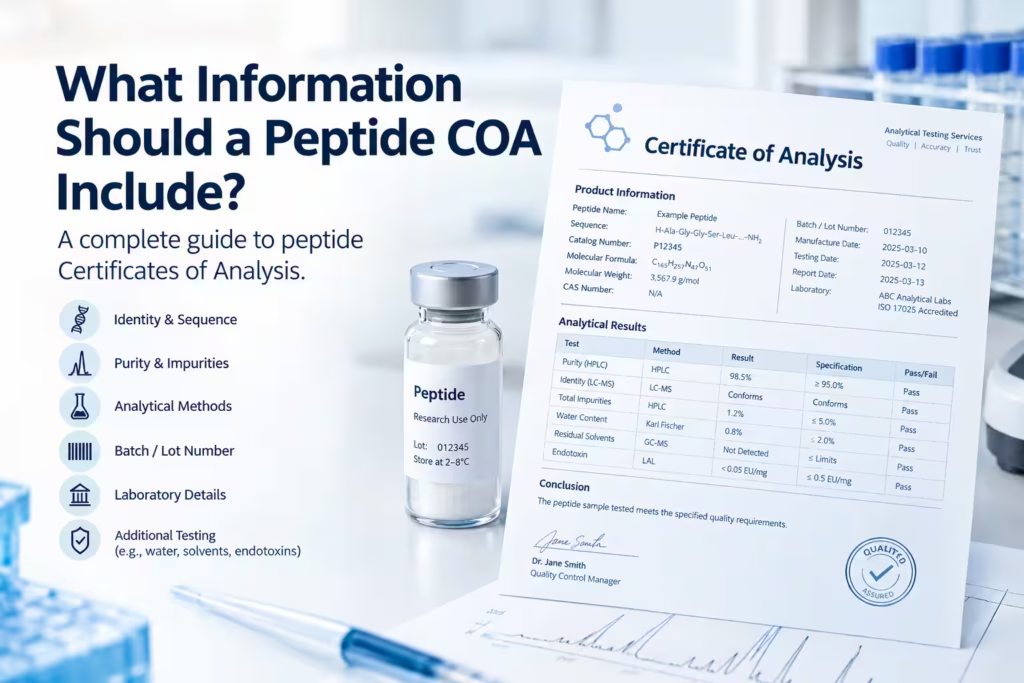
A peptide Certificate of Analysis is a quality-control document that summarizes the results of tests performed on a peptide sample or production batch.
It is generally issued by a manufacturer, quality-control department, or analytical laboratory. A COA helps document whether the tested sample meets specified quality criteria.
Depending on the product and its intended application, a peptide COA may report:
- Peptide identity and molecular characteristics
- Purity and related impurities
- Analytical testing methods
- Batch or lot identification
- Testing dates and laboratory details
- Additional measurements, such as water content or residual solvents, when relevant
what should be included in a peptide COA? A COA is useful for reviewing analytical evidence, but it should not automatically be treated as proof that a peptide is safe for human use. The meaning of the results depends on the testing methods, sample traceability, acceptance criteria, and intended application. ara-290
What Information Should a Peptide COA Include?
A useful peptide COA should provide enough information to identify the tested material, understand the analytical results, and determine whether the results relate to the specific batch being evaluated.
The following sections explain the most important elements.
1. Peptide Name and Identification
The COA should clearly identify the peptide that was tested.
This information may include:
- Peptide name
- Chemical or amino acid sequence, where applicable
- Catalog or product number
- Molecular formula
- Expected molecular weight
- CAS Registry Number, when applicable
These details help distinguish peptides with similar names or related structures.
For example, two peptides may have similar product names but different amino acid sequences or molecular characteristics. A product label alone may not provide enough information to distinguish them. what should be included in a peptide COA?
The reported identity should be consistent with the product specification and the analytical evidence provided in the report.
Why it matters: Clear identification helps establish which substance the laboratory intended to test and reduces the risk of confusing one peptide with another.
2. Batch or Lot Number
A batch number, also called a lot number, links the COA to a specific quantity of material.
A well-documented certificate should include a batch or lot identifier that can be compared with the product label, packaging documentation, or other quality records.
This connection is particularly important when reviewing documents obtained online. A genuine laboratory report may still be irrelevant to a particular product if it was generated for a different batch.
what should be included in a peptide COA? Check whether the lot number on the certificate matches the lot number associated with the material being evaluated.
Why it matters: Batch traceability helps determine whether the reported laboratory results apply to the specific material in question. Thymosin Beta-4
3. Peptide Purity Percentage
Purity is one of the most frequently discussed values on a peptide COA.
A certificate may report purity as a percentage, often determined using high-performance liquid chromatography (HPLC).
For example, a report might show a chromatographic purity result of 97%. This generally describes the proportion of the measured chromatographic signal attributed to the principal peak under the stated analytical conditions.
However, chromatographic purity does not necessarily mean that 97% of the sample’s total mass consists of the desired peptide.
The result can depend on the analytical method, detector response, impurities present, and how the laboratory calculates the percentage.
what should be included in a peptide COA? A high purity percentage should therefore be interpreted alongside the method used, the identity result, and any additional testing. Tesamorelin + Ipamorelin
Why it matters: A purity number provides useful information, but without the testing method and context, it can be misleading.
4. Analytical Testing Method
A COA should identify the analytical methods used to generate its reported results.
Common techniques used in peptide analysis include:
High-Performance Liquid Chromatography (HPLC): HPLC separates components in a sample and is commonly used to assess chromatographic purity and related impurities.
Liquid Chromatography–Mass Spectrometry (LC-MS): LC-MS combines separation with mass analysis. It can help assess whether a detected compound has a mass consistent with the expected peptide.
Mass Spectrometry (MS): Mass spectrometry measures the mass-to-charge ratios of ions and can provide evidence relevant to molecular identity.
Other methods may be used depending on the peptide, the quality specification, and the testing objective.
The COA should identify the methods clearly enough that a reader can understand the basis of the reported results. For more detailed reports, chromatograms, spectra, method references, or other supporting data may also be available. what should be included in a peptide COA?
Why it matters: Analytical results are only meaningful when the method is suitable for the characteristic being measured.
5. Peptide Identity Confirmation
Purity and identity are different analytical questions.
A sample can produce a prominent chromatographic peak without that peak necessarily representing the intended peptide. Identity testing helps establish whether the material corresponds to the expected compound.
A peptide COA may report identity testing through mass spectrometry, LC-MS, or another suitable method.
Depending on the analytical approach, the report may include:
- Expected molecular mass
- Observed molecular mass
- Identification result
- Supporting mass spectrum or analytical data
The expected and observed results should be interpreted according to the peptide’s chemical characteristics and the laboratory method.
what should be included in a peptide COA? For example, the molecular mass of a peptide may be reported in different forms depending on whether the report describes the neutral molecule or a charged ion. A difference between these values does not automatically indicate a problem. tesamorelin peptide
Why it matters: Identity testing provides evidence about what was detected, rather than simply how much of the chromatographic signal belongs to the main peak.
6. Impurity Profile
A detailed COA may include information about impurities detected during testing.
Peptide-related impurities can arise from synthesis, processing, storage, or degradation. Depending on the product, these may include incomplete sequences, deletion sequences, modified peptides, degradation products, or residual chemicals from manufacturing.
An impurity profile may report:
- Individual impurity peaks
- Relative impurity percentages
- Total related impurities
- Specified impurity limits
- Results compared with acceptance criteria
what should be included in a peptide COA? Not every impurity can be detected or quantified by every analytical method. Consequently, a report showing few detected impurities should not be interpreted as proof that the sample contains no impurities. testagen peptide
Why it matters: Reviewing impurities provides a more complete picture of the tested material than considering the principal purity percentage alone.
7. Water or Moisture Content
Peptide materials may contain water or moisture, depending on their chemical form, manufacturing process, packaging, and storage conditions.
Where relevant, a COA may include a water-content result measured using a suitable method, such as Karl Fischer titration.
Water content can influence the interpretation of a sample’s total mass and may be relevant to product specifications and stability.
what should be included in a peptide COA? A certificate may also distinguish between the peptide’s chemical form and the physical form of the supplied material.
Why it matters: Water content can be an important quality characteristic, but it is not necessarily included in every peptide COA. Its relevance depends on the material and intended application. thymosin alpha-1
8. Residual Solvent Testing
Some peptide manufacturing and purification processes use organic solvents.
Depending on the manufacturing process and applicable quality requirements, residual-solvent testing may be relevant. A COA or accompanying analytical report may identify the solvents tested, the method used, and the results.
A useful report should distinguish between a measured result, a result below the method’s reporting limit, and a test that was not performed.
what should be included in a peptide COA? For example, “not detected” does not necessarily mean that absolutely no solvent is present. It generally means that the substance was not detected under the stated analytical conditions.
Why it matters: Residual-solvent data can help evaluate a relevant aspect of material quality, particularly when the intended application has strict requirements.
9. Endotoxin and Microbiological Testing, When Applicable
Microbiological quality is a separate consideration from chemical purity.
Depending on the intended application, a peptide may require testing for bacterial endotoxins, microbial contamination, or other microbiological characteristics.
A COA may include applicable results, such as:
- Endotoxin concentration
- Microbial limits
- Test method
- Acceptance criteria
- Laboratory findings
Endotoxin testing and sterility testing are not interchangeable. A low endotoxin result does not establish that a product is sterile, and a chemical purity result does not establish microbiological safety.
The appropriate tests depend on the product’s intended use and relevant quality standards. what should be included in a peptide COA?
Why it matters: Chemical analysis alone cannot establish sterility or demonstrate that a material is suitable for injection or another medical use.
10. Test Specifications and Acceptance Criteria
A laboratory result is easier to interpret when the COA identifies the applicable specification or acceptance criterion.
For example, a report may state a required purity threshold and show the measured result alongside it.
Where applicable, the certificate should distinguish between:
- The specification or permitted limit
- The actual measured result
- The unit of measurement
- The pass/fail determination
what should be included in a peptide COA? Acceptance criteria should be appropriate for the specific material and intended use. A generic statement such as “passes quality control” offers less information than a report showing the relevant test, result, and specification. difference between peptides and proteins
Why it matters: Acceptance criteria help explain how the reported findings relate to the stated quality requirements.
11. Laboratory Name and Testing Dates
The COA should identify the organization responsible for the reported analysis and provide relevant dates.
Depending on the document, these details may include:
- Laboratory or manufacturer name
- Laboratory contact information
- Sample receipt date
- Testing date
- Report issue date
- Authorized reviewer or approval details
If an independent laboratory performed the analysis, its identity should be clear enough to allow the report’s authenticity and capabilities to be evaluated.
what should be included in a peptide COA? Accreditation, where claimed, should be verified against the relevant accreditation body’s records. Accreditation for one type of test does not automatically establish that every method or test performed by a laboratory falls within its accredited scope. what are peptides and how do they work
Why it matters: Laboratory details and dates help readers assess the origin, traceability, and relevance of the reported findings.
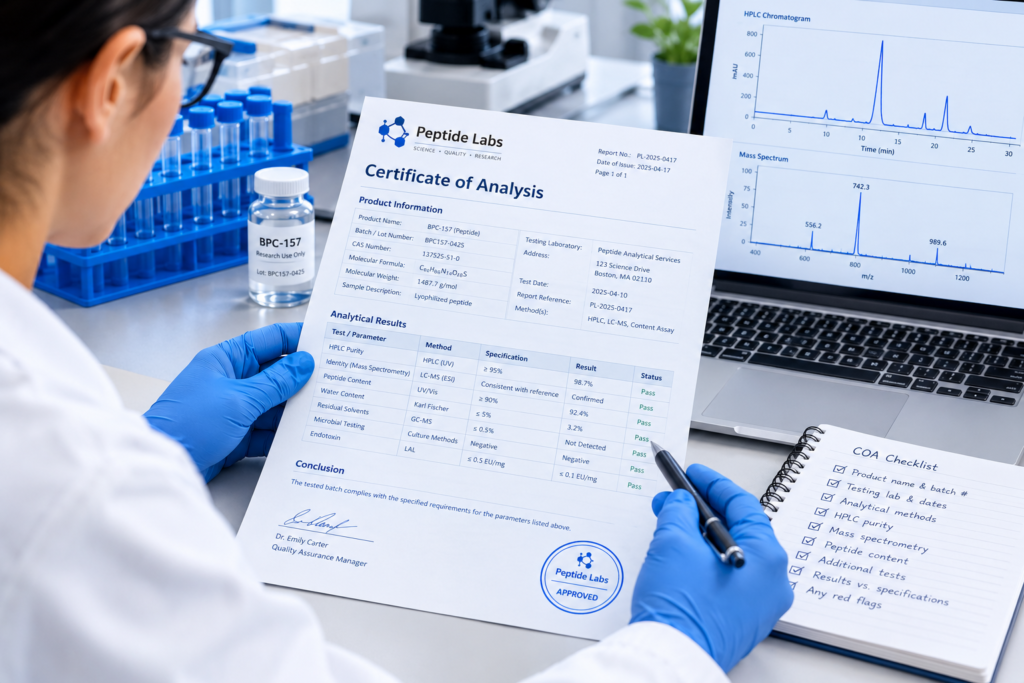
12. Supporting Chromatograms and Spectra
Some certificates provide only summarized results, while more comprehensive analytical packages include supporting data.
Examples include HPLC chromatograms and mass-spectrometry spectra.
These materials may help qualified reviewers assess whether the reported result is consistent with the underlying analytical evidence.
A chromatogram can show peaks detected during separation, while a mass spectrum can provide information about the ions measured by the instrument.
However, interpreting these data correctly requires an understanding of the analytical method and its limitations. what should be included in a peptide COA?
Why it matters: Supporting data can improve transparency and make the results easier for qualified reviewers to evaluate.
Peptide COA Checklist: What Should You Look For?
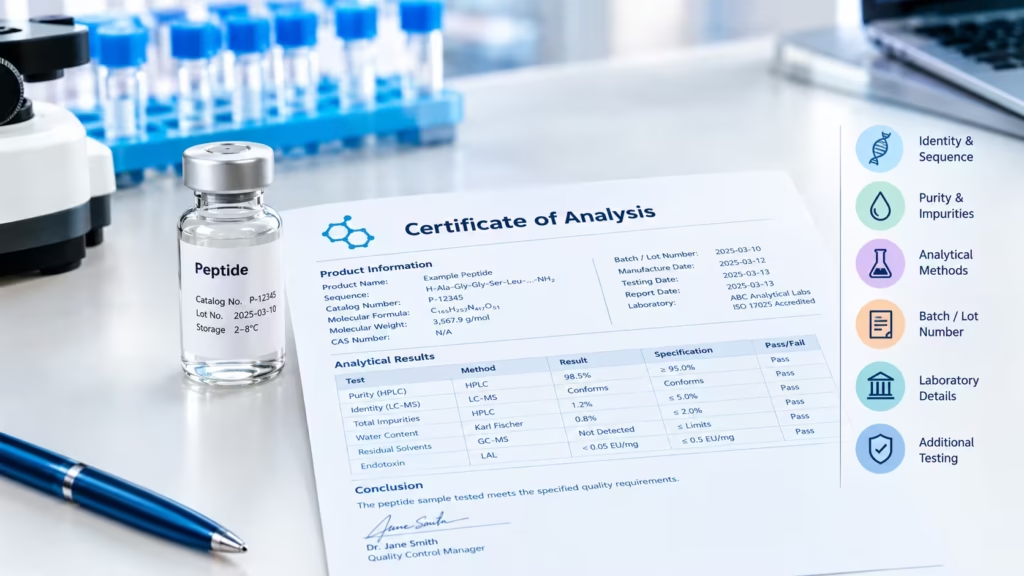
Use this checklist when reviewing a peptide Certificate of Analysis.
- The peptide is clearly identified.
- The batch or lot number is stated.
- The testing laboratory or responsible organization is identified.
- Testing and report dates are provided.
- Purity results are reported with the analytical method identified.
- Identity testing is documented where appropriate.
- Relevant impurity information is included.
- Specifications and acceptance criteria are stated.
- Additional tests, such as water content, residual solvents, endotoxins, or microbiological quality, are included when relevant.
- Supporting chromatograms or spectra are available when needed.
- The document can be connected to the specific batch being evaluated.
what should be included in a peptide COA? Not every peptide COA needs every test listed above. The appropriate scope depends on the product, manufacturing process, intended use, and applicable quality requirements. Are Peptides the Same as Steroids?
How to Tell Whether a Peptide COA Is Reliable
Finding a COA online is not the same as verifying its authenticity or determining whether it provides sufficient evidence of quality.
Consider these practical checks.
Verify the batch number
Compare the lot number on the COA with the identifier on the relevant product documentation. If the numbers do not match, ask for clarification.
Check the laboratory details
Look for the laboratory’s name, report identification number, dates, and other traceability information. Where possible, verify the report directly with the issuing laboratory using independently obtained contact information.
Review the actual test results
A certificate that lists only a purity percentage may provide less evidence than a report that identifies the method, documents identity testing, and includes relevant supporting data.
Examine the dates
Check when the sample was tested and whether the report corresponds to the batch in question. An old report may not describe the condition of material after extended storage or changes in handling.
Distinguish independent testing from supplier testing
A manufacturer-issued COA can provide useful quality information. An independent laboratory report may offer an additional layer of review, but independence alone does not guarantee reliable results.
The laboratory’s competence, methods, sample handling, and report traceability also matter.
Look for unexplained inconsistencies
Missing batch identifiers, contradictory results, unclear units, or mismatched product names are reasons to request clarification before relying on the document.
A professional-looking PDF, QR code, or laboratory logo is not sufficient proof of authenticity. what should be included in a peptide COA?
COA vs. Peptide Purity Report: What Is the Difference?
The terms “Certificate of Analysis” and “purity report” are sometimes used interchangeably, but they do not necessarily describe documents with the same scope.
| Feature | Peptide COA | Purity Report |
|---|---|---|
| Product or sample identification | Generally expected | May be included |
| Batch or lot number | Important for traceability | May be included |
| Purity result | Often included | Usually the main focus |
| Identity confirmation | May be included | Not always included |
| Impurity information | May be included | Often limited to chromatographic findings |
| Additional quality tests | May be included when relevant | Usually limited in scope |
what should be included in a peptide COA? The exact contents depend on the issuer. A COA title does not guarantee comprehensive testing, and a document called a purity report may still contain valuable analytical information. humanin peptide
The most important consideration is what the document actually demonstrates. kpv peptide
Does a High-Purity Peptide COA Mean the Peptide Is Safe?
No. A high-purity result does not, by itself, establish that a peptide is safe for human use.
Purity, identity, sterility, endotoxin levels, stability, and suitability for a particular application are separate considerations.
For example, an HPLC result may indicate that most of the detected chromatographic signal belongs to the main peak. It does not automatically establish the absence of harmful contaminants, confirm sterility, or demonstrate that the substance has been evaluated for clinical safety.
A COA should therefore be interpreted within the limits of the tests performed. what should be included in a peptide COA?
For products intended for medical or research applications, appropriate quality controls and regulatory requirements depend on the specific product and jurisdiction. Laboratory documentation alone does not establish authorization for human use.
Frequently Asked Questions About what should be included in a peptide COAs?
What is the most important information on a peptide COA?
The most useful starting points are the peptide’s identity, batch or lot number, purity result, analytical method, identity-confirmation data, testing laboratory, and report date. Additional tests depend on the peptide and its intended application.
What purity percentage should a peptide COA show?
There is no single purity percentage that applies to every peptide or application. Appropriate specifications depend on the material, manufacturing process, analytical method, and applicable quality requirements. A percentage should not be evaluated without understanding how it was measured.
Should a peptide COA include HPLC results?
HPLC is commonly used to evaluate chromatographic purity and related impurities. A useful report should identify the method and provide the relevant result. Supporting chromatograms may be available as part of a more detailed analytical package.
Is LC-MS testing necessary for every peptide?
Not every certificate follows the same testing plan. LC-MS or another suitable identity method can provide important evidence, but the appropriate method depends on the peptide’s characteristics and the quality requirements. The COA should make clear what was tested and what the findings establish.
Can a peptide COA prove that a product is sterile?
No. A chemical identity or purity result does not establish sterility. Sterility and endotoxin testing address different quality characteristics and must be evaluated separately where applicable.
How often should a peptide be tested?
Testing frequency depends on the manufacturing process, batch-release requirements, stability considerations, applicable regulations, and the type of product. A COA for one batch should not automatically be assumed to represent every subsequent batch.