What Is Mod GRF 1-29? A Guide to Its Function, Research, and Safety
Mod GRF 1-29 is a synthetic peptide studied for its ability to stimulate the body’s natural release of growth hormone. It is closely related to growth hormone-releasing hormone (GHRH), a signaling molecule produced in the hypothalamus that helps regulate growth hormone secretion by the pituitary gland. what is mod grf 1-29 ara-290
Interest in what is mod grf 1-29 has grown in discussions about peptide research, muscle recovery, body composition, and growth hormone regulation. However, understanding what this peptide does requires distinguishing its biological mechanism from claims about its effectiveness, safety, and potential benefits in humans. Mod GRF 1-29
what is mod grf 1-29 In this guide, we’ll explain what is mod grf 1-29, how it works, how it differs from related peptides, and what current scientific understanding says about its potential uses and risks. what are peptides and how do they work
What Is Mod GRF 1-29?
what is mod grf 1-29 is a modified synthetic version of the first 29 amino acids of growth hormone-releasing hormone. It is designed to interact with GHRH receptors and stimulate the pituitary gland to release growth hormone. What Information Should a Peptide COA Include?
The name is commonly associated with a modified form of the GHRH fragment known as GRF 1-29. It is also frequently discussed alongside CJC-1295, although the terminology used by peptide sellers and research communities is not always consistent. what is mod grf 1-29 difference between peptides and proteins
Growth hormone is involved in several physiological processes, including tissue growth, protein metabolism, and the regulation of insulin-like growth factor 1 (IGF-1). Because what is mod grf 1-29 acts on the signaling pathway that controls growth hormone secretion, researchers have an interest in how this type of peptide influences hormone release. thymosin alpha-1
Important distinction: A peptide that stimulates growth hormone secretion does not automatically produce proven improvements in muscle growth, fat loss, athletic performance, or longevity.
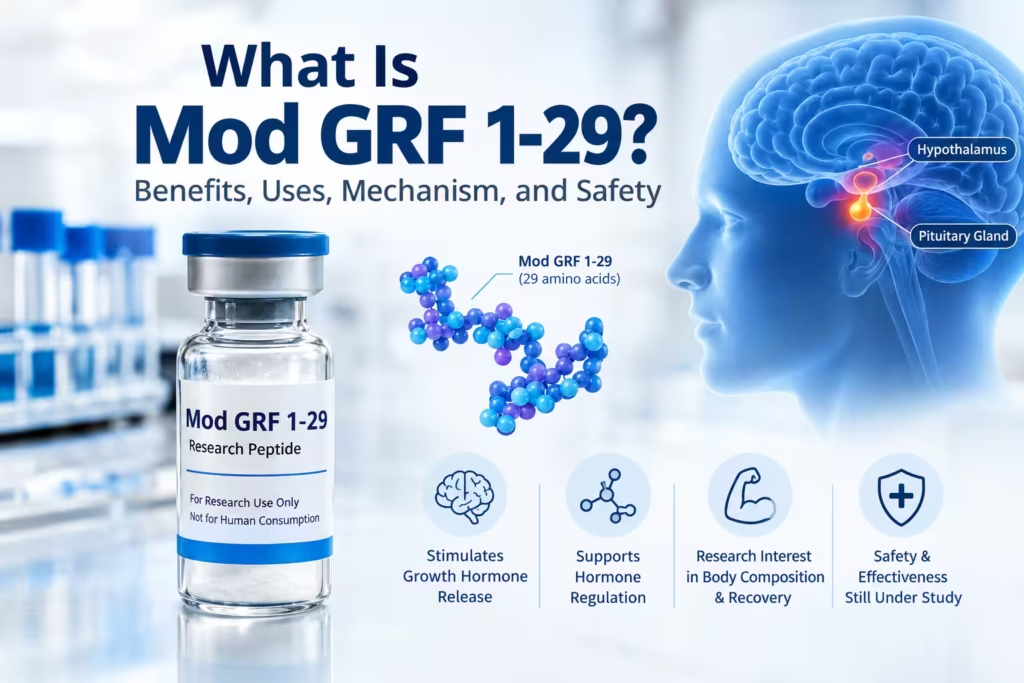
How Does Mod GRF 1-29 Work?
Mod GRF 1-29 is designed to mimic aspects of the body’s natural growth hormone-releasing hormone signaling system.
The process can be understood in three main stages.
1. Interaction With GHRH Receptors
Naturally occurring GHRH binds to specific receptors on somatotroph cells in the anterior pituitary gland. These cells are responsible for producing and releasing growth hormone.
Mod GRF 1-29 is designed to activate the same receptor pathway.
2. Stimulation of Growth Hormone Release
When the GHRH receptor is activated, intracellular signaling pathways help stimulate growth hormone secretion. The body’s response depends on several factors, including natural hormone rhythms, age, health status, and other regulatory signals.
Growth hormone release is normally pulsatile, meaning that secretion rises and falls throughout the day rather than remaining constant.
3. Downstream Effects of Growth Hormone
Growth hormone acts directly on various tissues and also stimulates the production of insulin-like growth factor 1, primarily in the liver.
Growth hormone and IGF-1 are involved in processes such as tissue growth, protein metabolism, and bone development. However, changes in hormone levels do not necessarily translate into a particular clinical benefit.
The effects of a synthetic GHRH-related peptide can differ between laboratory research and real-world human use.
What Is Mod GRF 1-29 Used For?
Mod GRF 1-29 is primarily discussed in the context of peptide research involving growth hormone regulation.
Researchers may investigate GHRH-related compounds to better understand pituitary function, hormone secretion, and the biological pathways involved in growth and metabolism.
Outside formal research, the peptide is sometimes promoted for several purposes. what is mod grf 1-29 hexarelin peptide
Muscle Growth and Recovery
Growth hormone plays a role in protein metabolism and tissue maintenance. This has led to interest in whether stimulating growth hormone release could affect muscle development or recovery.
However, there is insufficient high-quality clinical evidence to establish that Mod GRF 1-29 improves muscle growth, strength, or recovery in healthy people.
Body Composition and Fat Metabolism
Growth hormone influences how the body uses fat for energy. This biological role is one reason GHRH-related peptides are discussed in connection with fat loss and body composition.
Nevertheless, evidence about growth hormone physiology cannot be treated as proof that Mod GRF 1-29 causes meaningful or sustained fat loss. Reliable human studies demonstrating these outcomes are lacking. what is mod grf 1-29 tesamorelin vs ipamorelin
Research Into Hormonal Function
The most scientifically grounded area of interest is its relationship to growth hormone signaling.
Studying GHRH-related compounds can help researchers investigate how the pituitary gland responds to hormonal signals and how growth hormone secretion is regulated.
Claims thatwhat is mod grf 1-29 improves sleep, slows aging, boosts athletic performance, or extends lifespan should be treated cautiously because robust clinical evidence for these outcomes is lacking. semaglutide
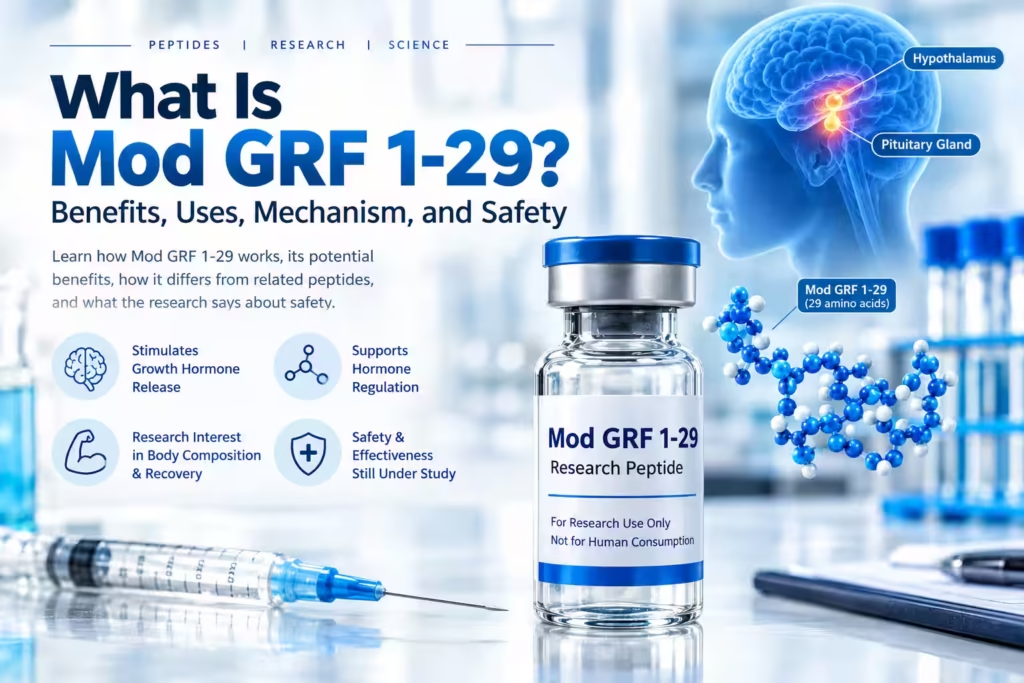
What Are the Potential Benefits of Mod GRF 1-29?
Potential benefits are often inferred from the role of growth hormone in the body. It is important to separate established growth hormone physiology from unproven claims about this particular peptide.
Areas of interest include:
- Growth hormone signaling: Mod GRF 1-29 is designed to stimulate a pathway involved in growth hormone secretion.
- Endocrine research: It may be of interest in research exploring how GHRH receptors and pituitary cells regulate hormone release.
- Metabolic research: Growth hormone is involved in fat and carbohydrate metabolism, making its signaling pathways relevant to metabolic studies.
- Tissue biology: Growth hormone and IGF-1 participate in tissue growth and maintenance, although benefits from Mod GRF 1-29 itself have not been established.
what is mod grf 1-29 These are research interests, not a list of proven therapeutic benefits. The available evidence does not establish what is mod grf 1-29 as a safe or effective treatment for a medical condition or as a validated performance-enhancing intervention. what is mod grf 1-29 How to Verify a Certificate of Analysis for Peptides
Mod GRF 1-29 vs. CJC-1295: What Is the Difference?
Mod GRF 1-29 and CJC-1295 are closely related terms that can cause confusion in peptide discussions.
Mod GRF 1-29 generally refers to a modified GHRH fragment designed to have a longer duration of action than the original, unmodified GRF 1-29 fragment.
CJC-1295 is associated with a longer-acting GHRH analogue. The original clinical research compound known as CJC-1295 was designed with a drug-affinity complex that allows binding to albumin, extending its persistence in circulation.
In informal marketing, the term “CJC-1295 without DAC” is frequently used to refer to what is mod grf 1-29. However, product naming and composition can vary, so the labels should not automatically be assumed to describe identical preparations.
| Feature | Mod GRF 1-29 | CJC-1295 with DAC |
|---|---|---|
| Relationship | Modified GHRH fragment | Longer-acting GHRH analogue |
| Main research interest | Growth hormone signaling | Prolonged growth hormone stimulation |
| Duration | Designed to be relatively short-acting | Designed for a longer duration |
| Common terminology | Sometimes called CJC-1295 without DAC | Often identified by the DAC designation |
| Evidence for routine use | Insufficient to establish safety and efficacy | Insufficient to establish routine-use safety and efficacy |
The key difference is the intended duration of action and molecular design. These distinctions matter because different compounds may have different pharmacological effects and risk profiles. what is mod grf 1-29 nad+
Mod GRF 1-29 vs. Ipamorelin
Mod GRF 1-29 and ipamorelin are both discussed in connection with growth hormone release, but they act through different receptor systems.
Mod GRF 1-29 is designed to activate the growth hormone-releasing hormone receptor. Ipamorelin is a growth hormone secretagogue that acts through the ghrelin receptor, also known as the growth hormone secretagogue receptor.
Because they act through different pathways, they should not be considered interchangeable.
Some peptide discussions describe combining the two compounds to influence growth hormone secretion through separate signaling mechanisms. However, the theoretical rationale for combining compounds does not establish that the combination is safe, effective, or appropriate for human use.
Is Mod GRF 1-29 Safe?
The safety of Mod GRF 1-29 has not been adequately established for routine human use. Limited clinical evidence, uncertain product quality, and incomplete long-term safety data make it difficult to determine its overall risk profile.
Potential concerns associated with manipulating growth hormone signaling may include:
- Changes in growth hormone and IGF-1 levels.
- Fluid retention or swelling.
- Joint or muscle discomfort.
- Changes in glucose regulation and insulin sensitivity.
- Unintended hormonal effects, depending on exposure and individual health factors.
These are potential concerns related to growth hormone pathways and related interventions, not a definitive list of adverse effects proven specifically for Mod GRF 1-29.
People with diabetes, glucose regulation problems, active or previous hormone-sensitive cancers, or other significant medical conditions should be especially cautious about unapproved hormone-modulating substances and discuss relevant concerns with a qualified healthcare professional.
A product labeled for research purposes should not be assumed to be suitable for human administration. Purity claims, certificates of analysis, and seller descriptions also do not establish clinical safety.
Is Mod GRF 1-29 FDA Approved?
Mod GRF 1-29 is not an FDA-approved medication for treating growth hormone deficiency, increasing muscle mass, reducing body fat, or slowing aging.
Approval status can differ between countries and regulatory authorities. Before considering any peptide-related treatment, people should consult a qualified healthcare professional and the relevant national medicines regulator.
Compounds sold online as research peptides may not have undergone the clinical testing, manufacturing oversight, and regulatory review required for approved medicines.
How Is Mod GRF 1-29 Administered?
Mod GRF 1-29 is commonly discussed online as an injectable peptide. However, the fact that a product is marketed for injection does not establish that it is approved, sterile, accurately labeled, or safe for human use.
There is no universally established, evidence-based dosing schedule for routine human use of Mod GRF 1-29. Products sold by different suppliers may also vary in identity, purity, concentration, and handling requirements.
For these reasons, an online dosing recommendation should not be treated as a medically validated protocol. Anyone investigating growth hormone-related symptoms should seek appropriate medical evaluation rather than attempting to self-treat with an unapproved peptide.
What Does Scientific Research Say About Mod GRF 1-29?
Research on growth hormone-releasing hormone provides a scientific basis for understanding the pathway targeted by Mod GRF 1-29. However, evidence about naturally occurring GHRH or other GHRH analogues cannot automatically establish the benefits or safety of this specific compound.
Three distinctions are important:
- Mechanistic evidence: A compound may interact with a receptor or influence hormone release in laboratory or physiological studies.
- Clinical evidence: Human studies must establish whether it produces meaningful benefits and identify adverse effects.
- Long-term evidence: Larger and longer studies may be needed to assess uncommon risks, sustained effects, and outcomes over time.
For Mod GRF 1-29, evidence supporting routine use for bodybuilding, fat loss, anti-aging, or general wellness remains insufficient.
Readers should prioritize peer-reviewed research, clinical trial records, and authoritative medical guidance over anecdotal reports or commercial marketing.