
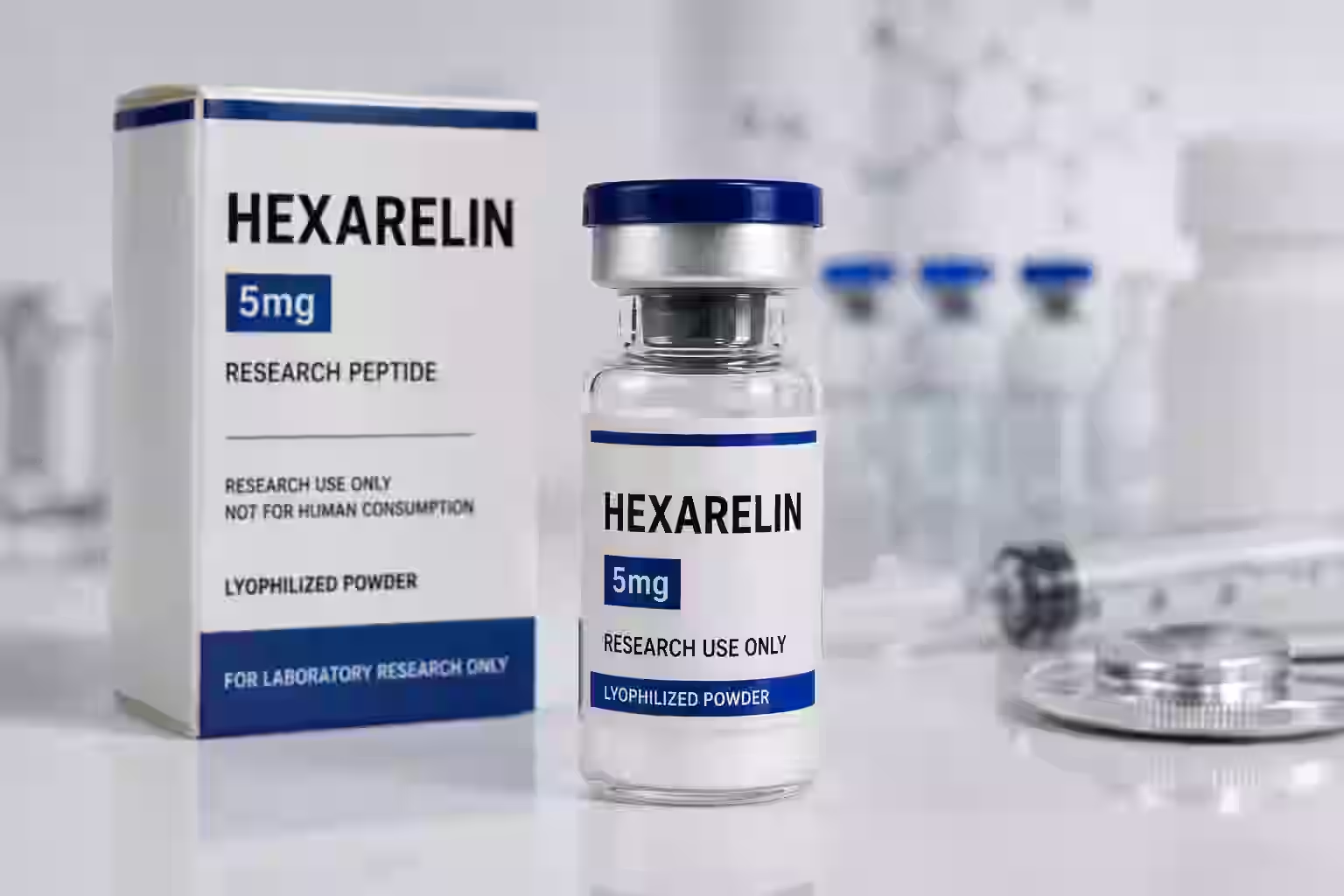
Hexarelin: Research, Mechanism, Potential Benefits, and Uses
Hexarelin is a synthetic hexapeptide that has been investigated extensively for its ability to stimulate the release of growth hormone (GH). Also known as examorelin, Hexarelin belongs to the growth hormone-releasing peptide (GHRP) family and has been studied in laboratory and human research since the 1990s. foxo4-dri peptide
Research has primarily focused on Hexarelin’s effects on growth hormone secretion, hypothalamic-pituitary signaling, and other physiological pathways. Experimental studies have also investigated potential cardiovascular and metabolic effects.
However, Hexarelin remains an experimental compound rather than an FDA-approved medication. The FDA’s substance database identifies Hexarelin under its scientific name, Examorelin, but notes that the presence of a substance record does not indicate regulatory review or approval. Dihexa Peptide
What Is Hexarelin?
Hexarelin is a synthetic six-amino-acid peptide belonging to the GHRP family. Its chemical name is:
His-D-2-methyl-Trp-Ala-Trp-D-Phe-Lys-NH₂
It is also known by the names Examorelin and EP-23905. The FDA’s Substance Registration System lists Examorelin as a synonym for Hexarelin and provides its chemical identity and molecular formula.
Hexarelin was developed as part of research into growth hormone secretagogues—compounds that stimulate the body’s endogenous release of growth hormone rather than directly supplying recombinant growth hormone. Bronchogen
What Does Hexarelin Do?
The primary research interest in Hexarelin is its ability to stimulate growth hormone secretion.
Early human studies demonstrated a dose-dependent increase in circulating GH after Hexarelin administration. In one placebo-controlled study involving healthy adult men, GH levels increased after administration and peaked approximately 30 minutes after the experimental dose.
Researchers have also investigated Hexarelin’s effects on other hormones, including:
- Growth hormone
- Prolactin
- ACTH
- Cortisol
This broader hormonal activity is important because Hexarelin does not exclusively affect growth hormone signaling. ACE-031
How Does Hexarelin Work?
Hexarelin belongs to the growth hormone-releasing peptide family and acts through growth hormone secretagogue signaling.
Research has shown that GHRPs can stimulate GH release at the level of the pituitary and hypothalamus. Hexarelin has demonstrated particularly strong GH-releasing activity in experimental studies.
Human research has shown that Hexarelin can produce a substantial GH response and that its activity can be influenced by the body’s existing hormonal environment. For example, previous administration of recombinant human GH reduced the subsequent GH response to Hexarelin, demonstrating a degree of negative feedback within the GH axis. cagrisema
Hexarelin and Growth Hormone
Growth hormone is a peptide hormone produced primarily by the pituitary gland. It plays important roles in growth, metabolism, tissue development, and regulation of insulin-like growth factor 1 (IGF-1).
Hexa-relin has been studied as a growth hormone secretagogue, meaning that it stimulates endogenous GH release.
In a controlled human dose-response study, researchers observed progressively greater GH responses with increasing experimental doses of Hexarelin.
Other research compared Hexa-relin with growth hormone-releasing hormone (GHRH). In some experimental settings, Hexa-relin produced a stronger GH response than GHRH alone, while combined stimulation of the two pathways produced a synergistic response. what is in glow peptide
These findings helped establish Hexa-relin as an important research compound for investigating GH secretion. what is in glow peptide
Hexa-relin and GHRP-6
Hexa-relin is structurally related to GHRP-6, another synthetic growth hormone-releasing peptide.
Hexa-relin is sometimes described as a GHRP-6 analog because its structure was developed from the same general research area. It contains a modified tryptophan residue that distinguishes it chemically from GHRP-6.
Both compounds have been studied for their ability to stimulate GH secretion, but they should not be assumed to have identical pharmacological profiles. Glow Peptide
Hexa-relin and IGF-1
Growth hormone and IGF-1 are closely connected components of the somatotropic axis.
GH released from the pituitary can stimulate IGF-1 production, particularly in the liver. IGF-1 subsequently contributes to several biological processes involving growth and metabolism.
Because Hexa-relin stimulates endogenous GH secretion, researchers have investigated its downstream effects on the GH/IGF-1 axis.
However, the relationship between an experimentally induced GH pulse and longer-term changes in IGF-1 depends on factors such as timing, baseline endocrine function, age, and physiological condition.
Therefore, laboratory evidence that Hexa-relin stimulates GH should not automatically be interpreted as proof of specific long-term effects from increased IGF-1. Glow Blend (TB 10mg + BPC 10mg + GHK 50mg)
Hexa-relin and Other Hormones
One important characteristic of Hexa-relin research is that its effects are not limited to growth hormone.
Human studies have reported increases in prolactin, while other research has documented effects on ACTH and cortisol.
This is relevant when evaluating claims that Hexa-relin selectively increases GH without affecting other endocrine pathways.
In a study involving healthy volunteers, Hexa-relin increased ACTH and cortisol as well as GH and prolactin. Researchers suggested that the effects on the hypothalamic-pituitary-adrenal axis could involve arginine vasopressin signaling.
These findings demonstrate why Hexa-relin should be considered an experimental endocrine-active compound rather than simply a generic “growth hormone peptide.” 5 amino 1mq benefits
Hexa-relin and Cardiovascular Research
Researchers have also investigated Hexa-relin for effects that may occur independently of growth hormone.
In a human study involving healthy adults, people with growth hormone deficiency, and patients with dilated cardiomyopathy, acute Hexa-relin administration produced changes in left ventricular ejection fraction in some groups without significant changes in blood pressure or heart rate. The investigators proposed a possible GH-independent cardiac mechanism.
These findings generated additional interest in growth hormone secretagogues and their potential interactions with cardiac tissues.
However, these experimental findings should not be interpreted as evidence that Hexa-relin is a treatment for heart disease or heart failure.
Hexa-relin and Growth Hormone Deficiency Research
Hexa-relin has been investigated in people with abnormalities involving the hypothalamic-pituitary system.
Research in patients with growth hormone deficiency demonstrated that the response to Hexa-relin depended partly on the integrity of hypothalamic-pituitary connections. Patients with more severe disruption of these pathways showed markedly reduced GH responses.
These experiments helped researchers understand how growth hormone secretagogues interact with the endocrine system.
Hexarelin has not, however, become an FDA-approved replacement for established treatments for growth hormone deficiency.
Potential Research Applications of Hexa-relin
Scientific research involving Hexa-relin has investigated several areas, including:
- Growth hormone secretion
- Growth hormone secretagogue signaling
- Hypothalamic-pituitary function
- GHRP pharmacology
- GH/IGF-1 physiology
- Prolactin secretion
- ACTH and cortisol regulation
- Cardiovascular physiology
- Growth hormone deficiency
- Endocrine responses to exogenous GH
These represent research applications, not established medical indications. GHK-CU 100mg
Is Hexarelin FDA Approved?
No. Hexarelin is not FDA-approved as a medication for any medical condition.
The FDA Substance Registration System lists Examorelin, also known as Hexarelin, as an identified chemical substance. However, the FDA specifically explains that the existence of a UNII record does not imply regulatory review or approval.
This distinction is important because experimental compounds can have extensive scientific literature without becoming approved therapies. zTesofensine Peptide
Is Hexa-relin Safe?
The available research provides information about Hexa-relin’s biological effects, but it does not establish Hexa-relin as a generally safe or approved therapeutic product for consumers.
Human experimental studies have documented changes in several hormones, including GH, prolactin, ACTH, and cortisol.
Potential safety questions requiring further evaluation include:
- Effects of repeated or long-term exposure
- Hormonal changes
- Effects on glucose and metabolic regulation
- Cardiovascular effects
- Interactions with other endocrine-active substances
- Individual differences in response
- Appropriate clinical dosing
- Long-term effects on the GH/IGF-1 axis
The absence of a documented adverse event in an individual experimental study should not be interpreted as proof of long-term safety. Semax
Hexarelin vs. Growth Hormone
Hexarelin and recombinant human growth hormone are fundamentally different types of compounds.
Hexarelin is a growth hormone secretagogue. It stimulates the body’s own pituitary GH release.
Recombinant human growth hormone directly supplies a manufactured form of human growth hormone.
This difference is important because endogenous GH release remains subject to physiological feedback mechanisms. Research has demonstrated that previous administration of GH can reduce the subsequent GH response to Hexarelin.
Hexa-relin vs. Ipamorelin
Hexa-relin and ipamorelin are both members of the broader growth hormone secretagogue research category.
However, they are chemically distinct compounds and can produce different hormonal responses.
Hexa-relin has been documented in human research to affect not only GH but also prolactin and ACTH/cortisol pathways.
This broader endocrine activity is one reason researchers may distinguish Hexa-relin from newer growth hormone secretagogue compounds when investigating selective hormonal signaling. Tesamorelin + Ipamorelin
Hexa-relin Research and Athletic Use
Growth hormone-releasing peptides have attracted attention in sports and performance research because of their effects on GH secretion.
However, athletes subject to anti-doping rules should be aware that Hexa-relin/examorelin is prohibited under the World Anti-Doping Agency’s prohibited-substance framework. Current anti-doping references classify examorelin (Hexa-relin) among growth hormone-releasing peptides.
Competitive athletes should consult the current rules of their applicable anti-doping organization before using any hormone-active research compound. cjc-1295+ ipamorelin
Reviews
There are no reviews yet.