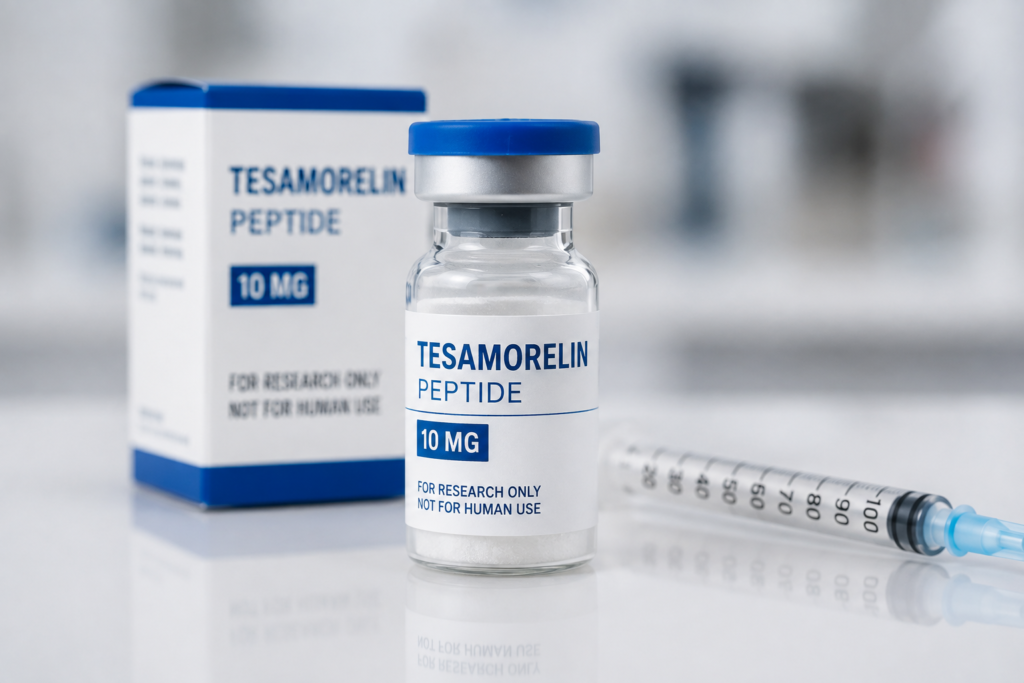
Tesamorelin Peptide Dosage: What the Research and FDA Label Say
If you’re researching tesamorelin peptide dosage, one of the most important things to understand is that there isn’t one universal dose that applies to every tesamorelin product. tesamorelin peptide
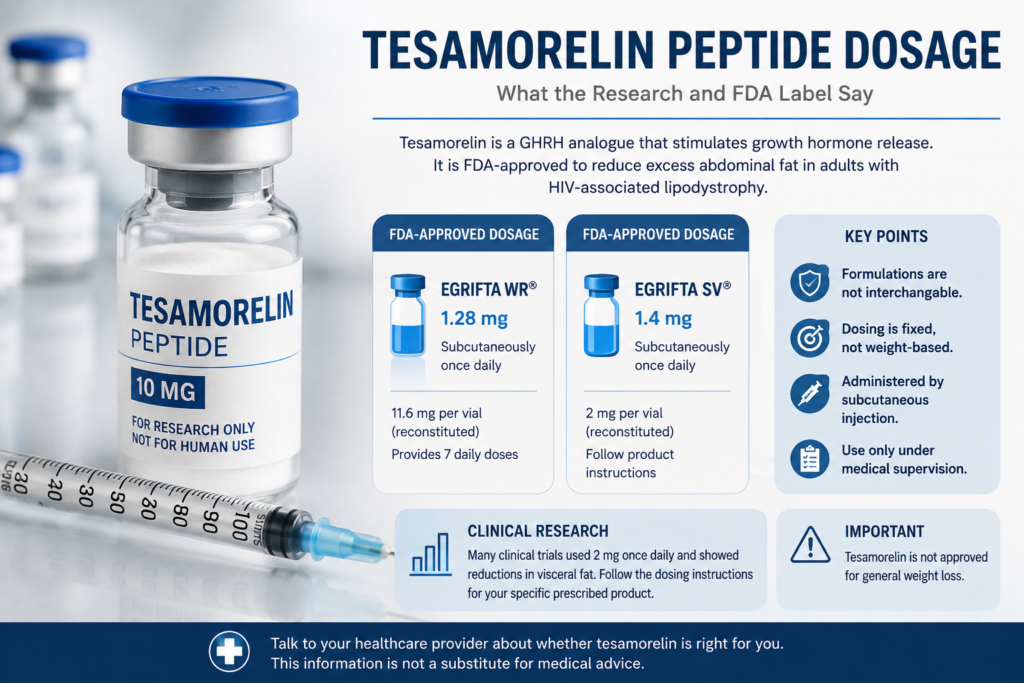
The FDA-approved tesamorelin products have different tesamorelin peptide dosage formulations and different recommended doses. EGRIFTA WR has a recommended dose of 1.28 mg subcutaneously once daily, while EGRIFTA SV has a recommended dose of 1.4 mg subcutaneously once daily. The FDA specifically states that these formulations are not interchangeable. Tesamorelin + Ipamorelin
tesamorelin peptide dosage is approved in the United States to reduce excess abdominal fat in adults with HIV-associated lipodystrophy. It is not indicated for general weight-loss management. ipamorelin peptide
What Is Tesamorelin?
Tesamorelin is a synthetic analogue of growth hormone-releasing hormone (GHRH). It stimulates the body’s production and release of growth hormone, which subsequently influences the insulin-like growth factor-1 (IGF-1) pathway.
The medication has been studied primarily in adults with HIV-associated lipodystrophy and excess visceral abdominal fat.
Clinical trials have found that tesamorelin can reduce visceral adipose tissue (VAT), the fat stored around the abdominal organs, in appropriately selected patients.
What Is the FDA-Approved tesamorelin peptide dosage?
The answer depends on the formulation.
EGRIFTA WR dosage
According to the current FDA prescribing information, the recommended dosage of EGRIFTA WR is 1.28 mg subcutaneously once daily. The product comes as an 11.6-mg vial and is reconstituted with the supplied diluent. One reconstituted vial provides daily doses for seven consecutive days. what is ipamorelin
EGRIFTA SV dosage
The recommended dosage of EGRIFTA SV is 1.4 mg subcutaneously once daily. The FDA labeling specifies that this recommendation applies to the 2-mg-per-vial EGRIFTA SV formulation.
Why the difference matters
These numbers should not be treated as interchangeable.
The FDA states that EGRIFTA WR and EGRIFTA SV have different strengths, dosing recommendations, reconstitution instructions, and storage requirements. The products are specifically identified as not substitutable.
This is particularly important when researching tesamorelin online because websites and forums may discuss doses in milligrams, milliliters, micrograms, or syringe “units” without making clear which formulation they are referring to. what is ghk-cu
What tesamorelin peptide dosage Was Used in Clinical Trials?
Earlier clinical trials investigated 2 mg of tesamorelin administered subcutaneously once daily.
For example, a randomized clinical trial involving 404 HIV-infected adults with excess abdominal fat administered 2 mg of tesamorelin subcutaneously every day for six months. The study found a significant reduction in visceral adipose tissue compared with placebo.
Another randomized trial involving 412 participants used 2 mg of tesamorelin daily for 26 weeks. Visceral adipose tissue decreased by 15.2% in the tesamorelin group compared with an increase of 5.0% in the placebo group. GHK-CU 100mg
These studies help explain the development of tesamorelin as a treatment for HIV-associated lipodystrophy, but a research dose should not automatically be interpreted as the correct dose for an individual today.
Formulation, indication, regulatory status, medical history, and the specific prescribing information all matter.
Why Are tesamorelin peptide dosage Online Sometimes Different?
People researching “tesamorelin peptide dosage” may encounter several different numbers online.
There are several reasons for this:
- Different formulations have different approved doses.
- Older clinical trials used doses that don’t necessarily match current product labeling.
- Compounded products may have different concentrations.
- Research peptides may not be equivalent to FDA-approved medications.
- Online protocols may be based on anecdotal use rather than controlled clinical evidence.
Consequently, a dosage chart found online should not be used to determine an individual’s treatment regimen.
Is tesamorelin peptide dosage Based on Body Weight?
The FDA-approved tesamorelin peptide dosage regimens are fixed doses rather than simple weight-based calculations.
For example, EGRIFTA WR has a recommended dose of 1.28 mg once daily, while EGRIFTA SV has a recommended dose of 1.4 mg once daily.
This means that formulas such as “X micrograms per kilogram” should not be assumed to apply to FDA-approved tesamorelin treatment.
A clinician may consider numerous factors when deciding whether tesamorelin is appropriate, but patients should not independently calculate a dose based solely on body weight. how many mg of semax a day
How Is Tesamorelin Administered?
FDA-approved tesamorelin products are administered by subcutaneous injection.
The injection is given in the abdomen, with injection sites rotated. The prescribing information provides specific instructions for reconstituting each formulation and preparing the injection.
Because the formulations differ, patients should follow the instructions supplied with their specific medication rather than applying instructions from another tesamorelin product. Semax
Does tesamorelin peptide dosage Change for Weight Loss?
Tesamorelin should not be viewed as a general-purpose weight-loss medication.
The FDA labeling for EGRIFTA WR states that it is not indicated for weight-loss management and describes its approved use as reducing excess abdominal fat in adults with HIV-associated lipodystrophy.
This distinction matters because visceral fat reduction and overall weight loss are not necessarily the same thing.
Clinical research has demonstrated meaningful reductions in visceral adipose tissue without establishing tesamorelin as a general obesity treatment.
What Does Research Say About tesamorelin peptide dosage and Visceral Fat?
The evidence supporting tesamorelin is strongest for HIV-associated lipodystrophy.
In a 26-week randomized trial, 2 mg of daily tesamorelin reduced visceral adipose tissue by approximately 15%, while placebo was associated with an increase.
Another study reported an approximately 18% reduction in visceral fat among patients who continued tesamorelin treatment for a year. Researchers also observed that visceral fat reaccumulated after treatment was discontinued. IGF-1 DES
More recent evidence remains consistent with these findings. A 2026 systematic review and meta-analysis of four randomized controlled trials involving 909 patients found reductions in visceral adipose tissue, waist circumference, and trunk fat, along with an increase in lean body mass. The authors also noted that questions remain regarding long-term safety, optimal dosing strategies, and the durability of treatment effects.
What Happens If Tesamorelin Is Discontinued?
The effects of tesamorelin may not persist indefinitely after treatment stops.
In a long-term study, patients who continued tesamorelin maintained reductions in visceral adipose tissue. Patients who discontinued treatment experienced reaccumulation of visceral fat.
This is an important consideration when evaluating tesamorelin because reducing visceral fat during treatment does not necessarily mean that the change will remain after discontinuation.
Tesamorelin Dosage and IGF-1
Because tesamorelin stimulates the growth hormone pathway, it can increase levels of IGF-1.
This effect was observed in clinical research. In one randomized trial, IGF-1 increased substantially among patients receiving daily tesamorelin.
The relationship between tesamorelin and IGF-1 is one reason appropriate medical monitoring is important. The FDA prescribing information includes warnings and precautions related to elevated IGF-1 and other effects associated with growth hormone activity. PEG-MGF
Tesamorelin Side Effects and Safety
Tesamorelin is not appropriate for everyone.
Potential adverse effects and safety concerns include:
- Injection-site reactions
- Joint pain
- Muscle pain
- Fluid retention
- Numbness or tingling
- Increased IGF-1
- Changes in glucose metabolism
- Hypersensitivity reactions
- Concerns related to active malignancy
The FDA labeling also contains specific contraindications and warnings. Patients with certain cancers, hypersensitivity to tesamorelin or its ingredients, and particular pituitary conditions should not use the medication.
Because tesamorelin affects the growth hormone/IGF-1 pathway, appropriate medical evaluation is important before treatment. GHK-Cu Peptide Guide
Can You Increase or Decrease the Tesamorelin Dose?
You should not independently change your prescribed tesamorelin dose.
Increasing the amount does not necessarily produce proportionally greater benefits and may increase the likelihood of adverse effects. Likewise, taking less than prescribed may affect treatment effectiveness.
If you experience side effects, miss a dose, or believe your prescribed dose is incorrect, the appropriate response is to contact your prescribing clinician or pharmacist rather than adjusting the dose yourself.
Tesamorelin Peptide Dosage vs. Online Peptide Protocols
Online peptide communities frequently discuss tesamorelin in combination with other compounds and may provide detailed dosing protocols.
These protocols should be treated cautiously. tesamorelin vs ipamorelin
A forum recommendation may involve a different product concentration, a compounded formulation, a research-only product, or an off-label use. It may also lack clinical monitoring and quality controls.
Most importantly, another person’s peptide protocol is not an individualized medical prescription.