5-Amino-1MQ Dosage: What the Research Actually Shows
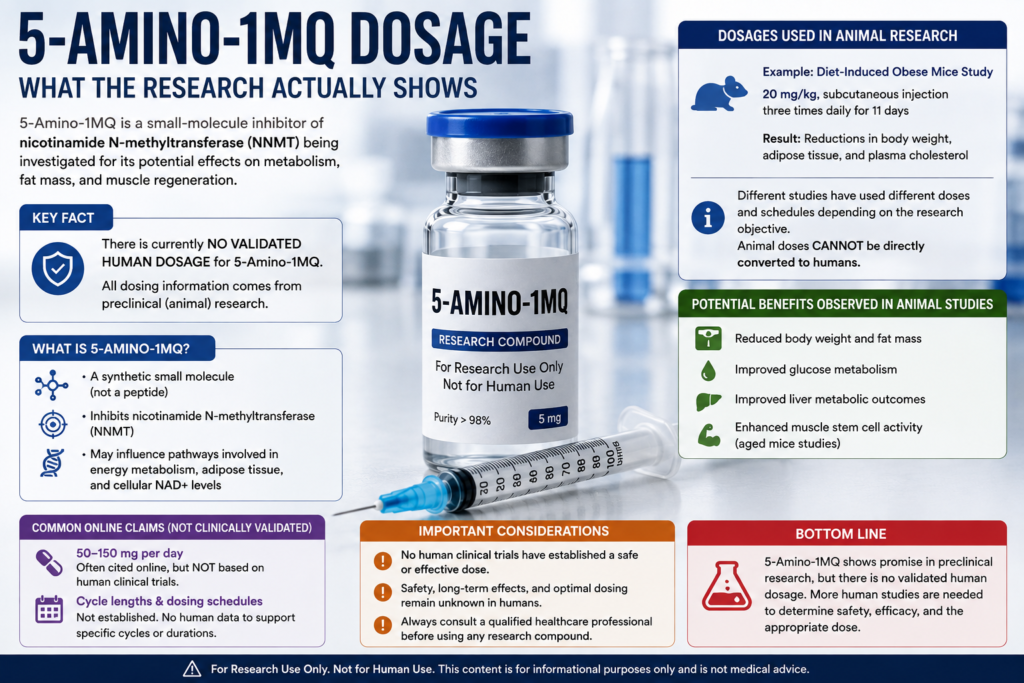
5-Amino-1MQ dosage, one important fact should come before any number: there is currently no validated human dose for 5-Amino-1MQ. 5-Amino-1MQ
5 amino 1mq dosage is a small-molecule inhibitor of nicotinamide N-methyltransferase (NNMT) that has been investigated primarily in laboratory and animal research. Although studies in mice have produced interesting findings involving body weight, adipose tissue, glucose metabolism, and muscle regeneration, these results have not established a safe or effective dosage for humans. ipamorelin peptide
This distinction is especially important because numerous websites publish specific 5 amino 1mq dosage schedules. Those numbers are generally based on extrapolations, vendor recommendations, or self-experimentation—not completed human clinical trials. Glow Blend (TB 10mg + BPC 10mg + GHK 50mg)
What Is 5-Amino-1MQ?
5-Amino-1MQ, also known as 5-amino-1-methylquinolinium, is a synthetic small molecule that inhibits the enzyme nicotinamide N-methyltransferase (NNMT).
Despite frequently being described online as a “research peptide,” 5-Amino-1MQ is not technically a peptide. It is a small molecule being investigated as a potential NNMT inhibitor.
NNMT participates in cellular metabolism by converting nicotinamide and consuming methyl donors. Researchers have investigated whether inhibiting NNMT could influence metabolic pathways associated with adipose tissue, energy metabolism, and cellular NAD+ availability.
Early research found that 5 amino 1mq dosage could inhibit NNMT and affect metabolic processes in cultured cells and mice. bpc 157 benefits
Is There an Established 5-Amino-1MQ Human Dose?
No.
There is currently no clinically established human dosage based on a completed human dose-finding study.
The available evidence comes from:
- Cell-culture experiments
- Mouse studies
- Rat pharmacokinetic research
- Preclinical metabolic research
Human clinical data are not available to establish an appropriate dose, frequency, duration, or long-term safety profile.
Therefore, numbers such as “50 mg,” “100 mg,” or “150 mg per day” that appear online should not be presented as clinically established doses. tesamorelin peptide benefits
What 5 amino 1mq dosage Have Been Used in Animal Research?
Animal studies have used substantially different doses and administration schedules depending on the research question.
For example, a foundational study published in Biochemical Pharmacology investigated 5-Amino-1MQ in diet-induced obese mice. The study used 20 mg/kg administered subcutaneously three times daily for 11 days. Researchers reported reductions in body weight and adipose tissue measures in treated animals.
Other preclinical studies have used different doses and schedules. This variation demonstrates why it is misleading to identify one animal dose as “the 5-Amino-1MQ dosage.”
Why animal doses cannot simply be converted to humans
A mouse dose expressed in mg/kg does not translate directly into an equivalent human dose.
Species differ in:
- Metabolic rate
- Absorption
- Distribution
- Drug metabolism
- Elimination
- Receptor biology
- Tissue exposure
- Pharmacokinetics
Consequently, multiplying an animal dose by a person’s body weight does not produce a scientifically validated human dose.
Human dose selection normally requires a progression of pharmacology, toxicology, pharmacokinetic, and clinical studies. semax peptide benefits
5 amino 1mq dosage and NNMT
Understanding the mechanism helps explain why researchers are interested in 5-Amino-1MQ.
NNMT is involved in the metabolism of nicotinamide and methyl donors. Researchers have proposed that excessive NNMT activity may influence metabolic processes in adipose tissue.
In preclinical experiments, inhibiting NNMT with compounds such as 5-Amino-1MQ has been associated with changes in:
- Adipose tissue metabolism
- Body weight
- Fat mass
- Lipid metabolism
- Glucose handling
- Cellular metabolic pathways
The original mouse research reported reductions in body weight, white adipose mass, adipocyte size, and plasma cholesterol without a significant reduction in food intake.
However, these are animal findings, not established effects in humans. tesamorelin peptide dosage
5 amino 1mq dosage for Weight Loss
One of the most common reasons people search for 5-Amino-1MQ dosage is its potential relationship with fat loss.
Preclinical research has generated interest in this area. In the foundational mouse study, 5-Amino-1MQ treatment reduced body weight and adipose tissue measurements in mice with diet-induced obesity.
Additional mouse research has investigated NNMT inhibition alongside dietary interventions and reported changes in body weight and fat mass.
However, there is no established human dosage for weight loss.
This means it would be inappropriate to take an animal dose and convert it into a recommended human weight-loss regimen. Sermorelin
5 amino 1mq dosage for Metabolic Health
Researchers have also investigated 5-Amino-1MQ in relation to metabolic dysfunction.
A more recent mouse study examined NNMT inhibition in diet-induced obesity and reported dose-dependent effects involving body weight, fat mass, glucose intolerance, and liver-related metabolic outcomes.
These findings are scientifically interesting because they suggest that NNMT may represent a potential metabolic target.
Nevertheless, the research remains preclinical.
A metabolic effect in mice does not demonstrate that 5-Amino-1MQ will produce the same result in humans or that a particular dose will be safe.
Is 5 amino 1mq dosageTaken Orally or Injected?
This is an area where online information can be confusing.
5 amino 1mq dosage is a small molecule, and research has investigated different routes depending on the experimental model.
The foundational mouse study used subcutaneous administration.
Separate pharmacokinetic research investigated oral bioavailability in rats.
Commercial products marketed online may therefore appear as capsules, powders, or other formulations.
However, the existence of an oral product does not establish that a particular oral dose is safe or effective in humans.
Similarly, an animal injection protocol should not be interpreted as a human injection recommendation. ace 031 peptide dosage
What About the Common 50–150 mg Daily Claims?
Search results frequently show claims that 5-Amino-1MQ is typically taken at 50–150 mg per day.
These numbers should be treated carefully.
They are not doses established through human clinical trials. Instead, they are commonly associated with research-community protocols, vendor recommendations, or attempts to extrapolate preclinical data.
There is currently no high-quality human study demonstrating that 50 mg, 100 mg, or 150 mg per day is safe and effective.
For an informational article, the most scientifically accurate statement is therefore:
There is no validated human 5-Amino-1MQ dosage.
Does 5 amino 1mq dosage Have a Recommended Cycle?
You may also encounter online recommendations suggesting cycles such as several weeks of use followed by several weeks off.
These schedules are not established clinical protocols.
There is no human clinical evidence demonstrating an optimal:
- Cycle length
- Treatment duration
- Break period
- Daily frequency
- Dose escalation schedule
Consequently, a “cycle” published by a vendor or research-chemical community should not be confused with a medically validated treatment protocol. GHK-CU 100mg
What Are the Potential Benefits Being Researched?
Preclinical research has investigated several possible effects of NNMT inhibition with 5 amino 1mq dosage.
Fat and body weight
Mouse studies have reported reductions in body weight and adipose tissue.
Glucose metabolism
More recent animal research has investigated improvements in glucose-related metabolic measures following NNMT inhibition.
Liver metabolism
Preclinical studies have also examined the effects of NNMT inhibition on obesity-associated liver abnormalities.
Muscle research
NNMT inhibition has also been investigated in aged mice for potential effects on muscle stem-cell activity and regenerative capacity.
These findings provide reasons for continued scientific interest, but they remain preclinical observations.
Is 5 amino 1mq dosage Safe?
The biggest limitation is the lack of human safety data.
Animal studies can provide information about potential toxicity and biological effects, but they cannot establish long-term safety in humans.
Important unanswered questions include:
- What is the safe human dose?
- What dose produces meaningful NNMT inhibition in humans?
- What are the long-term metabolic effects?
- How does 5-Amino-1MQ interact with medications?
- What happens with prolonged NNMT inhibition?
- What are the effects in people with kidney or liver disease?
- What are the effects during pregnancy or breastfeeding?
Until human studies answer these questions, the safety profile of 5-Amino-1MQ in people remains uncertain. tesamorelin peptide
Is 5 amino 1mq dosage FDA Approved?
5-Amino-1MQ does not have an FDA-approved human dosage or an approved therapeutic indication.
It remains a preclinical research compound rather than an established medication.
This is an important distinction when evaluating products marketed online as “research peptides” or “metabolic compounds.”
A product being commercially available does not mean that its safety, purity, potency, or effectiveness has been established through human clinical trials.
Why the Exact 5 amino 1mq dosage Matters
When researchers develop a new compound, dosage is not simply a matter of choosing a number that produced an effect in animals.
A clinical dosing program typically needs to establish:
- Pharmacokinetics — how the body absorbs and eliminates the compound.
- Pharmacodynamics — what biological effects occur at different exposures.
- Dose-response relationships — whether increasing exposure increases benefits or risks.
- Safety margins — how much exposure can occur before adverse effects become concerning.
- Population differences — how age, weight, kidney function, liver function, and other factors influence exposure.
5-Amino-1MQ has not progressed far enough through human development to answer these questions. Selank
5 amino 1mq dosage: Key Facts at a Glance
| Question | What the evidence shows |
|---|---|
| Is there an approved human dose? | No |
| Have human clinical trials established a dose? | No published human dose-finding data |
| Is 5-Amino-1MQ technically a peptide? | No; it is a small molecule |
| Has it been studied in animals? | Yes |
| Has it been studied for metabolic effects? | Yes, primarily in mice |
| Are 50–150 mg/day human protocols clinically validated? | No |
| Can mouse doses be directly converted into human doses? | No |
| Is long-term human safety established? | No |