aod 9604 dosage: What Clinical Research and FDA Information Show
AOD 9604 dosage is one of the most searched topics surrounding this experimental peptide. AOD-9604 has been investigated for its potential effects on fat metabolism and obesity, and historical human studies evaluated different oral exposure levels. However, there is no FDA-approved AOD 9604 dosage for weight loss or any other medical indication. aod-9604 peptide
That distinction is important because dosage information found online can mix together historical clinical-study protocols, research-product concentrations, and unofficial recommendations. These are not equivalent. Bronchogen
Current FDA materials also emphasize that safety information for aod 9604 dosage is limited and that important questions remain regarding pharmacokinetics, bioavailability, immunogenicity, peptide impurities, and long-term safety. Tesamorelin + Ipamorelin
Important: This article is for educational and informational purposes. It does not provide a personal dosing protocol or instructions for administering AOD-9604.
What Is AOD-9604?
AOD-9604 is a synthetic 16-amino-acid peptide fragment derived from human growth hormone. It was developed to investigate metabolic effects associated with a specific region of growth hormone, particularly effects related to fat metabolism.
Research has examined AOD-9604 in areas including:
- Lipid metabolism
- Lipolysis
- Lipogenesis
- Obesity
- Body-weight regulation
- Peptide pharmacology
A 2004 review described aod 9604 dosage as a compound being developed for potential obesity treatment, with Phase IIa studies already underway at that time.
Is There a Standard AOD 9604 Dosage?
No. There is currently no FDA-approved standard aod 9604 dosage.
This means there is no official prescribing label establishing:
- A recommended starting dose
- A maintenance dose
- A maximum dose
- A standard injection schedule
- A medically established dose for weight loss
Consequently, numbers published on research-peptide websites should not automatically be interpreted as medically validated dosing recommendations.
What Doses Have Been Studied in Humans?
Historical clinical research has evaluated aod 9604 dosage at multiple oral exposure levels.
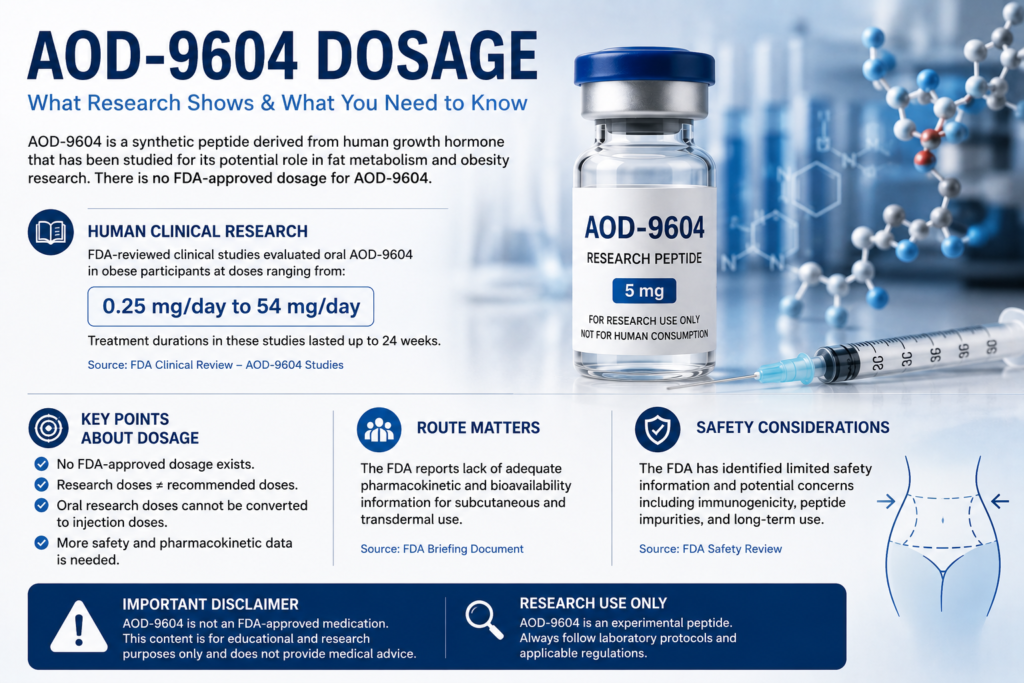
An FDA briefing document reviewing the available clinical evidence reports that four obesity studies evaluated oral AOD-9604 across doses ranging from 0.25 mg/day to 54 mg/day, with treatment periods extending up to 24 weeks.
These numbers are important for understanding the history of aod 9604 dosage research, but they should not be interpreted as a recommended human dosing range.
The studies were clinical investigations conducted under specific research protocols. They do not create an approved dosing schedule for people using AOD-9604 outside those trials. tesamorelin vs ipamorelin
Why Historical Study Doses Aren’t the Same as a Recommended Dose
A clinical trial dose is selected within a controlled research environment.
Researchers consider factors such as:
- Study objectives
- Route of administration
- Participant characteristics
- Exposure duration
- Safety monitoring
- Pharmacokinetics
- Pharmacodynamics
- Adverse events
- Laboratory measurements
A historical research dose therefore cannot automatically be converted into a general recommendation.
This distinction becomes particularly important with aod 9604 dosage because the FDA states that it did not find adequate pharmacokinetic or bioavailability information for proposed routes such as subcutaneous and transdermal administration. bpc 157 peptide
AOD 9604 Oral Dosage vs. Injectable Dosage
Another common source of confusion is the assumption that an oral research dose can simply be converted into an injectable dose.
It cannot.
The route of administration can substantially affect:
- Absorption
- Bioavailability
- Blood concentrations
- Exposure duration
- Metabolism
- Distribution
- Potential adverse effects
The FDA’s review specifically noted a lack of pharmacokinetic and bioavailability information for proposed subcutaneous and transdermal use of AOD-9604.
Therefore, historical oral study aod 9604 dosage should not be used to calculate an injection dose. TB-500
AOD 9604 Dosage for Weight Loss
AOD-9604 has attracted significant attention because it was originally investigated as a potential treatment for obesity.
However, it is important to separate research interest from an approved weight-loss treatment.
The existence of obesity trials does not mean AOD-9604 has an established therapeutic dosage for weight management. A 2004 review documented its development as an investigational obesity compound, while current FDA materials continue to identify significant gaps in safety and pharmacological information.
Therefore, there is no evidence-based FDA dosing schedule that can be presented as the standard AOD-9604 weight-loss dose.
Does AOD-9604 Have a Loading Dose?
There is no established FDA-approved AOD-9604 loading dose.
Terms such as “loading dose,” “maintenance dose,” or “dose escalation” should be interpreted cautiously when they appear on unofficial websites.
In clinical research, investigators may use different exposure strategies for specific scientific purposes. Those protocols do not establish a universal regimen for AOD-9604. Glow Blend (TB 10mg + BPC 10mg + GHK 50mg)
AOD 9604 Dosage and Dose Escalation
Dose escalation is a standard concept in drug development. Researchers may evaluate multiple exposure levels to determine how a compound behaves and whether increasing exposure changes its safety or biological effects.
However, AOD-9604 does not currently have a clinically established dose-escalation protocol for routine treatment.
The FDA has specifically highlighted the absence of sufficient information to characterize the pharmacokinetic and pharmacodynamic effects of AOD-9604 in humans.
What Does the FDA Say About AOD-9604 Safety?
Current FDA information deserves particular attention when researching AOD-9604 dosage.
The FDA states that it has identified limited safety-related information for AOD-9604 and that there may be concerns involving:
- Immunogenicity
- Peptide-related impurities
- Active pharmaceutical ingredient characterization
- Product formulation
- Storage conditions
- Long-term exposure
The agency concluded that there was insufficient information to determine whether compounded AOD-9604 products could cause harm when administered to humans.
This is one reason a specific online dosage should not be treated as automatically safe simply because it appears repeatedly across different websites.
What Adverse Events Have Been Reported?
The FDA’s review examined available human clinical data.
In historical oral studies, reported adverse events included headache, diarrhea, flatulence, increased appetite, and nausea. A severe case of diarrhea was considered possibly related to AOD-9604 by the study authors.
The FDA also discussed serious adverse events reported during clinical studies, while noting that available information was insufficient to establish causality for several events.
This illustrates why dosage cannot be considered separately from safety monitoring.
Is AOD-9604 FDA Approved?
No. AOD-9604 is not an FDA-approved medication.
The FDA has reviewed AOD-9604-related substances in the context of potential compounding and identified safety concerns and significant gaps in the available information.
This means there is no FDA-approved prescribing information that establishes an official AOD-9604 dosage for weight loss.
AOD-9604 Dosage vs. Research Concentration
Another important distinction is between dosage and concentration.
A dosage describes the amount administered to a subject, while concentration describes the amount of compound within a particular volume or experimental environment.
Research materials may list concentrations in units such as:
- Micrograms per milliliter
- Nanograms per milliliter
- Milligrams per vial
These values are not automatically human therapeutic doses.
Researchers should always interpret a reported value within the context of the study design in which it was measured.
Why AOD-9604 Dosage Information Online Can Be Confusing
Search results for “AOD-9604 dosage” may combine several very different types of information:
| Type of information | What it means |
|---|---|
| Historical clinical-study dose | Amount investigated under a specific research protocol |
| Laboratory concentration | Amount used in an experimental model |
| Product quantity | Amount contained in a research product |
| Compounding information | Information relating to a compounded preparation |
| Online dosing recommendation | An unofficial recommendation that may lack clinical validation |
These categories should never be treated as interchangeable.
Does AOD-9604 Need Dose Escalation?
There is no universally established AOD-9604 dose-escalation schedule.
For an investigational drug, dose escalation is normally determined through structured clinical research involving safety monitoring and predefined study criteria.
The FDA describes dosage optimization as a process requiring evaluation of factors such as dose-response relationships and benefit-risk considerations.
A person should therefore not assume that increasing or decreasing AOD-9604 exposure will predictably improve results.
AOD 9604 Dosage and Long-Term Use
Long-term dosing is another area where evidence is limited.
Obesity is generally a chronic condition that may require long-term treatment. The FDA specifically noted that there is insufficient information to support the safety of long-term repeated AOD-9604 use in people with obesity.
This is particularly relevant when evaluating claims about taking AOD-9604 continuously for months or longer. GHK-CU 100mg