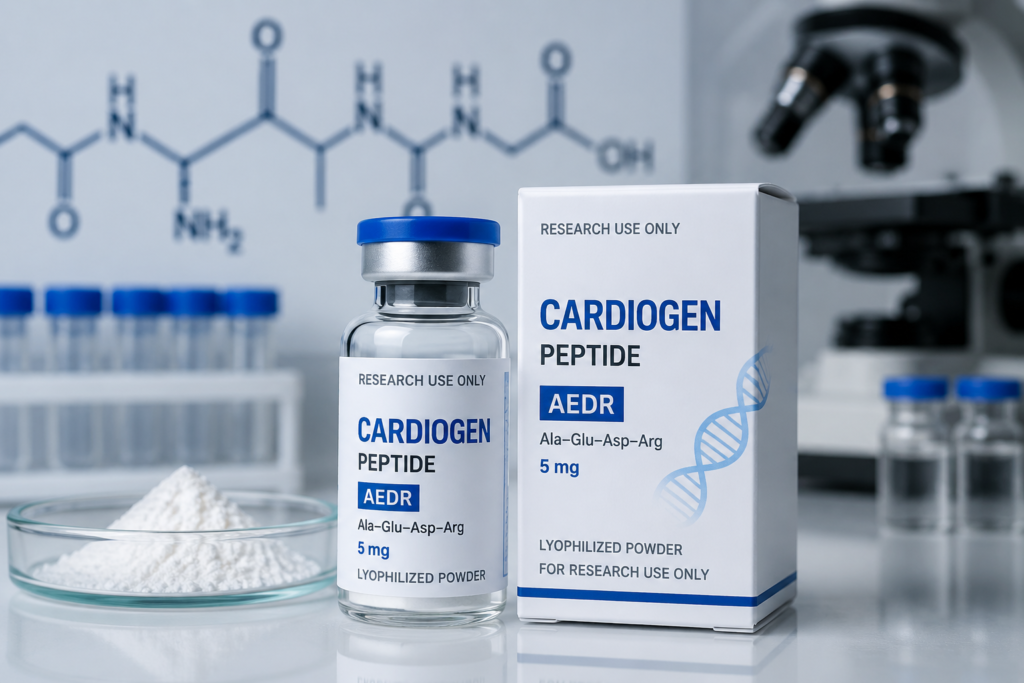
Cardiogen Peptide Dosage: What the Research Actually Shows
What is the Cardiogen peptide dosage? This is a common question among people researching Cardiogen, a short experimental peptide commonly identified as Ala-Glu-Asp-Arg (AEDR) and associated with the Khavinson family of peptide bioregulators. Cardiogen Peptide
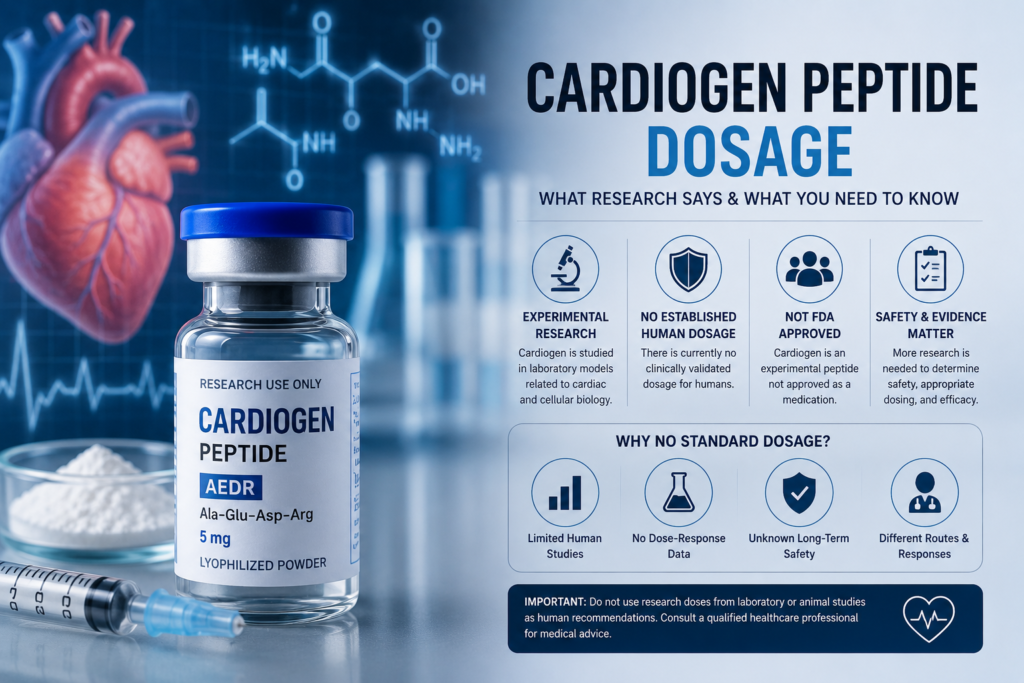
The most important point is that there is no established human therapeutic cardiogen peptide dosage. No controlled human dosing study has established an effective or safe dose, and Cardiogen is not an FDA-approved cardiovascular medication. Recent evidence reviews characterize the available literature as primarily preclinical, with no verified controlled human administration studies. aod-9604 peptide
That means research concentrations or amounts reported in laboratory and animal studies should not be converted into a recommended human dose.
Research disclaimer: This article is for educational and informational purposes only. cardiogen peptide dosage is an experimental peptide, not an FDA-approved cardiovascular treatment. Nothing below should be interpreted as a recommendation to self-administer Cardiogen or as personalized medical advice.
What Is Cardiogen Peptide?
Cardiogen is commonly described as a synthetic tetrapeptide consisting of:
Ala-Glu-Asp-Arg (AEDR)
It is associated with the Khavinson family of short peptide bioregulators and has been investigated in research involving cellular regulation and cardiovascular-related biology. A published review of peptide regulation lists AEDR/Cardiogen among peptides proposed for regulation of cardiovascular-system function.
However, the evidence supporting Cardiogen’s cardiovascular effects remains limited. Recent evidence reviews report that the available research consists primarily of laboratory and animal work, with no verified controlled human studies. tesamorelin vs ipamorelin
Is There a Standard Cardiogen Peptide Dosage?
No.
There is currently no scientifically established standard human dosage for Cardiogen.
This distinction is particularly important because websites discussing experimental peptides sometimes publish specific daily amounts or injection protocols. Those figures should not be confused with doses established through controlled clinical trials.
The available evidence does not establish:
- An effective human dose
- A safe human dose
- A maximum tolerated dose
- A validated dosing frequency
- A clinically appropriate treatment duration
- A human dose-response relationship
One recent evidence review explicitly states that no human dosing studies have been published in peer-reviewed literature.
cardiogen peptide dosage in Research
Researchers have used Cardiogen under experimental conditions, but these experiments are fundamentally different from human treatment.
For example, one reported myocardial tissue-culture experiment used Cardiogen at a concentration of approximately 10⁻¹² M in an organotypic culture model. This represents an experimental concentration in cultured tissue—not a human dosage.
This distinction is critical.
Research concentration ≠ human dosage
A laboratory concentration cannot simply be converted into:
- Milligrams per day
- Milligrams per kilogram
- Injection volume
- Oral dose
- Weekly dose
Without human pharmacokinetic and dose-ranging studies, such conversions would be speculative.
Why You May See Different cardiogen peptide dosage Online
Online information about Cardiogen dosing can be inconsistent.
Some websites describe oral protocols, while others publish subcutaneous dosing schedules. These numbers generally come from commercial protocols, community practices, or interpretations of peptide-bioregulator research, rather than controlled human clinical trials.
This is why a search for “Cardiogen peptide dosage” can produce dramatically different answers.
A responsible interpretation is:
There is no validated human Cardiogen dosage at this time. tesamorelin peptide
What About Oral cardiogen peptide dosage?
Some sources describe Cardiogen in oral capsule formulations.
However, the existence of an oral product or a published commercial protocol does not demonstrate that a particular amount is pharmacologically effective in humans.
Important unanswered questions include:
- How much intact AEDR survives digestion?
- What fraction reaches systemic circulation?
- What concentrations are achieved in tissues?
- How rapidly is the peptide metabolized?
- Does oral administration produce measurable cardiovascular effects?
- What dose would produce a clinically meaningful biological response?
Without answers to these questions, an oral dosage cannot be considered clinically established.
What About Injectable Cardiogen Dosage?
Similar caution applies to injectable Cardiogen.
Some online sources report experimental or community-derived subcutaneous protocols, but no controlled human dose-ranging program has established an appropriate injectable dose.
Consequently, specific injection amounts should not be presented as medically validated Cardiogen dosing.
Injection also introduces additional considerations involving:
- Sterility
- Endotoxins
- Peptide purity
- Formulation
- Route-specific pharmacokinetics
- Local reactions
- Immunogenicity
These factors cannot be adequately evaluated from a product label or internet protocol alone.
Cardiogen Peptide Dose-Response Research
A major limitation of Cardiogen research is the absence of a clearly established dose-response relationship.
A dose-response study would ideally determine whether increasing amounts of the peptide produce:
- No measurable effect at very low exposure
- A biological response within a defined range
- A plateau at higher exposure
- Potential adverse effects at excessive exposure
That type of information is necessary before researchers can establish a rational therapeutic dose.
Current evidence does not provide this information for Cardiogen in humans.
What Has Cardiogen Been Studied For?
Cardiogen research has focused on proposed effects involving cellular and cardiovascular biology.
Reported research areas include:
- Myocardial tissue
- Cellular proliferation
- Apoptosis-related pathways
- Peptide–protein interactions
- Peptide–DNA interactions
- Aging-related experimental models
However, the evidence remains predominantly preclinical. Recent reviews emphasize that the available studies are limited and have not established cardiovascular efficacy in humans.
Does Cardiogen Improve Heart Function?
There is currently insufficient human evidence to establish that Cardiogen improves heart function.
This is an important distinction because the name “Cardiogen” and its association with cardiac research can make the compound appear more clinically established than it actually is.
Research involving cultured myocardial tissue does not demonstrate that the peptide can:
- Treat heart failure
- Reverse cardiomyopathy
- Repair a myocardial infarction
- Improve ejection fraction
- Prevent coronary artery disease
- Reduce cardiovascular mortality
No such human therapeutic effects have been established.
Cardiogen Peptide Dosage and Safety
Dosage and safety cannot be separated.
Before a therapeutic dose can be established, researchers generally need to understand:
- Pharmacokinetics
- Pharmacodynamics
- Absorption
- Distribution
- Metabolism
- Elimination
- Dose-related adverse effects
- Drug interactions
- Long-term effects
For Cardiogen, these data are not adequately established in humans.
Recent evidence reviews characterize the human safety database as essentially absent.
Therefore, the fact that an experimental dose has been used in an animal or laboratory experiment does not demonstrate that the same exposure is safe for people.
Cardiogen Peptide Dosage vs. Research Concentrations
It is useful to understand the difference:
| Term | Meaning |
|---|---|
| In-vitro concentration | Amount of compound present in a laboratory experiment |
| Animal dose | Amount administered to a specific animal under a defined protocol |
| Human clinical dose | Amount established through human clinical research |
| Therapeutic dose | Dose demonstrated to provide benefit while maintaining an acceptable safety profile |
Cardiogen currently has preclinical research information but no established human therapeutic cardiogen peptide dosage. Bronchogen
Is Cardiogen FDA Approved?
No.
Cardiogen is not an FDA-approved drug for cardiovascular disease or any other medical indication. A recent evidence review found no FDA-approved Cardiogen product or verified human clinical development program.
This also means there is no FDA-approved prescribing information establishing:
- Cardiogen dosage
- Administration frequency
- Treatment duration
- Approved indications
- Contraindications
- Human safety parameters
Cardiogen vs. CardioGen-82: An Important Distinction
People searching for Cardiogen dosage may encounter information about CardioGen-82, but these are completely different products.
CardioGen-82 is an FDA-approved radioactive generator used to produce rubidium Rb-82 chloride for PET myocardial perfusion imaging. Its FDA labeling contains specific dosing and administration instructions.
That information does not apply to Cardiogen peptide.
Cardiogen peptide refers to the experimental short peptide commonly identified as AEDR, whereas CardioGen-82 is a radiopharmaceutical diagnostic system. cardiogen peptide dosage Glow Peptide