
How to Read a Peptide Certificate of Analysis (COA): A Complete Beginner’s Guide
A peptide certificate of analysis (COA) is an important laboratory document that reports the results of specified tests performed on a particular sample or batch of material. For anyone researching peptide science, understanding how to read a peptide certificate of analysis can help clarify what laboratory testing has established, which quality characteristics were examined, and what questions remain unanswered. how to read a peptide certificate of analysis what are peptides and how do they work
how to read a peptide certificate of analysis, a COA is only as informative as the tests it contains, the methods used, and the traceability of the report. A document displaying a high purity percentage does not automatically establish the identity of a compound, confirm the amount of peptide in a vial, or demonstrate that a product is safe for human use. reta peptide
In this guide, we explain the main sections of a peptide COA, how to read a peptide certificate of analysis, what HPLC and mass spectrometry measure, and which limitations to consider when reviewing analytical documentation. difference between peptides and proteins
What Is a Peptide Certificate of Analysis?
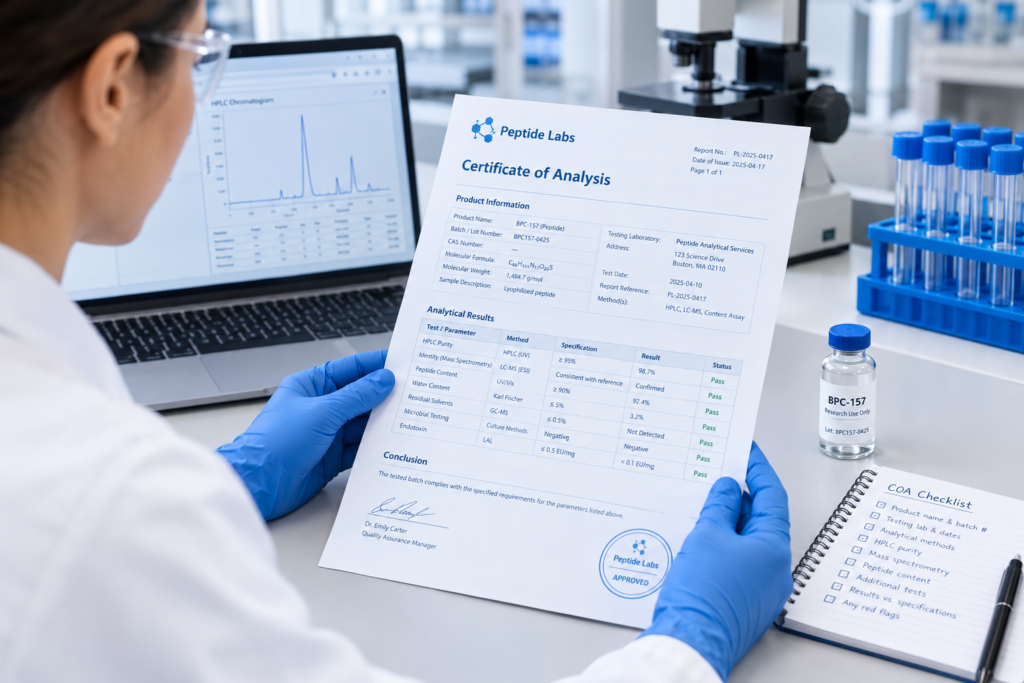
A Certificate of Analysis, commonly abbreviated as COA or CoA, is a document that records analytical test results for a specified material. Depending on the laboratory, product specifications, and intended application, it may include information about identity, purity, composition, impurities, and other quality characteristics.
For peptide research materials, a certificate may contain:
- The name of the peptide or material tested.
- A batch or lot identification number.
- The name of the testing laboratory.
- The dates of testing or report issuance.
- The analytical methods used.
- The results of individual tests.
- Acceptance limits or specifications, where applicable.
- The laboratory’s conclusions or release status, if included.
how to read a peptide certificate of analysis, The exact information varies between laboratories and materials. Not every certificate contains every test, and a missing result should not be interpreted as a passing result. how to read a peptide certificate of analysis kpv peptide
Why Is a Peptide COA Important?
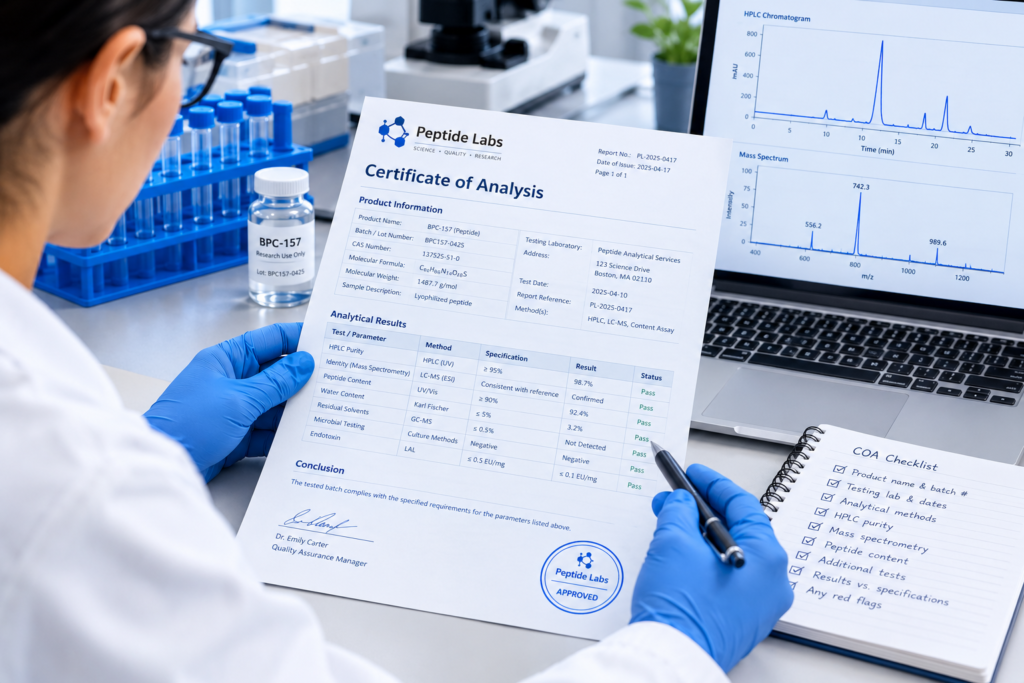
A COA can help researchers and quality professionals understand whether the tested sample meets specified analytical requirements. It can also provide traceability when the report is linked to a clearly identified batch.
how to read a peptide certificate of analysis, a certificate is not a universal guarantee of product quality. Its significance depends on whether the laboratory performed appropriate tests, whether the report is authentic, and whether the sample represents the material being evaluated. how to read a peptide certificate of analysis humanin peptide
1. Check the Peptide Name and Batch Number First
Before interpreting percentages or laboratory measurements, confirm that the certificate identifies the material it claims to describe.
Peptide or material name
Look for the compound name and any available identifying information, such as a chemical identifier, molecular formula, or amino acid sequence when relevant.
Names alone may not always distinguish closely related compounds, variants, or different forms of a material. Additional analytical evidence may be necessary to establish identity. how to read a peptide certificate of analysis
Batch or lot number
The batch number identifies a particular production lot or sample, depending on the manufacturer’s documentation system.
If a certificate is intended to describe a particular batch, compare its lot number with the corresponding product documentation. If the numbers differ, ask the supplier or laboratory to clarify the discrepancy.
A certificate from an older batch does not automatically describe a newer batch of the same product. how to read a peptide certificate of analysis
What to remember: Batch traceability connects a laboratory report to the material it describes. Without it, the relevance of the reported results may be uncertain.
2. Understand the Testing Laboratory and Report Details
The identity of the laboratory is another important part of a peptide certificate of analysis.
Look for the laboratory’s name, contact information, report reference number, testing dates, and any available means of verifying the report.
Independent testing versus supplier testing
Some certificates are issued by laboratories independent of the supplier, while others may contain results generated internally by the manufacturer or supplier.
Independent testing can provide an additional layer of evidence, but the term “third-party tested” is not sufficient by itself. The laboratory, tested sample, methods, and report should be identifiable.
Where relevant, check whether the laboratory holds accreditation for the specific testing activities being claimed. An accreditation logo alone does not establish that every test on a certificate falls within the laboratory’s accredited scope. how to read a peptide certificate of analysis thymosin alpha-1
How can you check whether a COA is authentic?
Consider the following questions:
- Is the laboratory clearly identified?
- Does the report contain a unique reference or report number?
- Are the test dates and sample identifiers provided?
- Can the laboratory confirm the report through an official verification process?
- Does the certificate correspond to the specific material or batch under review?
- Are the reported methods and results consistent with the stated specifications?
If important details cannot be verified, the document should be treated cautiously rather than assumed to be authentic. how to read a peptide certificate of analysis tirzepatide
3. Learn What HPLC Purity Means
High-performance liquid chromatography, or HPLC, is a widely used analytical technique that separates components in a sample so they can be detected and evaluated.
In peptide analysis, HPLC is frequently used to assess chromatographic purity.
A COA may report a result such as “98.5% purity by HPLC.” This generally refers to a percentage calculated from the chromatographic signals under the stated method, often using peak areas. how to read a peptide certificate of analysis igf-1 lr3 before and after
What is an HPLC chromatogram?
A chromatogram is a graph showing detector response over time as components pass through the analytical system.
The graph may contain several peaks:
- A prominent peak may correspond to the principal detected component.
- Smaller peaks may represent impurities, related substances, degradation products, or other detectable components.
- The retention time indicates when a component elutes under the particular analytical conditions.
The interpretation depends on the method, detector, sample preparation, and available reference information. A peak cannot always be identified solely by its position on a chromatogram. how to read a peptide certificate of analysis do you inject ace-031 peptide every day
Does 99% HPLC purity mean a sample is 99% peptide by weight?
Not necessarily.
An HPLC peak-area percentage is a relative measurement of detected signals. Different compounds can produce different detector responses, and some substances may not be adequately detected under a particular method.
Therefore, a reported HPLC purity of 99% does not automatically mean that 99% of the total sample mass consists of the target peptide.
The result also does not, by itself, establish the peptide’s identity or the quantity of target peptide in a container.
how to read a peptide certificate of analysis, When comparing two HPLC results, consider whether the methods, detection conditions, and reporting conventions are comparable. how to read a peptide certificate of analysis TB-500 — Certificate of Analysis
4. Understand Mass Spectrometry and Peptide Identity
Mass spectrometry (MS) is an analytical technique used to measure the mass-to-charge ratios of ions. It can provide evidence that helps determine whether a sample contains a compound with the expected molecular mass.
Peptide certificates may report results from techniques such as liquid chromatography–mass spectrometry (LC-MS) or electrospray ionization mass spectrometry (ESI-MS).
What should you look for?
A report may include:
- The expected or theoretical molecular mass.
- The observed mass or mass-to-charge ratio.
- The analytical technique used.
- Relevant ion assignments or spectrum data.
- An interpretation of whether the result agrees with expectations.
how to read a peptide certificate of analysis, Some peptides produce multiple charged ions during mass spectrometry, so interpreting the reported mass-to-charge ratio may require analytical expertise. how to read a peptide certificate of analysis L-carnitine
Does matching molecular mass prove peptide identity?
Not on its own.
Agreement between an observed and expected mass supports an identity assessment, but different substances can sometimes share the same molecular mass. A mass measurement alone may not establish the complete amino acid sequence or distinguish every structural variant.
Depending on the application, additional techniques, reference standards, or sequence-related analyses may be necessary.
Key distinction: HPLC purity and mass spectrometry answer different analytical questions. A purity percentage should not be treated as proof of identity, and a mass result should not be treated as a complete purity measurement. how to read a peptide certificate of analysis aod-9604 peptide
5. Check Peptide Content and Quantity Separately
Another important question is how much of the intended peptide is actually present in the tested material.
This is different from asking what percentage of the detected chromatographic signal corresponds to the main peak.
A COA may include a quantitative assay, peptide content measurement, or other test intended to estimate the amount of target material. However, not every certificate provides this information.
Results can be affected by factors such as water content, residual solvents, counterions, salts, and other components, depending on the form of the material and the analytical method.
For example, a stated net mass and a measured peptide content are not necessarily equivalent. The exact interpretation depends on how the product and test result are defined.
When reviewing a certificate, check whether the document reports:
- Relative chromatographic purity.
- Quantitative peptide content or assay.
- The units used for the result.
- The method and relevant reference basis.
- Any qualifications or limitations associated with the measurement.
how to read a peptide certificate of analysis, Do not assume that a high purity percentage establishes the exact amount of peptide in a container.
6. Review Other Tests Listed on the Certificate
Depending on the material and its intended application, a more extensive analytical report may include additional tests.
| Test or measurement | What it may help establish |
|---|---|
| HPLC | Separation profile and relative chromatographic purity under the specified method |
| Mass spectrometry | Evidence related to molecular mass and identity |
| Peptide content assay | Quantitative information about the target material under the stated method |
| Water content | The measured amount of water in the sample |
| Residual solvent analysis | Whether specified solvent residues were detected or quantified |
| Counterion analysis | Information about associated ions in relevant peptide forms |
| Elemental impurity testing | Results for specified elements or contaminants |
| Microbiological testing | Results for the particular microorganisms or microbiological parameters tested |
| Endotoxin testing | Measurement of bacterial endotoxins under the specified test conditions |
Not every material requires the same analytical panel. The appropriate tests depend on the intended use, applicable standards, specifications, and risks.
It is also important to distinguish between a test being listed and a test having actually been performed. A certificate that does not report an endotoxin or microbiological result does not establish that the material passed such testing.
Even a broad analytical panel cannot establish every possible quality or safety characteristic. how to read a peptide certificate of analysis cagrisema
7. Read the Specifications, Results, and Acceptance Limits
A certificate may show three related pieces of information for an individual test:
- Test or parameter: The characteristic being examined.
- Specification or acceptance limit: The defined requirement, where applicable.
- Result: The value or finding reported by the laboratory.
For example, a hypothetical certificate might state:
| Parameter | Example specification | Example result |
|---|---|---|
| HPLC purity | Not less than 95% | 97.2% |
| Identity by mass spectrometry | Consistent with reference | Reported as consistent |
| Water content | Defined by the applicable specification | 4.1% |
These figures are illustrative only. They do not describe a real product, establish universal acceptance criteria, or demonstrate that a material is suitable for a particular application.
A result should be evaluated against the correct specification and test method. A numerical result without context may be difficult to interpret.
Likewise, a statement such as “pass” is meaningful only in relation to the test performed and the criteria used. how to read a peptide certificate of analysis humanin peptide
8. Recognize Common Red Flags on a Peptide COA
When reviewing a certificate, pay attention to documentation gaps that limit what the report can establish.
Missing batch information
If a certificate cannot be connected to the specific lot being evaluated, its relevance to that material is uncertain.
No identifiable laboratory
An unnamed laboratory or an unverifiable report makes it difficult to establish who performed the testing.
A purity percentage without a method
A statement such as “99% pure” provides limited analytical information if the technique and reporting basis are not disclosed.
No supporting analytical information
A summary may be legitimate, but the absence of underlying chromatograms, spectra, or detailed results can limit independent interpretation.
Inconsistent dates or identifiers
Conflicting sample numbers, batch identifiers, or dates should be clarified before drawing conclusions.
Unsupported claims of complete safety
A COA showing favorable analytical results does not automatically establish that a peptide is safe for humans, effective for treating a condition, sterile, or suitable for clinical use.
These issues do not independently prove fraud or poor quality. They identify questions that require clarification and, where appropriate, further testing.
9. A Practical Checklist for Reading a Peptide COA
Use this checklist when reviewing a laboratory certificate for educational or research purposes.
- Confirm the material name and relevant identifiers.
- Check that the batch or sample number is traceable.
- Identify the laboratory that performed the tests.
- Review the test dates and report reference number.
- Identify the method used to measure chromatographic purity.
- Determine whether identity was evaluated using an appropriate analytical method.
- Check whether peptide content was measured separately from relative purity.
- Review additional tests relevant to the material and intended application.
- Compare reported results with the applicable specifications.
- Verify the report’s authenticity where possible.
- Record any missing information or unresolved discrepancies.
how to read a peptide certificate of analysis, This checklist helps organize a document review, but it does not replace qualified laboratory interpretation or application-specific quality requirements.
Frequently Asked Questions on how to read a peptide certificate of analysis
What does COA mean in peptide research?
COA stands for Certificate of Analysis. It is a document reporting the results of specified tests performed on an identified material or sample.
What does 99% peptide purity mean?
If measured by HPLC, 99% purity often refers to the proportion of the detected chromatographic peak area attributed to the principal peak under the stated analytical method. It does not automatically mean that 99% of the sample’s total weight is the target peptide.
Is HPLC enough to confirm peptide identity?
HPLC can help characterize a sample’s chromatographic profile, but a purity result alone does not establish molecular identity. Additional analytical evidence, such as mass spectrometry, may be needed.
Can mass spectrometry confirm that a peptide is correct?
Mass spectrometry can provide important evidence about molecular mass and identity. However, the level of confirmation depends on the method and available data. Matching molecular mass alone does not necessarily prove the complete sequence or distinguish all structural variants.
Does a peptide COA prove that a product is safe?
No. A COA reports specified analytical findings. Safety depends on additional factors, including the substance, intended use, manufacturing controls, contamination risks, and applicable regulatory requirements.
Should every peptide have the same COA tests?
No. The appropriate analytical tests depend on the material, its intended application, relevant specifications, and the risks that need to be assessed.