What Is ARA-290 Peptide? A Complete Guide to Cibinetide.
what is ara-290 peptide is an investigational synthetic peptide that has attracted attention for its potential role in tissue protection, inflammation, nerve health, and repair. Also known as cibinetide, ARA-290 was developed from a specific region of erythropoietin (EPO) but designed to produce tissue-protective signaling without stimulating red blood cell production. ara-290
Researchers have investigated ARA-290 in areas including neuropathic pain, small-fiber neuropathy, diabetes-related nerve problems, inflammation, and tissue injury. However, it is important to distinguish experimental research findings from established medical treatments. Adipotide
This guide explains what is ara-290 peptide, how it works, what researchers have studied, and what is currently known about its potential. ipamorelin peptide
What Is ARA-290 Peptide?
ARA-290 is an 11-amino-acid peptide derived from the tissue-protective region of erythropoietin. It is also referred to as cibinetide or pyroglutamate helix B surface peptide (pHBSP).
Unlike full-length erythropoietin, ARA-290 was designed to separate some of EPO’s tissue-protective effects from its ability to stimulate erythropoiesis, or red blood cell production.
This distinction is important because conventional EPO can increase red blood cell mass and is associated with risks such as increased blood viscosity and thrombotic complications. ARA-290 was developed as a non-erythropoietic peptide, meaning its intended mechanism does not involve stimulating red blood cell production. what is ara-290 peptide Glow Peptide
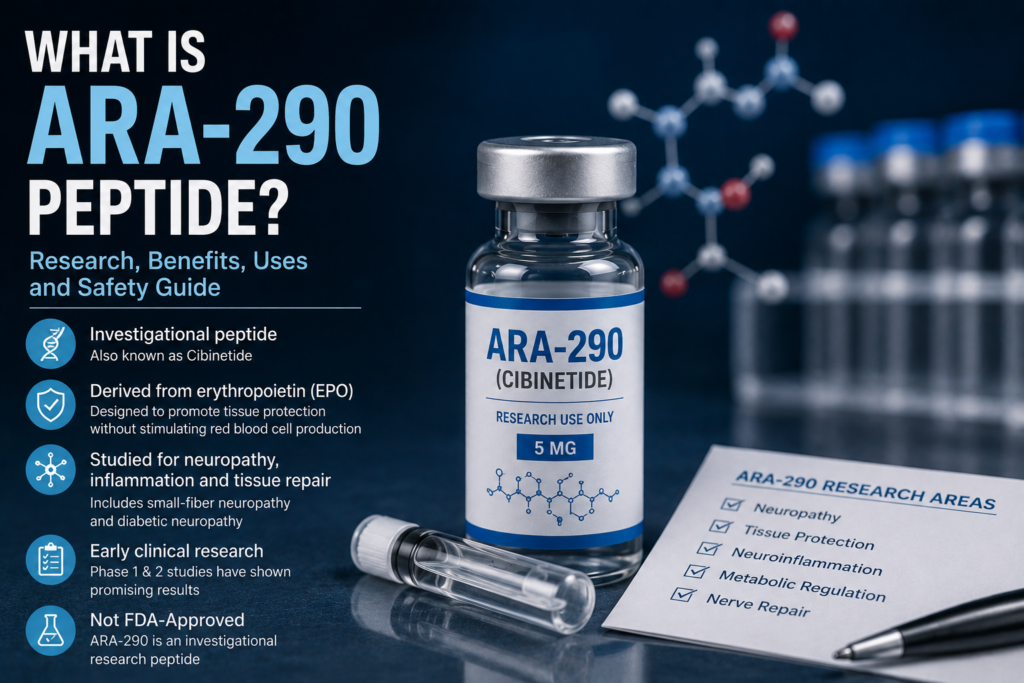
ARA-290 at a Glance
| Characteristic | Description |
|---|---|
| Other name | Cibinetide |
| Also known as | pHBSP |
| Origin | Derived from erythropoietin |
| Length | 11 amino acids |
| Research category | Non-erythropoietic EPO-derived peptide |
| Primary research interest | Tissue protection and inflammation |
| Research areas | Neuropathy, nerve health, inflammation, tissue injury |
| Regulatory status | Investigational; not an approved treatment |
How Does ARA-290 Work?
The mechanism behind ARA-290 is closely connected to the biology of erythropoietin.
EPO is best known for regulating red blood cell production. However, research has shown that EPO can also activate pathways involved in cell survival, tissue protection, inflammation, and repair. These effects appear to involve receptor complexes that differ from the classical receptor involved in erythropoiesis.
ARA-290 was designed to mimic a portion of EPO’s structure involved in these tissue-protective effects.
Researchers commonly describe its target as the innate repair receptor (IRR), a receptor complex involving the erythropoietin receptor and the beta-common receptor (βcR/CD131). Activation of this pathway has been associated with signaling involved in reducing inflammatory responses and protecting cells from injury. what is ara-290 peptide Glow Blend (TB 10mg + BPC 10mg + GHK 50mg)
In simplified terms:
EPO → tissue-protective signaling → ARA-290 mimics selected signaling → potential cellular protection and repair
The goal was to retain tissue-protective signaling while avoiding EPO’s primary blood-producing activity. what is ara-290 peptide 5-Amino-1MQ
What Is ARA-290 Used For in Research?
ARA-290 has been investigated in several areas of biomedical research. The most notable research has focused on neuropathy and nerve-related symptoms, although researchers have also studied its effects in other tissues and disease models.
1. Neuropathic Pain
One of the most significant areas of ARA-290 research is neuropathic pain.
Neuropathic pain occurs when nerves are damaged or dysfunctional and can produce symptoms such as burning, tingling, numbness, sensitivity, or abnormal pain responses.
Because ARA-290 interacts with pathways associated with tissue protection and inflammation, researchers have investigated whether it could influence nerve function and neuropathic symptoms.
Clinical research has included patients with diabetes and other conditions associated with neuropathy.
2. Small-Fiber Neuropathy
Small-fiber neuropathy is another important research area for ARA-290.
Small nerve fibers are involved in pain, temperature sensation, and certain autonomic functions. Damage to these fibers can cause persistent sensory symptoms.
Clinical studies have examined ARA-290 in patients with neuropathic conditions and have investigated measurements such as corneal nerve fiber density, which can provide information about small-fiber nerve health.
These findings are scientifically interesting, but additional research is needed to determine how broadly the results apply.
3. Inflammation
ARA-290 has also been studied for its potential effects on inflammatory signaling.
Research suggests that activation of the innate repair receptor may influence inflammatory pathways and cellular responses to injury. Experimental studies have reported changes involving inflammatory mediators and immune-cell behavior.
This is one reason ARA-290 has attracted interest beyond neurological research.
4. Tissue Protection
Preclinical research has investigated ARA-290 in different forms of tissue injury.
Animal studies have examined areas including:
- Nerve injury
- Ischemia-reperfusion injury
- Kidney injury
- Wound healing
- Cardiovascular tissue
- Inflammatory damage
These studies provide a basis for further research, but animal findings should not be interpreted as proof of effectiveness in humans.
ARA-290 and Erythropoietin: What’s the Difference?
ARA-290 originates from erythropoietin, but it is not the same thing as EPO.
Erythropoietin is a naturally occurring hormone and an established pharmaceutical target that plays a major role in red blood cell production.
ARA-290, on the other hand, is a much smaller peptide designed to selectively reproduce certain tissue-protective characteristics associated with EPO.
| ARA-290 | Erythropoietin |
| 11-amino-acid peptide | Large glycoprotein hormone |
| Derived from EPO’s helix-B region | Naturally occurring hormone |
| Designed to be non-erythropoietic | Stimulates red blood cell production |
| Research focus includes tissue protection | Primarily used medically to stimulate erythropoiesis |
| Investigational | Established medical therapy for specific indications |
The distinction between these two molecules is central to the development of ARA-290.
ARA-290 Benefits: What Does the Research Suggest?
When discussing ARA-290 benefits, it is important to use the term “potential” because research is still developing.
Studies have investigated several possible effects, including:
Potential Neuroprotective Effects
ARA-290 has been investigated for its ability to support nerve tissue and influence pathways associated with nerve injury and neuropathic symptoms. what is ara-290 peptide Bpc-157 + TB-500
Potential Anti-Inflammatory Effects
Research indicates that the innate repair receptor pathway may influence inflammatory signaling and immune responses.
Potential Tissue-Protective Effects
Preclinical studies have examined ARA-290 in models of tissue injury and ischemia-reperfusion, with findings suggesting possible protective effects.
Potential Effects on Nerve Regeneration
Some clinical research has evaluated objective indicators of small-fiber nerve health, including corneal nerve fiber density.
However, these potential benefits should not be presented as established therapeutic effects. Much of the evidence remains experimental or comes from relatively small clinical studies. what is ara-290 peptide GHK-CU 100mg
What Does ARA-290 Research Say About Neuropathy?
Neuropathy is one of the most interesting areas of human ARA-290 research.
A phase 2 study involving people with type 2 diabetes investigated ARA-290 and reported improvements in certain neuropathic symptoms. The study also examined corneal nerve fiber density and metabolic measures.
These results helped establish ARA-290 as an interesting candidate for additional investigation into nerve-related disorders.
Nevertheless, a small clinical study does not establish that ARA-290 is an effective treatment for neuropathy. Larger and longer-duration trials would be necessary to establish efficacy, appropriate patient populations, and long-term safety. what is ara-290 peptide ACE-031
Is ARA-290 the Same as Cibinetide?
Yes. ARA-290 and cibinetide refer to the same investigational peptide.
You may encounter several names in scientific literature, including:
- ARA-290
- Cibinetide
- pHBSP
- Pyroglutamate helix B surface peptide
- Helix B surface peptide
The terminology can vary depending on the study, chemical description, or development stage. what is ara-290 peptide tesamorelin vs ipamorelin
Is ARA-290 FDA Approved?
ARA-290 is not an FDA-approved medication.
It remains an investigational compound, and research into its potential applications has included preclinical studies and early-stage human clinical trials.
This distinction is especially important when evaluating websites that describe ARA-290 as an established treatment or make definitive claims about its ability to treat disease.
Research results are not equivalent to regulatory approval or established clinical efficacy. what is ara-290 peptide Tesamorelin + Ipamorelin
Is ARA-290 Safe?
Safety is an important consideration with any investigational peptide.
Early research has reported encouraging safety findings in certain study populations. For example, a phase 2 study of ARA-290 in people with type 2 diabetes reported no potential safety issues identified during the study period.
However, this does not establish long-term safety.
Questions concerning long-term exposure, appropriate medical use, interactions, patient selection, product quality, and other factors require further research.
what is ara-290 peptide People should not assume that a peptide is safe simply because it occurs in scientific literature or because a study reported favorable short-term findings.
ARA-290 Half-Life
ARA-290 has a relatively short plasma half-life.
Research has reported an elimination half-life of approximately 2 minutes after intravenous administration, while subcutaneous administration can produce a longer apparent elimination half-life of roughly 20 minutes.
Interestingly, researchers have observed biological effects that can persist beyond the period in which measurable peptide concentrations remain high in circulation. This has contributed to interest in the signaling mechanisms activated by ARA-290. what is ara-290 peptide Thymosin Beta-4
Why Is ARA-290 Interesting to Researchers?
The major scientific interest in ARA-290 comes from its unusual relationship with erythropoietin.
EPO has biological effects extending beyond red blood cell production. Researchers have sought ways to separate its tissue-protective effects from its erythropoietic effects.
ARA-290 represents one approach to this problem.
Rather than using the complete EPO molecule, researchers developed a small peptide based on a specific structural region of EPO. The resulting peptide was designed to activate tissue-protective signaling without activating the classical erythropoietic pathway.
That concept makes ARA-290 particularly interesting for research involving:
- Nerve injury
- Chronic inflammation
- Tissue repair
- Neuroprotection
- Metabolic disorders
- Ischemic injury
- Cellular stress responses
ARA-290 vs. Other Research Peptides
ARA-290 is sometimes discussed alongside other peptides being investigated for tissue repair or inflammation. However, its mechanism is substantially different from many commonly discussed research peptides.
Its defining characteristic is its origin from erythropoietin and its interaction with the innate repair receptor pathway.
This makes ARA-290 particularly relevant to researchers studying the relationship between:
EPO → tissue stress → inflammation → innate repair signaling → cellular protection
what is ara-290 peptide Rather than simply being another generalized “recovery peptide,” ARA-290 has a specific molecular rationale behind its development. what is ara-290 peptide TB-500