
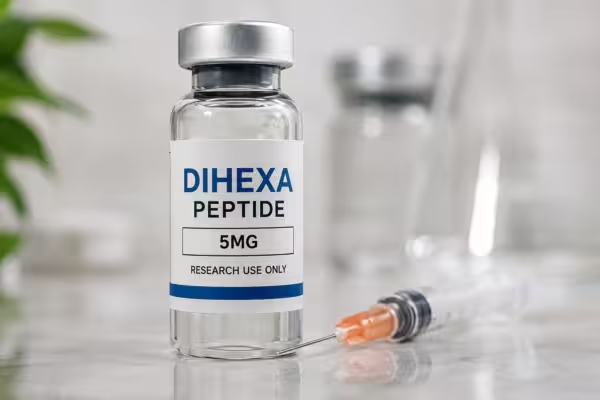
Dihexa Peptide: What It Is, Benefits, Uses, and Research
Dihexa peptide is an experimental synthetic compound that has attracted interest in neuroscience research because of its proposed effects on hepatocyte growth factor (HGF) signaling and the c-Met receptor pathway. Preclinical research has investigated Dihexa in connection with synaptic development, neuronal signaling, and cognitive function. Cerebrolysin
Despite significant interest online, Dihexa Peptide remains an experimental research compound. It has not been established as a clinically proven cognitive enhancer or treatment for Alzheimer’s disease, dementia, brain injury, or other neurological conditions.
This page provides an evidence-focused overview of Dihexa Peptide, including what it is, how it has been studied, potential research applications, safety considerations, and frequently asked questions. Cardiogen Peptide
Research disclaimer: Dihexa is an experimental compound and is not an FDA-approved medication. This article is for educational purposes only and does not provide instructions for human use, dosing, or self-administration.
What Is Dihexa Peptide?
Dihexa Peptide is a synthetic peptide-derived compound developed from research into the angiotensin IV system and its relationship with growth-factor signaling in the nervous system.
The compound has received attention because laboratory research has suggested that Dihexa Peptide may influence HGF/c-Met signaling, a pathway involved in cellular growth, development, survival, and synaptic processes.
Dihexa is sometimes described online as a “nootropic peptide,” but this terminology can be misleading. Its evidence base is primarily preclinical, and there is currently insufficient clinical evidence to establish its effectiveness as a cognitive-enhancement treatment in humans. tesamorelin peptide
Dihexa Peptide at a Glance
| Characteristic | Description |
|---|---|
| Name | Dihexa |
| Category | Experimental peptide-derived compound |
| Primary research area | Neuroscience |
| Proposed pathway | HGF/c-Met signaling |
| Research interests | Synaptic function, neuroplasticity, cognition |
| Human clinical evidence | Limited/insufficient |
| FDA approved | No |
| Established therapeutic dosage | No |
How Does Dihexa Peptide Work?
The proposed mechanism of Dihexa Peptide centers on hepatocyte growth factor (HGF) and its receptor, c-Met.
HGF/c-Met signaling is involved in several biological processes, including:
- Cell growth
- Cell survival
- Tissue development
- Cellular differentiation
- Synaptic biology
Preclinical research has investigated whether Dihexa Peptide can interact with this signaling system and potentially influence processes involved in neuronal connectivity.
One of the reasons Dihexa has attracted attention is research suggesting that the compound may have effects on synaptogenesis, or the formation of synaptic connections between neurons.
However, proposed mechanisms based on laboratory and animal studies do not automatically translate into demonstrated benefits in humans. Glow Blend (TB 10mg + BPC 10mg + GHK 50mg)
Dihexa Peptide and Neuroplasticity
Neuroplasticity refers to the nervous system’s ability to adapt by changing connections between neurons.
This process is involved in:
- Learning
- Memory
- Skill development
- Recovery following neurological injury
- Adaptation to environmental changes
Researchers have investigated Dihexa Peptide because of its potential effects on pathways associated with neuronal connectivity and synaptic development.
This has led to considerable interest in Dihexa within experimental neuroscience.
However, there is currently no high-quality human evidence establishing that Dihexa meaningfully improves neuroplasticity or cognitive performance.
Dihexa and Synaptogenesis
One of the most frequently discussed potential applications of Dihexa is synaptogenesis.
Synaptogenesis describes the formation of synapses, which are specialized communication points between neurons.
Preclinical research has investigated whether Dihexa can promote processes associated with synaptic formation and neuronal connectivity.
This is scientifically interesting because synaptic health plays an important role in learning and memory.
However, demonstrating increased synaptic activity or connectivity in an experimental model is not equivalent to demonstrating improved memory or intelligence in humans. Bronchogen
Potential Dihexa Peptide Benefits
When people search for Dihexa peptide benefits, they often encounter claims involving memory enhancement, cognitive performance, brain repair, and neurogenesis.
The current evidence does not establish these as proven human benefits.
Instead, the main areas of scientific interest include:
1. Cognitive Research
Animal studies have investigated whether Dihexa can influence learning and memory.
These findings are one reason Dihexa has become associated with experimental nootropic research.
2. Synaptic Research
Researchers have examined the compound’s potential influence on synaptic formation and neuronal connectivity.
3. Neuroplasticity Research
Dihexa has been investigated in connection with pathways that may affect neuronal adaptation and communication.
4. HGF/c-Met Signaling
The HGF/c-Met pathway represents one of the most important mechanistic areas associated with Dihexa research.
5. Neurological Research
Because synaptic function is relevant to many neurological conditions, Dihexa has generated interest as a potential research tool for studying cognitive and neurological processes.
These are research areas rather than established clinical indications.
Does Dihexa Improve Memory?
Dihexa has attracted substantial attention because of animal research involving learning and memory.
Some preclinical experiments have reported effects on cognitive performance, leading to speculation about potential memory-enhancing properties.
However, these findings should be interpreted carefully.
There is a major difference between:
Animal evidence → human clinical evidence
A compound can produce promising results in an animal model and still fail to demonstrate meaningful benefits in human clinical trials.
At present, Dihexa does not have sufficient human clinical evidence to establish it as a safe or effective memory-enhancing drug.
Dihexa and Alzheimer’s Disease Research
Dihexa is sometimes marketed online as a potential Alzheimer’s treatment.
That claim goes beyond the available evidence.
Because Alzheimer’s disease involves complex processes involving:
- Amyloid pathology
- Tau pathology
- Neuroinflammation
- Synaptic dysfunction
- Neuronal loss
- Vascular factors
a compound affecting one signaling pathway cannot automatically be considered a treatment for the disease.
Dihexa’s preclinical cognitive and synaptic research provides a reason for continued investigation, but clinical efficacy in Alzheimer’s disease has not been established. ACE-031
Dihexa and Brain Repair
Another commonly encountered claim is that Dihexa can “repair the brain.”
This terminology is overly broad.
Research into synaptic formation and neuroplasticity provides a biological rationale for studying Dihexa in models of neurological dysfunction, but there is no established clinical evidence showing that Dihexa regenerates damaged human brain tissue.
Brain recovery is a complex process involving:
- Neuronal survival
- Synaptic remodeling
- Blood flow
- Glial responses
- Inflammation
- Network reorganization
More research would be necessary before any therapeutic brain-repair claim could be supported.
Why Is Dihexa Considered an Experimental Compound?
Dihexa has generated considerable interest through preclinical neuroscience research, but it has not progressed to established clinical use.
Important evidence gaps include:
- Limited human clinical data
- Lack of established therapeutic indications
- Lack of standardized human dosing
- Limited long-term safety information
- Uncertainty regarding pharmacokinetics in humans
- Lack of established regulatory approval
Consequently, Dihexa should be considered an experimental research compound, not a proven pharmaceutical treatment.
Dihexa Safety
Safety is one of the most important considerations when evaluating experimental compounds.
Because there is insufficient clinical evidence, researchers do not have a reliable picture of Dihexa’s long-term safety in humans.
Important unanswered questions include:
- What is the appropriate therapeutic exposure?
- How is Dihexa metabolized in humans?
- What are the long-term effects?
- What medications could interact with it?
- Does prolonged HGF/c-Met modulation create unwanted biological effects?
- What adverse effects might occur with repeated exposure?
The HGF/c-Met pathway is biologically important in cell growth and tissue development, which makes careful evaluation particularly important.
The absence of established human safety data means that online claims describing Dihexa as “safe” should be treated cautiously.
Dihexa Dosage
There is no established FDA-approved human dosage for Dihexa.
Online sources may describe experimental protocols or quantities, but these should not be interpreted as clinically validated dosing recommendations.
Animal-study doses cannot simply be converted into safe human doses.
A scientifically established human dosage would require controlled clinical research examining:
- Pharmacokinetics
- Pharmacodynamics
- Dose-response relationships
- Safety
- Adverse events
- Therapeutic endpoints
Such evidence is not currently sufficient to establish a standard human dosing protocol. 5-Amino-1MQ
Is Dihexa FDA Approved?
No.
Dihexa is not an FDA-approved medication.
It should not be marketed as an approved treatment for:
- Alzheimer’s disease
- Dementia
- Memory loss
- Traumatic brain injury
- Depression
- Neurodegenerative disease
- Cognitive impairment
Products sold online as Dihexa should therefore be clearly distinguished from approved pharmaceutical treatments.
Dihexa as a Research Peptide
Dihexa is often grouped with other experimental compounds studied for potential effects on the nervous system.
Its research profile is particularly interesting because of the proposed relationship between HGF/c-Met signaling and synaptic biology.
Researchers may use compounds such as Dihexa to investigate questions involving:
- Synaptic formation
- Neuronal communication
- Growth-factor signaling
- Memory mechanisms
- Neuroplasticity
- Cognitive function
This makes Dihexa potentially useful as a research subject, even though its therapeutic value in humans remains unproven.
Dihexa Peptide vs. Conventional Nootropics
Dihexa Peptideshould not be confused with conventional nootropic supplements.
| Feature | Dihexa Peptide | Conventional Nootropic Supplement |
|---|---|---|
| Category | Experimental peptide-derived compound | Dietary supplement |
| Human evidence | Limited | Varies by ingredient |
| FDA-approved | No | Usually marketed as supplements |
| Primary research | Neuroscience | Cognition/general wellness |
| Mechanism | HGF/c-Met-related research | Depends on ingredient |
| Established therapeutic dosage | No | Depends on product |
The term “nootropic” is frequently used in online Dihexa marketing, but it should not be interpreted as evidence of clinical effectiveness.
What Makes Dihexa Different From Other Peptides?
Dihexa is unusual because its research interest is closely connected to the HGF/c-Met signaling pathway rather than functioning like a conventional peptide hormone.
Its proposed biological activity involves mechanisms related to:
- Growth-factor signaling
- Cellular communication
- Synaptic development
- Neuronal plasticity
This distinguishes it from peptide hormones such as insulin or growth hormone and from many cosmetic peptides. Glow Peptide


Reviews
There are no reviews yet.