What Does GLOW Peptide Do? Benefits, Ingredients, Research & What to Know
If you have been searching for what does GLOW peptide do, you may have come across claims about improved skin appearance, collagen production, tissue repair, and recovery. But understanding GLOW peptide requires an important distinction: GLOW peptide is generally a name used for a combination of different peptides rather than a single peptide molecule. Glow Peptide
what does glow peptide do, Most products marketed as GLOW peptide blends contain GHK-Cu, BPC-157, and TB-500. Each ingredient has been investigated separately for different biological processes, particularly those involving skin, connective tissue, wound healing, cell migration, and tissue repair. However, the combination itself has not been established as an FDA-approved treatment, and there is no strong clinical evidence demonstrating that the three ingredients work synergistically as a single formulation. what does glow peptide do What Is Glow Peptide? Ingredients, Benefits & Safety
What Is GLOW Peptide?
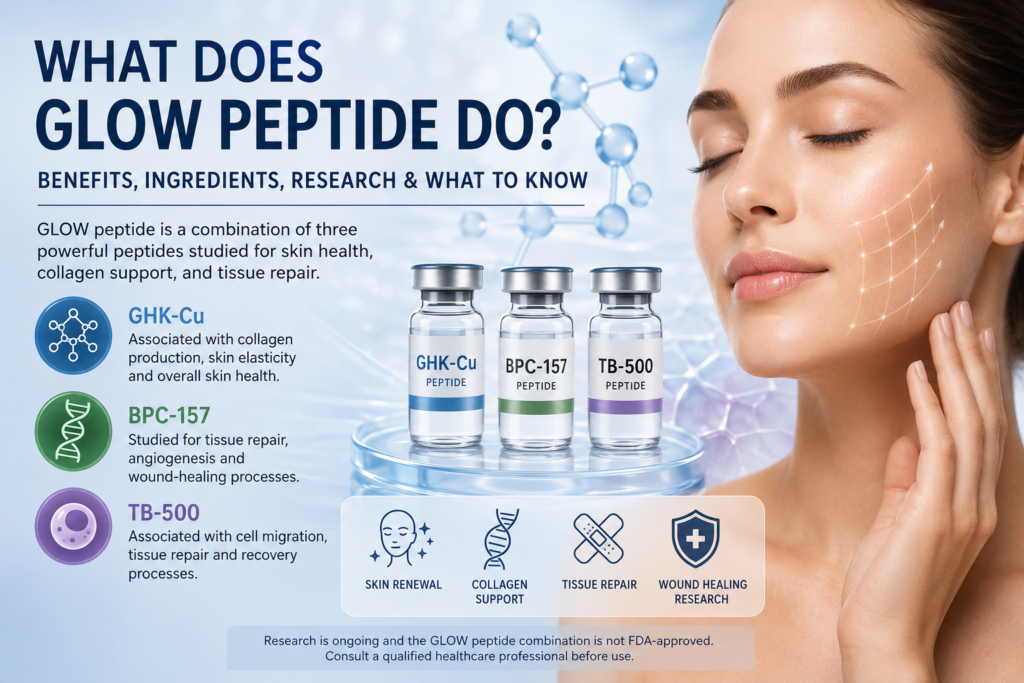
GLOW peptide is commonly used to describe a three-peptide research blend containing:
- GHK-Cu — a copper-binding peptide associated with collagen and extracellular-matrix processes.
- BPC-157 — a synthetic peptide investigated primarily in preclinical research involving tissue repair and angiogenesis.
- TB-500 — a synthetic fragment associated with thymosin beta-4 and studied for cell migration and tissue-repair processes.
what does glow peptide do The exact formulation can vary between suppliers, so the term “GLOW peptide” does not necessarily refer to one standardized pharmaceutical product. glow peptide dosag: What You Should Know Before Using a Peptide Blend
What Does GLOW Peptide Do?
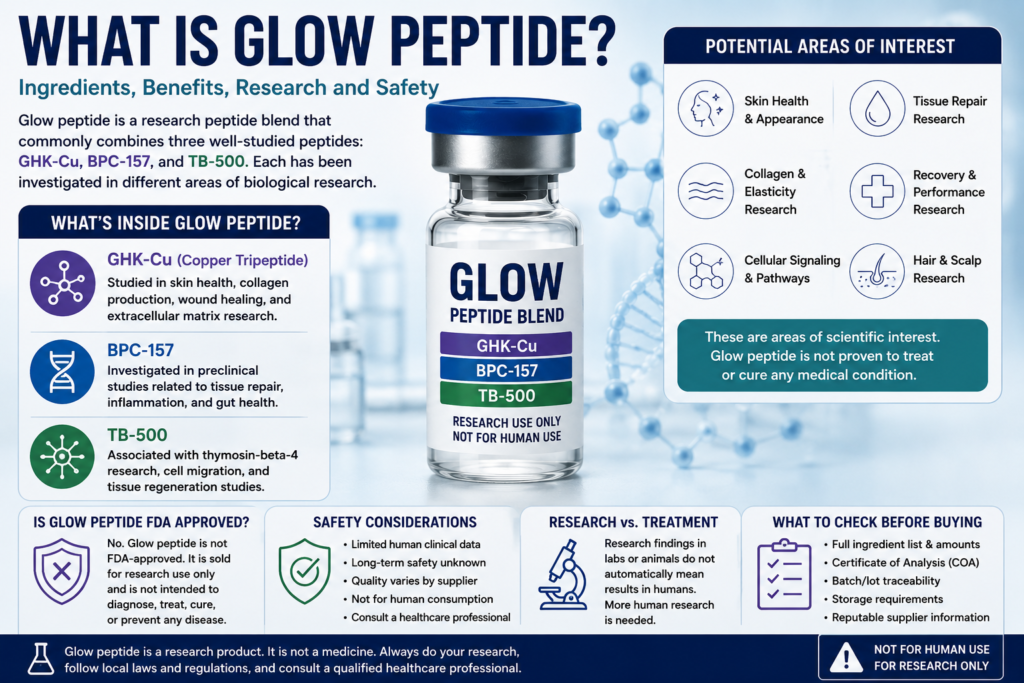
The proposed purpose of a GLOW peptide blend is to bring together three different biological mechanisms related to skin renewal and tissue repair.
1. GHK-Cu and Collagen Support
GHK-Cu is probably the best-known component of the GLOW blend when it comes to skin-related research.
GHK-Cu has been studied for its effects on fibroblasts, collagen production, extracellular-matrix remodeling, and wound-healing processes. Laboratory and some human research has investigated whether topical GHK-Cu can influence skin appearance and structural components such as collagen.
This is why GHK-Cu is frequently associated with:
- Skin elasticity
- Collagen production
- Skin texture
- Wound-healing research
- Extracellular-matrix remodeling
- Overall skin appearance
what does glow peptide do Importantly, promising laboratory findings do not automatically mean that an injectable or combined GLOW formulation will produce the same results in humans. GHK-CU 100mg
2. BPC-157 and Tissue-Repair Research
BPC-157 has attracted considerable interest because of research examining its potential role in tissue repair.
Preclinical studies have investigated BPC-157 in areas including connective tissue, blood-vessel formation, muscle, tendon, and other healing processes. Some proposed mechanisms involve angiogenesis and signaling pathways associated with tissue repair.
However, much of the evidence surrounding BPC-157 remains preclinical, meaning it comes from laboratory or animal studies rather than large, high-quality human clinical trials.
For that reason, claims that BPC-157 definitively accelerates healing in humans should be treated cautiously. what does glow peptide do bpc 157 peptide
3. TB-500 and Cell Migration
TB-500 is commonly described as a synthetic fragment related to thymosin beta-4.
Research involving thymosin beta-4 has examined processes such as cell migration, angiogenesis, wound closure, and tissue repair. These mechanisms are relevant because cells need to migrate and reorganize tissue during the healing process.
This provides the biological rationale for including TB-500 in a GLOW peptide blend.
what does glow peptide do Again, however, research on thymosin beta-4 or related fragments should not automatically be interpreted as proof that a commercially marketed GLOW formulation produces the same effects. Glow Blend (TB 10mg + BPC 10mg + GHK 50mg)
What Are the Potential Benefits of GLOW Peptide?
Because the complete GLOW combination has not been adequately tested in controlled clinical trials, it is more accurate to discuss areas being investigated rather than guaranteed benefits.
Research surrounding the individual ingredients has focused on:
Skin Health
GHK-Cu has received particular attention for its potential role in collagen production, extracellular-matrix remodeling, and skin-related processes.
A current ClinicalTrials.gov study is evaluating topical GHK-Cu gel for acute skin wound healing, demonstrating that the compound remains an active area of clinical investigation.
Collagen and Skin Structure
Collagen is one of the primary structural proteins in skin. GHK-Cu research has examined pathways involving fibroblasts and extracellular-matrix components, which helps explain why copper peptides are frequently discussed in connection with skin quality.
Wound-Healing Research
GHK-Cu, BPC-157, and thymosin-beta-4-related research has investigated different aspects of wound healing and tissue repair.
The important distinction is that evidence for individual components is not the same as evidence for the GLOW blend itself.
Tissue Repair
BPC-157 and thymosin-beta-4-related research has explored connective-tissue and tissue-repair mechanisms. Much of this evidence remains experimental, so more human research is needed before firm conclusions can be made. what does glow peptide do what is ghk-cu
Does GLOW Peptide Really Work?
The most accurate answer is: there is not enough clinical evidence to say that the GLOW peptide blend definitely works for a specific medical or cosmetic purpose.
Individual ingredients have research behind them, but the complete combination has not been adequately evaluated in controlled human trials. Several sources reviewing the current evidence specifically note that claims about the GLOW blend are largely extrapolated from research on its individual components.
That distinction is important when evaluating online peptide claims.
A compound can have an interesting biological mechanism without being proven to provide a clinically meaningful benefit when used by humans.
Is GLOW Peptide FDA Approved?
GLOW peptide should not be confused with an FDA-approved medication.
The GLOW combination is not an FDA-approved drug product, and the individual components commonly associated with the blend do not establish an approved indication for using the combination as a medical treatment.
what does glow peptide do Consumers should therefore be particularly cautious about websites that present GLOW peptide as a proven treatment for disease, injury, aging, or other medical conditions. Tesamorelin + Ipamorelin
GLOW Peptide vs. GHK-Cu
One common source of confusion is the difference between GLOW peptide and GHK-Cu.
GHK-Cu is one specific peptide-copper complex.
GLOW peptide is generally a multi-peptide combination that includes GHK-Cu along with BPC-157 and TB-500.
Therefore, research on GHK-Cu alone should not be interpreted as clinical evidence proving that the entire GLOW blend produces the same effects.
What Does GLOW Peptide Do for Skin?
The skin-focused rationale for GLOW peptide primarily comes from GHK-Cu.
Research has explored GHK-Cu’s relationship with collagen synthesis, fibroblast activity, extracellular-matrix remodeling, and wound-healing mechanisms.
This is why GLOW peptide is frequently marketed online for concepts such as:
- Skin renewal
- Collagen support
- Improved skin texture
- Skin recovery
- Wound-healing research
- Tissue regeneration
Nevertheless, these should be viewed as research areas rather than guaranteed outcomes. what does glow peptide do ipamorelin peptide
Are There Human Studies on GLOW Peptide?
One of the most important limitations is that there is currently no robust clinical evidence demonstrating the effectiveness of the complete GHK-Cu + BPC-157 + TB-500 GLOW combination.
There are studies involving individual ingredients, and GHK-Cu in particular has been investigated in human skin research. But that does not establish the safety, effectiveness, ideal formulation, or appropriate use of the combined GLOW peptide blend. what does glow peptide do Semax