
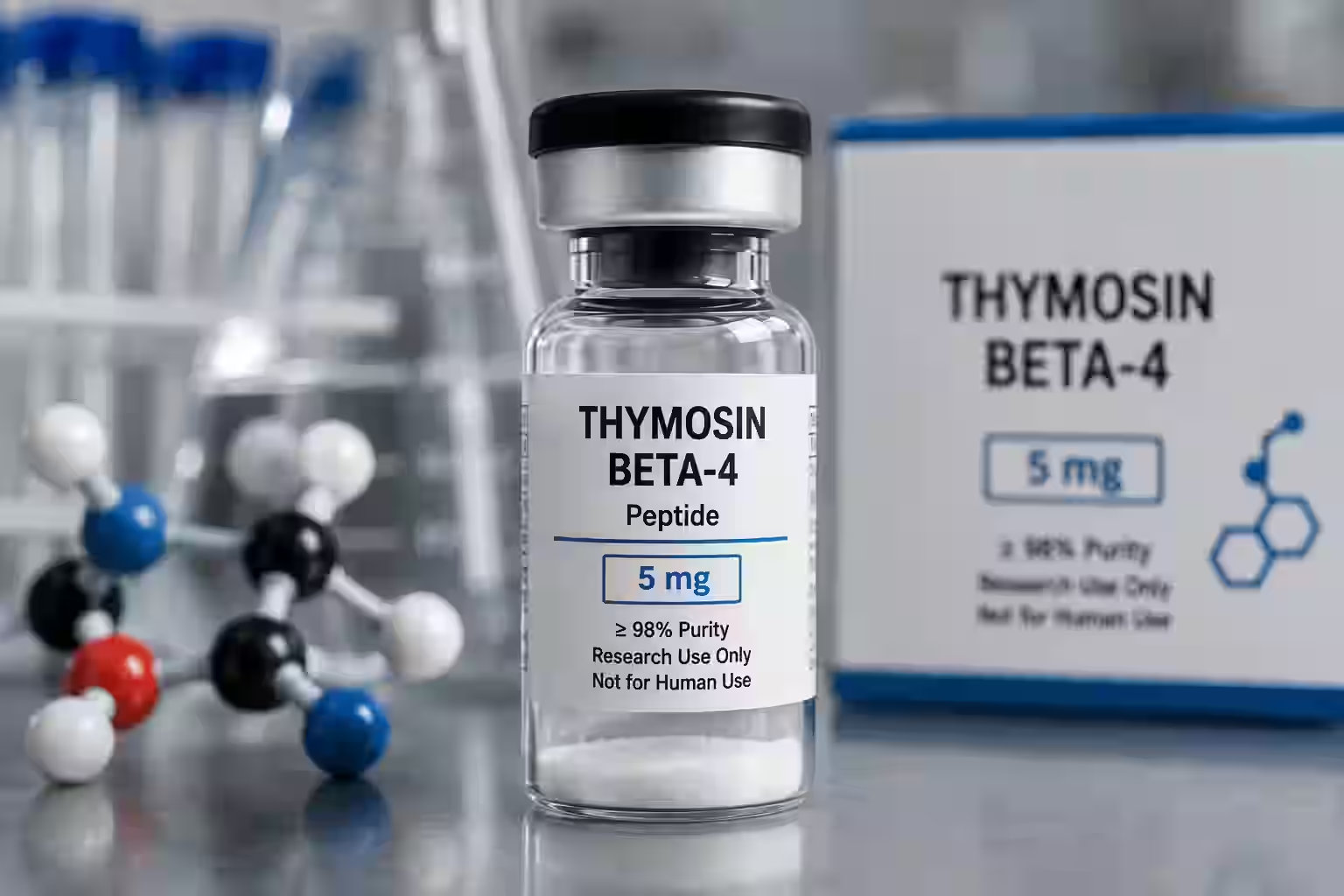
Thymosin Beta-4 Peptide: Research, Benefits, Uses & Scientific Overview
Thymosin Beta-4 (Tβ4) is a naturally occurring 43-amino-acid peptide that has become an important subject of research in regenerative biology, cell migration, angiogenesis, tissue remodeling, and wound-healing research. TB-500
Unlike many peptides discussed primarily for hormone-related pathways, Thymosin Beta-4 is particularly interesting because of its relationship with actin, a protein that plays a central role in cellular structure and movement. Research has investigated Tβ4 in connection with cell migration, blood-vessel formation, cell survival, extracellular-matrix remodeling, and tissue repair. Glow Peptide
This Thymosin Beta-4 peptide product page provides an informational overview of its molecular characteristics, research applications, potential biological mechanisms, and the distinction between scientific research and clinically established treatments. Glow Blend (TB 10mg + BPC 10mg + GHK 50mg)
Research-use note: Thymosin Beta-4 is not an FDA-approved therapeutic product. This page is intended for educational and laboratory research information only.
What Is Thymosin Beta-4?
Thymosin Beta-4 is a small, naturally occurring peptide consisting of 43 amino acids. It is found in many types of cells and tissues and is particularly abundant in certain cell types, including platelets.
One of the best-characterized functions of Tβ4 is its ability to interact with G-actin, helping regulate the pool of actin available for cellular structural and movement processes.
Researchers have investigated Thymosin Beta-4 in areas including:
- Cell migration
- Angiogenesis
- Tissue remodeling
- Wound-healing biology
- Cellular survival
- Extracellular-matrix regulation
- Inflammatory signaling
- Regenerative medicine
Its broad range of biological activities has made Tβ4 an important research molecule in cell biology and regenerative medicine. bpc 157 peptide
Thymosin Beta-4 Peptide at a Glance
| Characteristic | Thymosin Beta-4 |
|---|---|
| Common abbreviation | Tβ4 / Tβ4 |
| Peptide length | 43 amino acids |
| Molecular size | Approximately 5 kDa |
| Naturally occurring | Yes |
| Primary research area | Cellular and regenerative biology |
| Key molecular interaction | G-actin |
| Research interests | Cell migration, angiogenesis, tissue remodeling |
| Clinical status | Not FDA-approved |
| Research classification | Laboratory research peptide |
How Does Thymosin Beta-4 Work?
The biological activity of Thymosin Beta-4 is closely associated with its interaction with actin.
Actin is one of the major structural proteins inside cells. It helps cells maintain their shape and plays an important role in cellular movement.
Tβ4 acts as a major G-actin-sequestering peptide, influencing the availability of actin monomers for polymerization and cellular remodeling.
This relationship with actin provides part of the scientific rationale for investigating Tβ4 in cell migration and tissue repair.
Researchers have also identified additional biological pathways associated with Tβ4, including processes involving:
- Cell survival
- Angiogenesis
- Extracellular-matrix remodeling
- Cytokine and chemokine signaling
- Cellular differentiation
- Tissue remodeling
However, the exact mechanisms are complex and continue to be investigated. GHK-CU 100mg
Thymosin Beta-4 and Cell Migration
Cell migration is one of the most frequently studied biological functions associated with Thymosin Beta-4.
Cell movement is essential for many normal biological processes, including development and tissue repair.
Experimental studies have shown that Tβ4 can influence endothelial-cell migration and other cellular movement pathways. One early study found that Tβ4 stimulated directional migration of human endothelial cells and increased migration into experimentally wounded cell layers.
This research helped establish a scientific basis for investigating Tβ4 in regenerative biology. ACE-031
Importantly, cell-migration research does not mean that a Thymosin Beta-4 product is automatically a proven treatment for injuries or wounds. 5-Amino-1MQ
Thymosin Beta-4 and Angiogenesis Research
Angiogenesis is the formation of new blood vessels from existing vessels.
This process is important in normal development and tissue repair because damaged or developing tissues may require additional blood supply.
Thymosin Beta-4 has been extensively studied in relation to angiogenesis. Research has reported effects involving endothelial-cell migration, vascular sprouting, and blood-vessel formation in experimental models.
More recent reviews describe Tβ4 as having roles in several vascular processes, including:
- Vasculogenesis
- Angiogenesis
- Arteriogenesis
- Endothelial-mesenchymal transition
- Extracellular-matrix remodeling
These findings are among the reasons Thymosin Beta-4 continues to attract interest in regenerative medicine research.
Thymosin Beta-4 and Tissue Repair Research
Another major area of research involves tissue repair and regeneration.
Following tissue injury, numerous biological processes occur simultaneously. Cells migrate into the affected area, inflammatory signaling changes, new extracellular matrix is produced, and blood vessels may develop to support the repairing tissue.
Research suggests that Tβ4 can influence several of these processes.
Preclinical studies have investigated Tβ4 in different injury models, with findings involving cell migration, angiogenesis, inflammation, apoptosis, and tissue remodeling.
This broad biological activity makes Tβ4 a useful research tool for investigating the molecular mechanisms involved in tissue repair.
Thymosin Beta-4 and Wound-Healing Research
Wound healing is one of the most extensively researched potential applications of Thymosin Beta-4.
Preclinical research has reported that Tβ4 can influence several processes involved in dermal repair, including:
- Keratinocyte migration
- Endothelial-cell migration
- Angiogenesis
- Collagen deposition
- Re-epithelialization
- Inflammatory signaling
There has also been human clinical research involving topical Tβ4 formulations. For example, a Phase 2 study investigated topical Tβ4 in patients with venous stasis ulcers and reported an acceptable safety and tolerability profile for the tested formulation, while also generating efficacy findings that warranted further investigation.
These findings are scientifically relevant but should not be interpreted as establishing every commercially marketed Thymosin Beta-4 preparation as an approved wound treatment. Sermorelin
Thymosin Beta-4 and Inflammation Research
Inflammation is another area of interest in Tβ4 research.
The peptide has been investigated in relation to signaling pathways involved in inflammatory responses and tissue injury.
Reviews have described Tβ4 as having effects associated with inflammation, apoptosis, tissue protection, and repair.
The relationship between Tβ4 and inflammation is complex, however, and researchers continue to investigate the specific molecular pathways involved. Tesofensine Peptide
Thymosin Beta-4 and Cellular Survival
Research has also examined the relationship between Tβ4 and cell survival.
Some experimental studies suggest that Tβ4 can influence signaling pathways associated with cell survival and protection from cellular stress.
These findings have contributed to research investigating Tβ4 in different tissue models, including vascular, dermal, and cardiac systems.
As with other potential applications, much of this evidence comes from laboratory and preclinical research. tesamorelin vs ipamorelin
Thymosin Beta-4 and Regenerative Medicine
Regenerative medicine aims to understand how damaged tissues can repair themselves or potentially be restored through biological mechanisms.
Tβ4 is of interest because it appears to influence several processes that are relevant to regeneration.
Research areas include:
Cellular migration
Tβ4 has been investigated for its ability to influence the movement of different cell types.
Blood-vessel formation
Research suggests that Tβ4 can influence vascular development and angiogenesis.
Extracellular-matrix remodeling
The extracellular matrix provides structural support to tissues and changes substantially during repair.
Cell survival
Experimental research has investigated Tβ4-related signaling associated with cellular survival.
Tissue remodeling
Tβ4 has been studied in relation to the coordinated cellular processes involved in tissue repair.
Together, these properties explain why Tβ4 continues to be investigated as a potential regenerative research molecule.
Thymosin Beta-4 vs. TB-500
One of the most important distinctions when researching these peptides is the difference between Thymosin Beta-4 and TB-500.
They are related, but they should not automatically be treated as identical compounds.
Thymosin Beta-4 is the full-length, naturally occurring 43-amino-acid peptide.
TB-500 is commonly used to describe a synthetic peptide fragment associated with the thymosin beta-4 sequence.
The actin-binding region of Tβ4 includes the sequence LKKTETQ, which has been studied as an important functional region of the molecule.
Because full-length Tβ4 and shorter peptide fragments can have different biochemical characteristics, research findings involving one compound should not automatically be applied to the other.
Quick comparison
| Feature | Thymosin Beta-4 | TB-500 |
| Molecule | Full-length peptide | Synthetic peptide fragment |
| Length | 43 amino acids | Commonly described as 7 amino acids |
| Natural occurrence | Naturally occurring | Synthetic |
| Research focus | Cell migration, angiogenesis, tissue remodeling | Related peptide and regenerative research |
| Relationship | Parent/full-length peptide | Related fragment |
| FDA-approved therapeutic | No | No |
What Is the Thymosin Beta-4 Sequence?
Thymosin Beta-4 is a 43-amino-acid peptide.
Its commonly reported sequence is:
MSDKPDMAEIEKFDKSKLKKTETQEKENREQEKPEISL
The sequence contains several functional regions that researchers have investigated for their individual biological properties.
One particularly important region is the LKKTETQ sequence, which is associated with the actin-binding domain of Tβ4. Research has also identified other short sequences with potentially distinct biological activities.
For laboratory research, sequence identity is an important consideration when evaluating peptide materials.
What Is Thymosin Beta-4 Used for in Research?
Thymosin Beta-4 is primarily used as a research tool for studying cellular and tissue biology.
Common research areas include:
- Cell migration assays
- Angiogenesis research
- Wound-healing models
- Tissue regeneration studies
- Cytoskeletal research
- Actin biology
- Extracellular-matrix research
- Cellular survival studies
- Vascular biology
- Regenerative medicine research
Researchers may use purified Tβ4 to investigate how peptide concentration, cellular environment, and signaling pathways influence biological responses.
Thymosin Beta-4 in Laboratory Research
For laboratory applications, the quality and characterization of peptide material are important.
Researchers evaluating a Thymosin Beta-4 peptide product may look for:
- Peptide identity
- Amino-acid sequence
- Purity
- Molecular weight
- Lot or batch number
- Certificate of analysis (COA)
- Analytical testing
- Storage specifications
- Manufacturer information
A certificate of analysis can help document the analytical characteristics of a particular batch.
However, a high-purity laboratory peptide should not automatically be interpreted as safe or effective for use in humans.
Why Peptide Purity Matters in Tβ4 Research
Peptide purity can affect the reproducibility of laboratory experiments.
Impurities, degradation products, aggregation, and differences in peptide preparation can potentially influence experimental outcomes.
For research involving Tβ4, scientists may therefore consider both the nominal purity of the material and the analytical documentation supporting the product.
A well-characterized research peptide can help investigators establish more consistent experimental conditions.
Is Thymosin Beta-4 FDA Approved?
No. Thymosin Beta-4 is not an FDA-approved therapeutic drug.
The FDA has stated in a 2026 warning letter that products marketed as Thymosin Beta-4 were unapproved new drugs and biological products without an approved biologics license application.
The FDA’s orphan-drug database also lists Thymosin Beta-4 as having received an orphan designation for epidermolysis bullosa, but the listing specifically states that it was not FDA approved for that orphan indication.
This distinction is important: an orphan designation is not the same as FDA approval.
What Does the Research Say About Thymosin Beta-4?
The research surrounding Tβ4 is extensive, but the evidence comes from several different levels.
Laboratory research
Cell-based experiments have investigated Tβ4’s effects on migration, angiogenesis, cytoskeletal organization, and signaling.
Animal research
Animal models have been used to investigate wound healing, vascular development, tissue repair, and other biological processes.
Human research
Clinical studies have explored specific Tβ4 formulations and routes of administration, including topical applications for wound-related conditions. Some studies have reported encouraging findings, but these investigations do not establish Tβ4 as an FDA-approved general-purpose treatment.
Consequently, it is important to distinguish research potential from established medical indications.
Reviews
There are no reviews yet.