What Is Cardiogen Peptide? Research, Benefits, Uses, and Safety
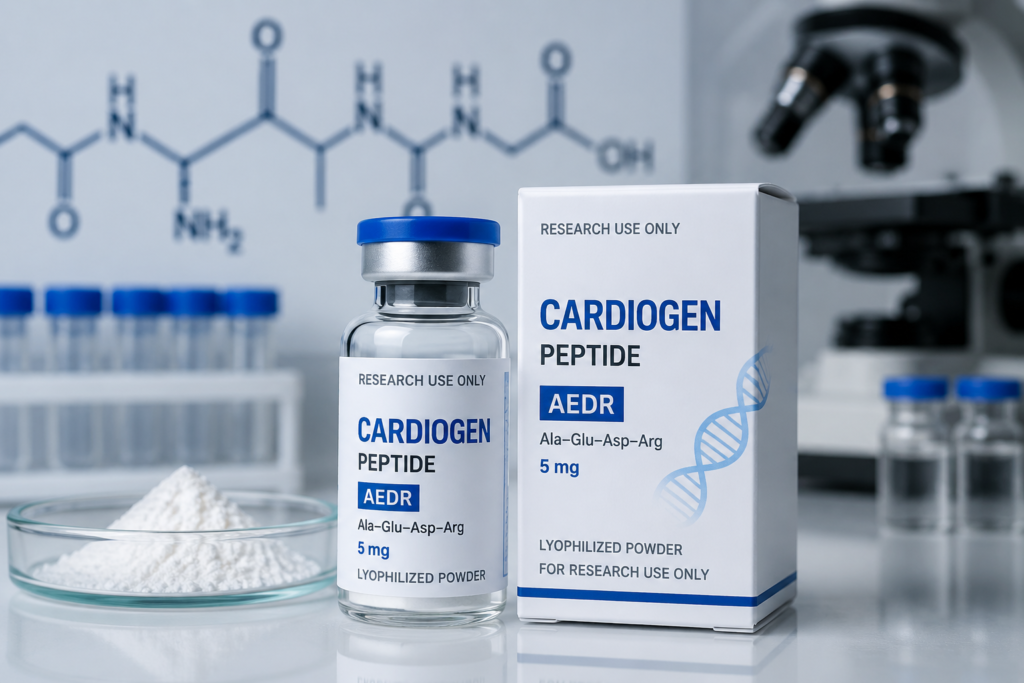
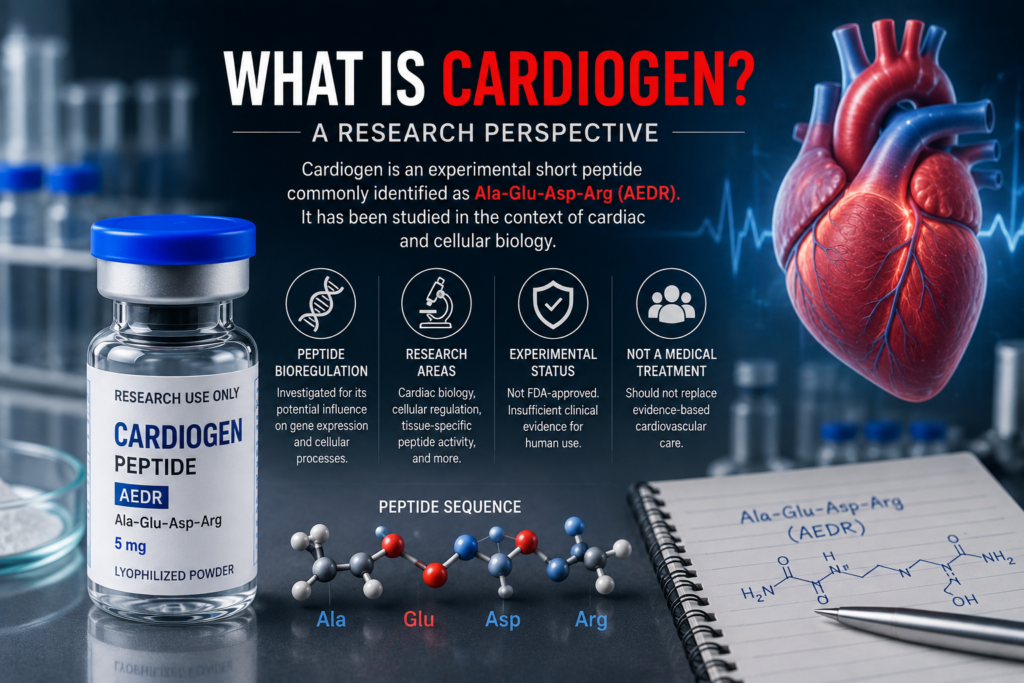
What is Cardiogen? Cardiogen is a name commonly used for an experimental short peptide associated with the Khavinson peptide bioregulator research field. It is generally described as the tetrapeptide Ala-Glu-Asp-Arg (AEDR) and has been investigated primarily in laboratory and animal research involving myocardial and cellular biology. Cardiogen Peptide
Interest in to what is cardiogen comes from research exploring whether very short peptides can influence cellular regulation, gene expression, and tissue-specific biological processes. However, the evidence surrounding Cardiogen remains preclinical, and there is currently no established human therapeutic use, standardized human dosage, or FDA-approved Cardiogen medication. cardiogen peptide dosage
This distinction is important because online descriptions can make experimental findings sound more clinically established than they actually are.
Research disclaimer: This article is for educational and informational purposes only. what is cardiogen is an experimental peptide and is not an FDA-approved treatment for cardiovascular disease or any other medical condition. Bronchogen
What Is Cardiogen?
Cardiogen is commonly identified as a synthetic tetrapeptide consisting of four amino acids:
Ala-Glu-Asp-Arg (AEDR)
It is associated with the broader family of short peptides sometimes referred to as Khavinson peptide bioregulators.
Research into this class of peptides has explored the possibility that very short amino-acid sequences may participate in cellular regulatory processes.
Cardiogen has specifically attracted research interest because of its association with myocardial tissue and cardiovascular biology.
However, “associated with cardiovascular research” does not mean that Cardiogen has been proven to treat cardiovascular disease. what is cardiogen 5-Amino-1MQ
Cardiogen Peptide at a Glance
| Characteristic | Description |
|---|---|
| Name | Cardiogen |
| Type | Synthetic short peptide |
| Peptide length | 4 amino acids |
| Commonly reported sequence | Ala-Glu-Asp-Arg (AEDR) |
| Research category | Peptide bioregulator research |
| Primary research interest | Myocardial and cellular biology |
| Human clinical evidence | Very limited / no established controlled clinical evidence |
| FDA approved? | No |
| Established human dosage? | No |
The reported AEDR sequence and Cardiogen identity appear in research and peptide-bioregulator literature, although the broader evidence base remains limited.
What Does Cardiogen Do?
The proposed biological role of Cardiogen centers around cellular regulation, particularly in research involving myocardial tissue.
Experimental studies have investigated Cardiogen in relation to processes such as:
- Cellular proliferation
- Apoptosis-related pathways
- Gene-expression regulation
- Myocardial tissue changes
- Peptide–protein interactions
- Peptide–DNA interactions
Some studies have examined Cardiogen in myocardial tissue obtained from young and aged animals, while other research has explored biochemical interactions involving short peptides.
These findings are scientifically interesting, but they do not establish Cardiogen as a human cardiovascular therapy. what is cardiogen ACE-031
How Is Cardiogen Thought to Work?
The proposed mechanism comes largely from the broader theory surrounding short peptide bioregulators.
According to this research framework, small peptides may interact with proteins involved in gene regulation and potentially influence cellular activity.
AEDR has also been studied in biochemical experiments involving histones and DNA complexes, providing a possible molecular basis for further investigation.
However, the precise mechanism by which Cardiogen might act in living organisms remains uncertain.
It would therefore be more accurate to describe its mechanism as proposed and under investigation, rather than established. what is cardiogen aod-9604 peptide
Cardiogen and Myocardial Research
One of the main reasons researchers became interested in Cardiogen is its association with myocardial tissue.
Experimental research has investigated the peptide in organotypic myocardial cultures, including tissue derived from young and older animals.
These studies have examined cellular processes such as:
- Proliferation
- Apoptosis
- Cellular aging
- Expression of regulatory proteins
Some findings have suggested that Cardiogen may influence markers involved in cellular regulation. However, these experiments were conducted in preclinical models and cannot establish that the peptide repairs or regenerates the human heart. what is cardiogen Tesamorelin + Ipamorelin
What Is Myocardial Tissue?
The myocardium is the muscular tissue that makes up most of the heart wall.
Because Cardiogen research has included myocardial tissue models, the peptide is often described online as a “heart peptide.”
That description can be misleading if interpreted as meaning that Cardiogen is an established cardiovascular treatment.
A more accurate description is:
Cardiogen is an experimental peptide that has been investigated in myocardial and cardiovascular-related research models.
Cardiogen Peptide Benefits: What Does Research Suggest?
Searches for Cardiogen peptide benefits often return claims involving heart health, regeneration, anti-aging, and cardiovascular protection.
At present, these should be treated as areas of research interest rather than established human benefits.
Myocardial Cell Research
Studies have investigated Cardiogen in myocardial tissue models to examine changes in cellular proliferation and apoptosis-related markers.
Cellular Regulation
Cardiogen is part of a research field interested in whether short peptides can influence cellular regulatory pathways.
Aging-Related Research
Some experiments have compared tissues from young and aged animals, making Cardiogen relevant to research into age-associated cellular changes.
Molecular Interactions
AEDR has also been investigated for interactions involving histones and DNA-associated structures.
None of these findings, however, establish Cardiogen as a clinically proven treatment for heart disease or aging. what is cardiogen ipamorelin peptide
Does Cardiogen Regenerate the Heart?
There is not enough human evidence to make this claim.
Some preclinical research has investigated Cardiogen in myocardial tissue and has examined cellular proliferation. This has contributed to claims about potential “heart regeneration.”
But there is a major difference between observing cellular activity in an experimental tissue model and demonstrating regeneration of a functioning human heart.
There are currently no established clinical data showing that Cardiogen:
- Regenerates damaged human heart muscle
- Reverses heart failure
- Repairs myocardial infarction
- Improves ejection fraction
- Prevents cardiovascular disease
what is cardiogen Those claims would require well-designed human clinical trials.
Cardiogen and Heart Health
The connection between Cardiogen and heart health primarily comes from its research history involving myocardial tissue.
This makes the peptide potentially interesting for basic cardiovascular research, particularly research examining cellular regulation.
However, Cardiogen should not be confused with medications that have demonstrated clinical cardiovascular benefits.
Approved cardiovascular treatments have been evaluated in human clinical trials for specific conditions and outcomes.
Cardiogen has not undergone comparable clinical validation. what is cardiogen
Is Cardiogen a Research Peptide?
Yes.
Cardiogen is best categorized as an experimental research peptide.
Researchers interested in short-peptide biology may investigate Cardiogen as a model compound for studying:
- Cellular regulation
- Myocardial biology
- Peptide–protein interactions
- Gene-expression mechanisms
- Aging-related cellular processes
Its research status means that experimental findings should not be automatically translated into human treatment claims.
Is Cardiogen FDA Approved?
No.
Cardiogen is not an FDA-approved medication.
There is no established FDA-approved Cardiogen indication for:
- Heart disease
- Cardiovascular disease
- Heart failure
- Myocardial infarction
- Aging
- Tissue regeneration
Available research reviews characterize Cardiogen as an experimental compound rather than an approved therapeutic product. what is cardiogen
Cardiogen Peptide Safety
Another important question is whether Cardiogen is safe.
At present, a comprehensive human safety profile has not been established.
The available evidence is predominantly derived from preclinical research, which means researchers do not have sufficient data to establish:
- Long-term human safety
- Appropriate therapeutic exposure
- Human pharmacokinetics
- Drug interactions
- Immunogenicity
- Potential adverse effects from prolonged use
A lack of reported toxicity in an experimental model does not automatically demonstrate safety in humans. what is cardiogen cagrisema
Why Human Research Matters
Human clinical trials are necessary to determine whether an experimental peptide’s:
- Biological effects occur in humans
- Effects are clinically meaningful
- Dose-response relationship is predictable
- Benefits outweigh potential risks
- Long-term use is reasonably safe
Cardiogen has not accumulated the clinical evidence necessary to answer these questions conclusively.
What Is the Cardiogen Peptide Dosage?
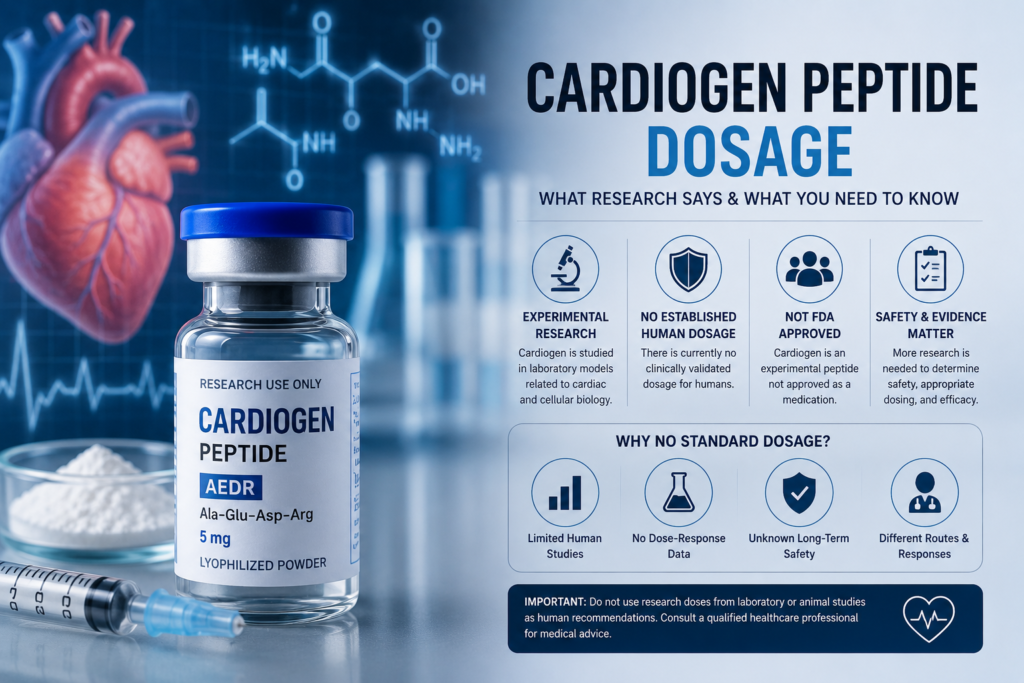
There is no established human therapeutic dosage for Cardiogen.
Experimental studies may use specific concentrations or amounts in laboratory and animal models, but these cannot simply be converted into a human dose.
For example, an in-vitro concentration is not equivalent to a daily oral or injectable dosage.
Therefore, websites presenting a precise “standard Cardiogen dosage” should be interpreted cautiously unless they can provide appropriate human clinical evidence.
Cardiogen vs. Other Peptide Bioregulators
Cardiogen is one of several short peptides associated with the Khavinson peptide-bioregulator research field.
| Peptide | Common research association |
|---|---|
| Cardiogen | Myocardial/cardiac research |
| Bronchogen | Respiratory/bronchial research |
| Cortagen | Nervous-system research |
| Epitalon | Aging/pineal research |
The idea behind these compounds is that particular short peptide sequences may have tissue-associated regulatory activity.
However, the amount and quality of evidence varies between compounds, and the proposed tissue specificity has not been established as a clinically proven phenomenon for Cardiogen.
Cardiogen vs. Conventional Heart Medications
Cardiogen belongs to a very different category from conventional cardiovascular medicines.
Prescription cardiovascular medications may be designed to:
- Lower blood pressure
- Reduce LDL cholesterol
- Prevent blood clots
- Control heart rhythm
- Reduce cardiovascular risk
- Manage heart failure
These medications have undergone clinical testing and regulatory evaluation for specific indications.
Cardiogen has not.
Therefore, Cardiogen should not be described as an alternative to evidence-based cardiovascular treatment.
Cardiogen vs. CardioGen-82
An important SEO and research distinction is the difference between Cardiogen peptide and CardioGen-82.
They are unrelated products.
Cardiogen peptide refers to the experimental short peptide commonly identified as AEDR.
CardioGen-82 is an FDA-approved radiopharmaceutical generator used to produce rubidium Rb-82 chloride for myocardial perfusion PET imaging.
Because their names are similar, search results can sometimes cause confusion. what is cardiogen
Current Cardiogen Research
The evidence surrounding Cardiogen can be broadly divided into several categories.
Laboratory research
Researchers have investigated molecular interactions and cellular processes involving short peptides.
Tissue research
Myocardial tissue cultures have been used to investigate cellular responses to Cardiogen.
Animal research
Animal models have provided additional information about potential biological activity.
Human research
This is where the evidence is currently weakest. There is no established body of controlled human clinical research demonstrating cardiovascular efficacy.
This means Cardiogen remains primarily a preclinical research subject. what is cardiogen bpc 157 peptide